Intifada – Zachary Lockman & Joel Benin

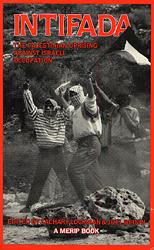
Cover of Intifada


Intifada
Zachary Lockman & Joel Benin
423 pages including index
published in 1989

During Israel’s invasion of Gaza this January there was one of those stupid drummed up controversies that always happen whenever Israel’s engaging in warcrimes again and hence coming under foreign pressure. In this case it was Dutch Socialist Party member of parliament Harry van Bommel who got into trouble after his call for Intifada was twisted from being a call to resistance into not just a call for armed resistance but fullblown terrorism. Various zionist pressure groups were keen to pretend that intifada invariably meant terrorist attacks, including suicide bombings while ignoring that the first Intifada had been characterised by non-violent protests and most socalled Palestinian violence only happened in self defence against IDF aggression. Nobody honest can call boys throwing stones at tanks terrorists, but that didn’t stop our local zionists from pretending it was, helped by conflating the much more violent Second Intifada with the first.

Now I grew up in the eighties and I remember the first Intifada. I was barely in highschool when it started in 1987 and not very politically aware, but I did notice that by late 1988, early 1989 there were quite a lot older students wearing keffiyehs, usually as shawls, as a symbol of their support for the Palestinians; this at a not too leftwing Christian school. The Intifada had the same sort of stature as the ANC’s struggle to end Apartheid had because everybody could see how the Palestinians were being oppressed and how justified they were in their (largely non-violent) resistance despite IDF agression. It was therefore a blatant rewriting of history to equate Intifada with terrorism and to confirm this, I read this collection of essays on the Intifada.

Read more…

And everybody is writing books…

We’ve found the source of America’s decline: It’s football. BLCKDGRD found this superb wingnutty screed blaming the decline of America on egalitarianism and egalitarianism on “the rise of soccer”:

Soccer is running America into the ground, and there is very little anyone can do about it. Social critics have long observed that we live in a therapeutic society that treats young people as if they can do no wrong. Every kid is a winner, and nobody is ever left behind, no matter how many times they watch the ball going the other way. Whether the dumbing down of America or soccer came first is hard to say, but soccer is clearly an important means by which American energy, drive and competitiveness are being undermined to the point of no return….

Pure concentrated wingnut, rallying to the warcry of every reactionary asshole since the days of Sumer: “things are changing and I don’t like it”

Books read March

Lots of science fiction this month, because I bought a lot of it this month.

The Hacker Crackdown — Bruce Sterling
Nostalgia. During the eighties the personal computer, followed slightly later by the first computer networks came of age and with it came the hackers and crackers. Then came Operation Sundevil, the first big nationwide hacker crackdown in the States, which inspired Sterling to write about how this came about, who the players were and what was happening. Cyberpunk had become reality.

To Your Scattered Bodies Go — Philip José Farmer
Read this to honour Farmer’s death. I’ve attempted to read this before but never finished it, but this time tore through it.

AK-47 — Larry Kahaner
A slight and flawed cultural history of the Kalashnikov; parts of it were excellent.

Inventing Ruritania — Vesna Goldsworthy
A study which examines the influence popular fiction and its stereotypical images of the Balkans over the centuries have influenced our views of the region and not just our views, but our politics.

Fugue for a Darkening Island — Christopher Priest
One of Priest’s first novels. Published in 1972, it’s a very uncomfortable echo of the racial fears of white Britain of the early seventies. After a localised nuclear war that devestated most of Africa, refugee laden ships land in Britain. What follows is civil war. Well written and disturbing.

Sweet Silver Blues — Glen Cook
The first Garret P.I. novel. Garret’s a private dick in fantasyland but despite the elves his adventures are just as hardboiled of that of any thirties detective. Great stuff.

The Man Who Japed — Philip K. Dick
Typical early Dick, fun, not too outrageous and slight.

Or All the Seas with Oysters — Avram Davidson
A brilliant short storyteller who deserves a larger audience, Avram Davidson is at his best in this collection. Classic American fantasy, which takes the familiar elements and fairytales from Europe but just can’t take them too seriously anymore. The title story is the origin for that old gag of where all your paperclips disappear to.

Flandry of Terra — Poul Anderson
Three stories starring Dominic Flandry, secret agent of the Terran Empire trying to hold back the long night when inevitably the empire collapses. Despite the gloomy background these are still fun adventure stories, much better than they have to be.

The Universe Against Her — James H. Schmitz
A fixup novel introducing Telzey Amberdon, a fifteen-year-old genius and first-year law student whose psychic powers are triggered during an encounter with big cat-like telepathic aliens; now I know where David Weber got the idea for treecats from… Good fun, like Anderson Schmitz’s stories are much better than they’d need to be.

Time for the Stars — Robert A. Heinlein
Another Heinlein juvenile, about a twin, one of whom went to the stars while the others stayed home. Yes, it’s the classic time dilation thought experiment made into a story, though I still don’t think Heinlein ever really understood relativity…

The Falling Torch — Algis Budrys
Twenty years after Earth was conquered by the Invaders, the son of the president in exile returns from Centaurus to help mount the resistance. As seems to be typical of Budrys, the emphasis lies firmly with the psychological development of the protagonist rather than on the action.

Millennium — John Varley
Once upon a time Varley wrote a great short story, “Air Raid” that was turned into a mediocre movie and a much better novel. This is this novel. Far future humans are traveling back in time to snatch people doomed to die in aircrashes with no survivors. Then something goes wrong and an air crash investigator slowly learns the truth. A very seventies sort of story, even if it was written in 1983.
McAuley’s fifty fortyeight essential sf titles

Yesterday, Paul McAuley put up a list of what he thinks are the fortyeight essential science fiction titles. As per usual, I’ve bolded the ones I’ve read and struck through the ones I dislike.

Frankenstein, or The Modern Prometheus MARY SHELLEY 1818
Journey to the Centre of the Earth JULES VERNE 1863
After London RICHARD JEFFRIES 1885
The Time Machine HG WELLS 1895
The House on the Borderland WILLIAM HOPE HODGSON 1912
We YEVGENY ZAMIATIN 1924
Brave New World ALDOUS HUXLEY 1932
Star Maker OLAF STAPLEDON 1937
1984 GEORGE ORWELL 1949
I, Robot, ISAAC ASIMOV 1950
The Martian Chronicles RAY BRADBURY 1950
The Dying Earth JACK VANCE 1950
Childhood’s End ARTHUR C CLARKE 1953
The Space Merchants CM KORNBLUTH & FREDERIK POHL 1953
Tiger! Tiger! ALFRED BESTER 1956
The Death of Grass JOHN CHRISTOPHER 1956
The Seedling Stars JAMES BLISH 1957
The Midwich Cuckoos JOHN WYNDHAM 1957
Starship Troopers ROBERT A HEINLEIN 1959
A Canticle for Liebowitz WALTER M MILLER JR 1959
Solaris STANSLAW LEM 1961
Hothouse BRIAN ALDISS 1962
A Clockwork Orange ANTONY BURGESS 1962
Cat’s Cradle KURT VONNEGUT JR 1963
Martian Time-Slip PHILIP K DICK 1964
Dune FRANK HERBERT 1965
The Crystal World JG BALLARD 1966
Flowers For Algernon DANIEL KEYES 1966
Lord of Light ROGER ZELAZNY 1967
Nova SAMUEL R DELANY 1968
Pavane KEITH ROBERTS 1968
The Left Hand of Darkness URSULA K LE GUIN 1969
Roadside Picnic ARKADY AND BORIS STRUGATSKI 1969
334 THOMAS M DISCH 1972
Dying Inside ROBERT SILVERBERG 1972
The Fifth Head of Cerberus GENE WOLFE 1972
Ten Thousand Light Years From Home JAMES TIPTREE JR 1973
The Forever War JOE HALDEMAN 1974
Inverted World CHRISTOPHER PRIEST 1974
The Female Man JOANNA RUSS 1975
Arslan MJ ENGH 1976
The Ophiuchi Hotline JOHN VARLEY 1977
The Final Programme MICHAEL MOORCOCK 1968
Kindred OCTAVIA BUTLER 1979
Engine Summer JOHN CROWLEY 1979
Timescape GREGORY BENFORD 1980
Neuromancer WILLIAM GIBSON 1984
Divine Endurance GWYNETH JONES 1984

An interesting list. You can’t really argue with it, as it is after all a personal list of essential titles. It is very New Wave orientated: Roberts, Ballard, Dick, Priest, Moorcock, Delany, Le Guin, Disch undsoweiter, but with some surprises. I wouldn’t have expected to see Starship Troopers on this list based on what else is on it. On the whole, for anybody who wants to get acquainted with this particular strand of science fiction: literary, somewhat gloomy and less interested in the hard sciences than the soft sciences, this would be a good start.

In terms of McAuley’s own writing this list also makes a lot of sense. You can see the influences at work in his own novels and stories.

More news from freedom loving Georgia

Saakashvili may still be popular with Decents and other wingnuts abroad, but his own people are sick and tired of him:

In recent weeks, anti-Saakashvili posters have appeared all over the capital, while the opposition has also been boosted by a television show featuring a popular singer conducting interviews with opposition activists and local celebrities from a specially constructed “prison cell”. The protest singer Giorgi Gachechiladze – known as Utsnobi, or “The Unknown” – has said that he will remain in self-imposed incarceration until Saakashvili steps down.

Earlier this month, Utsnobi held a protest concert near the president’s residence, drawing several thousand. The 9 April demonstrations are hoped to draw far greater numbers.

The Georgian authorities have accused the opposition of accepting money from Russia to fund its anti-government campaign, although no proof has yet been offered. They have also raised fears that mass protests next month could turn violent after several activists were detained last week on charges of illegally buying weapons and plotting a coup.

[…]

The mood in Tbilisi has become increasingly tense in recent days after the authorities released covertly recorded police videos of opposition activists allegedly buying automatic rifles and rocket-propelled grenade launchers.

“These tapes show there is a group of people who were thinking of toppling the government by violence, and using the demonstration as the place to do it,” said Yakobashvili.

it all sounds remarkable like the warnings the English police has been spewing about a possible “Summer of Discontent” in general and the G-20 protests in particular…