Getting back into science fiction

Reader Chris Y, in comments to this post asks:

Gloriana is not Moorcock at his best, but Riddley Walker (1982) is an all time classic, and Heliconia Spring (1983) is well worth reading. I more or less gave up on SF about that time, with the decline of the New Wave and the resurgence of boring old hardcore. Who should I read to get back into it? I’ve tried Charlie Stross, who seems OK; anybody else?

So we’re looking for recommendations for somebody who likes New Wave science fiction and Charlie Stross, but is less keen on hardcore science fiction. What I immediately think of is the socalled New Weird, a self-conscious literary movement of a few years ago that sort of coalesced around China Miéville and the generation of up and coming authors that got compared to him. Other New Weird authors include Steph Swainson, M. John Harrison and on the more space opera side of things, Alastair Reynolds. Tachyon Publications has put out an Ann and Jeff Vandermeer edited anthology of New Weird stories that looks to be a good starter. Another author that might be of interest is Adam Roberts, whose work I don’t actually like all that much but I do admire, if that makes any sense.

On the Strossian side of things, there’s Ken MacLeod, not to mention Iain M. Banks and Ian McDonald. Two underrated authors I only discovered myself last year are Nicola Griffith, writing feminist science fiction in the best sense of the word, as well as Paul Cornell.

Any other recommendations?

Why defend hunting?

Andy Newman is going contrarian on us:

The dislike of some people (mainly urban dwellers) for hunting is a symptom of an alienation from the visceral, sensual reality of the natural world; opponents of hunting live in a world where meat comes shrink wrapped; animals are sentimentalised and pets are treated like children. In truth, the alienation of human life to be decontextualised from the reality of animal husbandry and rearing animals for slaughter is a feature of modern industrialised society, and probably specific to capitalism.

Overcoming that alienation and putting women and men back into the natural world, overcoming the gap between town and country; and the distinction between manual and mental labour should in fact be part of the socialist project of creating a more sustainable, ecological and human-scaled society.

I have always thought it was shocking hypocrisy that so many townies oppose hunting, that kills a tiny number of animals; and usually kills them clean and quick; and yet they happily eat chickens that have spent their entire short life in pain and torment, crammed together in the dark so closely that the dead birds don’t even fall, bewildered, diseased, crippled and wading in their own shit.

The ban on hunting with dogs was really very little to do with animal welfare, and much more to do with imposing social conformity. Opponents of blood sports don’t understand hunting, and don’t understand rural life. There is no equivalent campaign to ban factory farming simply because people want the cheap meat and don’t really care about cruelty to animals if there is any personal cost; but banning hunting allowed people to feel morally superior to other folks whose lives are different. What opponents of hunting object to is not the fate of the hunted animals, but the fact that hunters enjoy it. (Actually, there is also quite a bit of opposition specifically to fox hunting in rural areas, because the hunts are often bad neighbours, who spook other people’s livestock, leave gates open, and are typically snobby; but this opposition doesn’t extend to other forms of hunting.)

Andy bases his post on a BBC report on the supposed mass slaughter house cats engage in; allegedly “a typical urban cat kills around five prey animals every single day”. Reading the report though
it quickly becomes clear that the researcher quoted there isn’t actually saying this, but is only looking into the possibility that cats are to blame for huge number of bird and other small animal deaths. The BBC doesn’t have the best reputation when it comes to reporting science accurately, so I would always take their claims with a grain of salt. To launch an attack on townie hypocrisy on such a slender reed?

To be fair, there is a kernel of truth in what Andy says. New Labour didn’t bring in the anti-hunting laws out of concern for animal welfare, as any casual glance at its farming policies shows, but as a sop to old skool Labour supporters, the party’s rank and file activists and more than a few MPs to whom the fox hunt was still one of the most hated symbols of class ridden Britain — no matter that their leaders had long since embraced capital.

Nevertheless, Andy’s attempt to defend hunting at this late stage has more than a hint of Christopher Hitchen-style mindless contrarianism to it. You know how those things go. Take a topic that’s of special interest to “the left” and take the deliberately opposite stance to what you think is the recieved wisdom. Caricature your opponents as hypocrites who argue from emotion, not reason or are acting out of ulterior motives, then claim your own position is the only correct one to take for a socialist. Bonus point if you manage to work in working class cliches.

In his defense Andy claims hunting opponents are hypocrites for not caring about factory farming, when in fact most anti-hunting activists were also engaged in a lot of other animal rights issues. He claims they don’t really care about the suffering of the hunted animals, but are offended by the joy hunters derive of their pastime, that they’re “alienated” from nature. In short, he’s busy setting up strawmen to knock down rather than engage in real argument in his piece, with a bit of reverse peasant snobbery thrown in.

What’s more, Andy puts forth a juxtaposition that just doesn’t exist, between the noble art of hunting and the reality of modern industrialised food production. These are two sides of the same coin, hunting being a passtime for rich farmers and landowners, (when the working classes do it it’s called poaching) who got the time and the money to engage in it exactly because they own modern, heavily industrialised farms. The idea that farmers of all people are closer to nature than socalled townies is laughable. Any fule knows they only have an eye for nature if there’s an EU subsidy attached to it, as regular listening to Farming Today will soon make clear. Farming is and has been for a long time just as industrialised a profession as that of any pencil pusher and hunting is the same, or else we’d seen nude hunters tearing down foxes with their bare hands, not use horses, hounds driving tactics and shotguns.
The only thing Blair deserves costs about thirty cents

But since this is a fundamentally unjust world, he’ll get one million dollars for his
“global leadership”:

Tony Blair has won a prestigious million-dollar (£697,000) prize for his leadership on the world stage, it was announced today.

The former prime minister, now a Middle East peace envoy, will receive the Dan David prize for “his exceptional leadership and steadfast determination in helping to engineer agreements and forge lasting solutions to areas in conflict”.

The award is presented by the Dan David Foundation, based at Tel Aviv University, and a spokesman for Blair said the money would be donated to the former Labour leader’s charity for religious understanding, the Tony Blair Faith Foundation.

It sounds absurd to give Blair this prize — and you’ll notice the word “Iraq” doesn’t occur in the announcement — until you realise who‘s giving this award. Dan David is an avowed zionist and his foundation is located at Tel Aviv University; zionist usually have little problems with mountains of corpses, if they’re Arab corpses. Furthermore, Blair was very helpful to Israel not just with Iraq, but also with the War on Lebanon, helping delay the ceasefire to give the IDF more time to kill civilians.

It would of course be impolite to mention Blair gets this money for helping get rid of an enemy of Israel or perpetuating mass murder, hence the blather about “asking the important questions” and “morally courageous leadership”. Note that the Israelis aren’t the only ones to thank Blair for delivered services; he’s made a very nice living hovering up nice cushy jobs after he left office. That’s why he went along with Bush all these years. Never mind whether or not he genuinely believed in the War on Terror in the end he did it all for the old do-re-mi, his staunch Christianity no barrier for starting an immoral war that killed some million Iraqis now.

He’s not the only Christian crusader. Our own prime minister, the great moral scold and Harry Potter (grown up to be an accountant) lookalike Jan Peter Balkenende, fought tooth and nail to keep an inquiry into the War on Iraq from happening. Yet he would call himself a moral man, an examplar to the nation, always happy to disapprove of binge drinking teenagers or something, but who so far has not shown any recognition of the sheer monstrosity of what happened, what is still happening in Iraq and Afghanistan. None of the great and the good have, whether they were pro or anti-war back in 2003. It was just another policy choice for them, not a moral question and it could’ve gone either way if the incentives were right.

De Menezes murderers escape justice

By now, even the most naive believer in the basic honesty of the British justice system must be vaguely discomforted by the news that yet again, the murderers of Jean Charles de Menezes will not be prosecuted despite an inquest jury returning an open verdict:

The family of Jean Charles de Menezes is to continue their legal battle by suing the Metropolitan police for damages for killing the Brazilian electrician, the Guardian has learned.

Yesterday the family were told that the two police marksmen who shot dead the innocent Brazilian after mistaking him for a terrorist will not face prosecution, despite a jury disbelieving key parts of their account of the killing.

In December a jury at the inquest into the killing returned an open verdict after hearing damning evidence of police blunders that led to the shooting.

He was killed on 22 July 2005 in a tube carriage by officers hunting for suicide bombers who had attacked London’s transport network the
previous day.

The inquest was never supposed to return an open verdict of course, with the coroner carefully attempting to guide the jury to the prefered conclusion, so it’s no wonder it’s now ignored by the crown prosecution service. The de Menezes killing is an embarassement, to be swept under the carpet as soon as possible and damn these ungrateful Brazilians for bringing it up again and again.

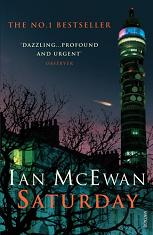
Saturday — Ian McEwan

Cover of Saturday


Saturday
Ian McEwan
278 pages
published in 2005

I’ve been suspicious of Ian McEwan ever since I read his Book prize winning novel Amsterdam and almost threw the book against the wall at the denouncement where McEwan descended into stupid cliches about the Netherlands’ attitude towards euthenasia. That suspicion deepened when it turned out McEwan, like Martin Amis had turned into a permanent bedwetter after the September 11 attacks. He’s been less outspoken than Amis, but he has said enough for me to know I dislike his politics, which seems to be of the Decent Leftist persuasion, being obsessed with the struggle against “Islamism”, the threat of terror attacks and the vulnerability of the western democracies. As with Amis, “9/11” seems to have functioned as McEwan’s midlife crisis, his fear and doubts about his own encrouching mortality being confused for insight into the general condition of the world. It’s this mixture of Decent politics and midlife crisis that’s been poured out into Saturday. I didn’t want to read it at the time when it first came out, being warned off it by various reviews, but four years on I thought it would be interesting to see if it really was as dire as it was made out to be.

It is.

Had I read this in 2005 it would’ve been thrown against the wall, library book or not. Set on the day of the worldwide anti-war protests on 15 February 2003 a month before the invasion of Iraq, with the London march making regular appearances througout the novel. Not that any of the characters in the book actually go on the march, they all have something better to do. Even the protagonist’s son, described as anti-war doesn’t, as “he doesn’t feel much need to go tramping through the streets to make his point”, confusing making a political statement with narcissism. It’s typical for the entire novel, which hammers this point home again and again from the first encounter with the march, with a street cleaner sweeping up garbage left behind by people going to the march to the last, with the same street cleaner still busy cleaning up behind the march. This way the anti-war protest is reduced to something hypocritical, narcisstic and even frivolous. Saturday only pays lip service to the arguments of the antiwar movement, spelled out explicitely just once, in a row between the protagonist and his daughter, who gets to represent the antiwar side. She gets emotional and slightly hysterical while her father gets to stay calm and collected; later it’s revealed she’s pregnant. In such a way the antiwar movement is constantly dismissed, at best shown as shallow people who mean well but who just don’t realise how bad Saddam is.

Read more…