Hedge funds and the economic crisis

You could walk around Mayfair all day and not notice them. Hedge funds don’t — can’t — advertise. The most you’ll see is a discreet nameplate or two. An address in Mayfair counts in the world of hedge funds. It shows you’re serious, and have the money and confidence to pay the world’s most expensive commercial rents. A nondescript office no larger than a small flat can cost £150,000 a year. Something bigger and in the style that hedge funds like (glass walls, contemporary furniture) can set you back a lot more. It’s fortunate therefore that hedge funds don’t need a lot of space. Two rooms may be enough: one for meetings, for example with potential investors; one for trading and doing the associated bookkeeping. Some funds consist of only four or five people. Even a fairly large fund can operate with twenty or fewer.

These small organisations control substantial amounts of capital. If a hedge fund manages less than $100 million it isn’t seen as a big player; $1 billion is quite commonplace. The capital managed by the world’s ten thousand or so funds amounts to around $2000 billion. (Hedge funds don’t have to divulge the details of their finances and operations, so no one knows the exact numbers.) About a fifth of this money is managed by funds based in London, and two fifths by those based in the US, mostly in New York and its upmarket suburbs, especially Greenwich, Connecticut.

The start of Donald MacKenzie’s excellent article on hedge funds in the London Review of books, which in general has done a good job of providing background articles on the credit crisis in the past few months. Though at the start of the current crisis in late september/early October hedge funds were portrayed as the villains of the story, they’ve now seem to have been largely forgotten. The crisis is now reported on as if it were a natural disaster, something beyond the control of humans, which governments and banks are manfully trying to containt. Any residual populist anger is limited to the bank managers and market specialists which earned such huge bonuses for what now seems very little work or result, with the poor old shareholder as their victim.

What’s conveniently lost in the story is the role shareholders in general and hedge funds in particular played in creating this crisis. It was after them after all who egged on those overpaid bank managers, CEOs and financial wizards to take ever increasing risks to make ever greater profits for them. Yes, it is risible that even managers of failing companies are paid millions of euros in bonuses, but that’s small peanuts compared to the limitless hunger of shareholders for a quick profit.

A local example is the story of ABN AMRO. This bank, one of the three biggest in the Netherlands (the others being ING and Fortis) had been under shareholder pressure to perform better for years, preferably by merging with another bank or selling off some of its subsidaries. Things came to a crisis last year, when a hedge fund called TCI (The Children’s Investment Fund Management) challenged the board of directors directly to split or sell the company to the highest bidder. The response of the
board was to seek a merger with Barclays, a bidding war with a rival group of companies (Royal Bank of Scotland, Fortis and Banco Santander) erupted which the latter won, but not before ABN had sold off some of the targets this group was particularly after. Billions of euros were wasted in this fight, only for several of the companies involved to end up in deep trouble this year. Both ABN AMRO and Fortis have been nationalised by the Dutch government, while the Royal Bank of Scotland had to be rescued by the British government, in what both insisted was not a nationalisation but just looked like one. Without the pressure from TCI this costly takeover fight could’ve been avoided and AB, Fortis and RBS would’ve been in a much better position now.

That’s the problem with hedge funds and shareholders in general. They’re parasites with no stake in the companies they control. The economy 101 idea of shareholders as investors in companies providing them with the capital to expand or set up their business has long been obsolete. The vast majority of shares is traded between third parties, with the company receiving no money at all from them. For the shareholder the only issue is whether or not their share will make a profit in the short run and to achieve that they’ve egged on companies to take greater and greater risks. HEdge funds in particular are dangerous because there’s so little public oversight of them. A handful of people in control of billions of euros, pounds or dollars can make decisions that will make or destroy companies, make thousands of people unemployed or destroy the economy of a small or not so small country. They’re fundamentally undemocratic and need to be abolished as a first step to take public control of our economies.
Aargh

aagh

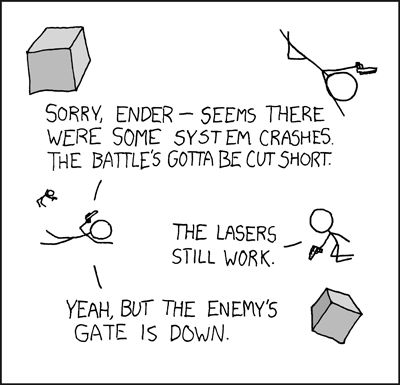
The perils of trawling through the XKCD archive.

Dutch mayors call for legalised cannabis

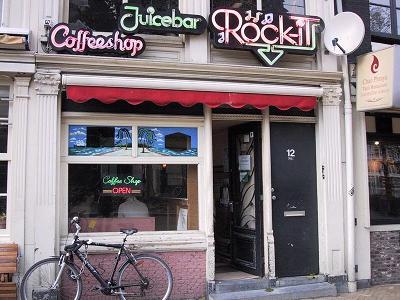
Amsterdam coffeeshop

Only a few weeks ago it seemed the Dutch tolerance towards soft drugs would end soon, due to the increasing strength of the puritan movement in Dutch politics. Magic mushrooms are already banned, while the future of the coffeeshop seemed limited, due to cheese paring measures forced on city councils like the rule that no coffeeshop could be located within 500 metres of a school. Try and find a coffeeshop in Amsterdam that doesn’t…

Meanwhile the growing troubles caused by socalled drugs tourists from France, Germany and Belgium in border towns had already led several of those towns to close down their coffee shops altogether. The future therefore seemed bleak for the ordinary cannabis user in the Netherlands, who smokes it recreationally or to relief pains and nausea (for which it works quite well, as I’ve seen myself, better than many conventional pain killers or nausea relievers). Though the system had worked reasonably well for some three decades, making going to the coffee shop almost as normal as going down the local for a quick pint and a half, it had always been a stopgap, an attempt to regulate cannabis trade without legalising it, as that would be difficult to explain abroad. It was introduced as a measure to free police resources for the battle against hard drugs as well as to limit the dangers of cannabis users “graduating” towards harder drugs. As such it worked well, but there never was the intention on the part of the authorities to go any further towards legalisation. It was a policy they were forced into but never were comfortable with.

Tolerance as a policy, even had it had the full support of politicians and police, could never continue forever. The inherent contradictions of the policy, which made it semi-legal to buy and sell cannabis at a retail level, but illegal to sell wholesale, let alone grow it, would see to this. But because we could never make the choice of legalisation without incurring the wrath of France and America, nor end Tolerance altogether the situation did continue. The hobbyists and smalltime growers who had been the base of the cannabis culture in the Netherlands were driven out by organised crime causing huge problems for many city councils.

The way these criminals operate is to go to an impoverished neighbourhood in Rotterdam or Tilburg or someplace simular and get a front man to hire a house from the council or housing society. This is then turned into a full blown industrial cannabis nursery, powered by stolen electricity from the neighbours. They only need to keep the flat on for several months, until harvest time, then disappear and make a huge profit selling their harvest to the coffeeshops. Despite everything the councils do to combat this, there’s little risk for the real criminals themselves: they leave everything to their patsies.

So it’s no wonder that the mayors of some thirty cities, including Amsterdam, last Saturday called for an end to this situation, by regulating the “backdoor of the coffeeshop”. What they want is to legalise the growing of cannabis by putting it under state supervision and allowing coffeeshops to legally buy their supplies from these suppliers. This would end the involvement of organised gangs, regulate the awkward situation the coffeeshops themselves are in now where they’re forced to buy from criminals, not to mention provide amuch needed source of income for local councils. It’s a good idea, but at the moment it still seems unlikely the central government will take the councils on, as the governing parties are largely opposed to legalisation.

Neocon hubris still causing trouble years later

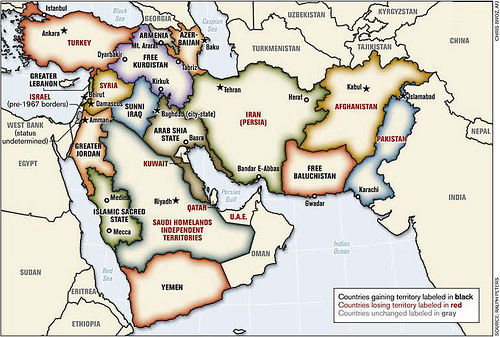
redrawn map of the Middle East at the height of neocon illusions

Remember the above map? It was drawn up by Infinite Star Armchair general Ralph “Blood ‘N Guts” Peters back in 2006 in the last flourish of neocon thriumphalism as the way to create a “better Middle East”. The idea apparantly being that since these borders were drawn up almost a century ago by a bunch of European imperialists and have caused a lot of trouble since, what better way to end this trouble by letting another bunch of imperialists, American this time, draw up another set of borders according to their prejudice and idee-fixes, because that worked out so well last time. Also, to stop ethnic cleansing by pre-emptively ethnic
cleanse these countries. At the time it seemed like a joke, if a sick one made palatable by the idea that Peters is such a loon he would be too over the top even for Dr Strangelove.

Guess what? The joke’s on us:

NEW YORK: A redrawn map of South Asia showing a truncated Pakistan, reduced to an elongated sliver of land, has sparked fear among military planners in Islamabad who think India and Afghanistan are “colluding” to destroy the only nuclear powered-Muslim nation with the US help, a media report said on Sunday.

The map, first circulated as a theoretical exercise in some American neoconservative circles, has fueled a belief among Pakistanis that what the United States really wants is the breakup of their country, the New York Times reported.

Pakistani people have reason to be paranoid about the USA’s intentions for their country, considering their mutual history, which includes enthusiastic American support for succesive Pakistani dictators, CIA backed meddling in Afghanistan during the eighties which helped destabilise Pakistan as well, not tomention the recent American airstrikes on Pakistan itself. It may look absurd now, but an invasion of Iraq looked absurd too, back in the nineties. That Obama will be president in January is no guarantee: Democrats are just as prone to stupid foreign policies: even Carter supported Somoza.

Found via Randy McDonald.

Legal advice on Iraq War flawed: No shit Sherlock

For some reason –probably all the hoohah over John Sargent– I missed the news last Monday that Lord Bingham, onetime senior law lord of the UK, criticised the War on Iraq as “a serious violation of international law and of the rule of law”:

Summarising Lord Goldsmith’s reasoning, Lord Bingham said: “A reasonable case could be made that resolution 1441 was capable in principle of reviving the authorisation in resolution 678, but the argument could only be sustainable if there were ‘strong factual grounds’ for concluding that Iraq had failed to take the final opportunity. There would need to be ‘hard evidence’.”

Ten days later, in a Parliamentary written answer issued on March 17, 2003, Lord Goldsmith said it was “plain” that Iraq had failed to comply with its disarmament obligations and was therefore in material breach of resolution 687. Accordingly, the authority to use force under resolution 678 had revived.

The former judge then quoted the conclusion to Lord Goldsmith’s Parliamentary statement: “Resolution 1441 would, in terms, have provided that a further decision of the Security Council to sanction force was required if that had been intended. Thus, all that resolution 1441 requires is reporting to and discussion by the Security Council of Iraq’s failures, but not an express further decision to authorise force.”

Lord Bingham was not impressed. “This statement was, I think flawed in two fundamental respects,” he said.

“First, it was not plain that Iraq had failed to comply in a manner justifying resort to force and there were no strong factual grounds or hard evidence to show that it had: Hans Blix and his team of weapons inspectors had found no weapons of mass destruction, were making progress and expected to complete their task in a matter of months.

“Secondly, it passes belief that a determination whether Iraq had failed to avail itself of its final opportunity was intended to be taken otherwise than collectively by the Security Council.”

Which is more or less what every anti-war activist already knew anyway. Like the dirty dossiers and the claims about Iraq being thirty minutes away from attacking Britain, Goldsmith’s legal advice was always meant as a figleaf for a decision already taken. There was never the intent on the part of Blair to really test the legality of an invasion; his former roomie knew what he wanted and so he delivered it. Had Goldsmith’s argument been made in a court of law it wouldn’t have passed the laugh test. As long as it was good enough to convince the doubters in parliament and the press it was good enough.

The runup to the War on Iraq made hollow phrases of democracy and rule of law, as the first was ignored while the second was perverted to make possible this war. It made clear what the population’s role was: to shut up, vote every few years without expecting anything important to change and to let the important decisions be made by our betters. And then Hazel “bloody” Blears has the gall to lecture us about about political disengagment and the negativity of bloggers?