Deadhouse Gates – Steven Erikson

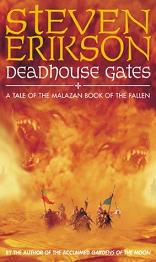
Cover of Deadhouse Gates


Deadhouse Gates
Steven Erikson
941 pages
published in 2000

Deadhouse Gates is the second book in Erikson’s Malazan Book of the Fallen epic fantasy series of ten projected volumes. Whereas the previous volume, Gardens of the Moon had a severe case of everything but the kitchen sink plotting, this is much more focussed. Of course, it’s still a 900+ pages epic fantasy brick with several interlocking storylines, not all of which are wrapped up in this installment. You have to expect a certain amount of complexity.

This second book of the Malazan cycle takes place on a completely different continent from the first, with a largely new cast of characters, some of which are however related to the people we got to know in Gardens of the Moon. The central story revolves around a religious revolts on the subcontinent of the Seven Cities, one of the oldest conquests of the Malazan empire. For decades there has been a prophecy doing the rounds about the return of the Whirlwind, which would cleanse the Seven Cities and drive the Malazan out of the continent. Now it has started and most of the Seven Cities, apart from the capital of Aren have fallen.

Read more…

Victory for Superman’s creators

Via Howling Curmudgeons comes the news that the heirs of Jerry Siegel have been given back part of the copyright on Superman:

The ruling specifically upheld the Seigels’ copyright in the Superman material published in Detective Comics’ Action Comics Vol. 1. The extent to which later iterations of the character are derived from that original was not determined by the judge.

In an unusually detailed narrative, the judge’s 72-page order described how Mr. Siegel and Mr. Shuster, as teenagers at Glenville High School in Cleveland, became friends and collaborators on their school newspaper in 1932. They worked together on a short story, “The Reign of the Superman,” in which their famous character first appeared not as hero, but villain.

By 1937, the pair were offering publishers comic strips in which the classic Superman elements — cape, logo and Clark Kent alter-ego — were already set. When Detective Comics bought 13 pages of work for its new Action Comics series the next year, the company sent Mr. Siegel a check for $130, and received in return a release from both creators granting the company rights to Superman “to have and hold forever,” the order noted.

In the late 1940s, a referee in a New York court upheld Detective Comics’ copyright, prompting Mr. Siegel and Mr. Shuster to drop their claim in exchange for $94,000. More than 30 years later, DC Comics (the successor to Detective Comics) gave the creators each a $20,000-per-year annuity that was later increased to $30,000. In 1997, however, Mrs. Siegel and her daughter served copyright termination notices under provisions of a 1976 law that permits heirs, under certain circumstances, to recover rights to creations.

What tends to be airbrushed out of the careful corporate histories of DC and Marvel, the socalled Big Two, is how much of their succes was built on outright stealing. Jerry Siegel and Joe Shuster losing control of Superman is only the best known example, but there’s also the way Kirby was treated by Marvel, were he lost control not just of his creations, but of his artwork as well! All those well known and well loved creations DC and Marvel pride themselves on were created by people who largely had to sign away their rights to them on the back of the checks they got for their work. Onetime payments only; toyalties were unknown in the comics industry until the early eighties…

It’s unfortunate that Siegel himself did not live to see this victory, but at least his heirs can now share some of the profits DC has made out of their father’s and husband’s creation.

Wilders in trouble –for copyright infringement?

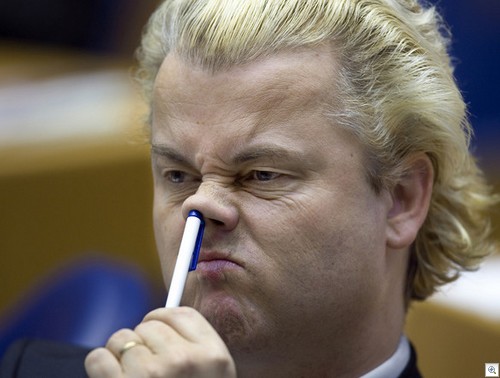
wilders picking his nose

So Fitna debuted yesterday to an universal reception of yawns, though of course there was much navel gazing in the Dutch newspapers today. One thing everybody noticed is how little original material there was in the movie, much of it being news footage from various events like the September 11 attacks, the Madrid bombings etc. There was some speculation online on whether or not all those images were properly licensed. Well, we got our answer: The Danish cartoonist whose Mohammed cartoon was used in the opening and ending parts of Fitna is preparing to sue for copyright infringement:

The Danish Union of Journalists said Friday it will sue Dutch lawmaker Geert Wilders for copyright infringement for using a Danish cartoon of the Prophet Muhammad in his anti-Quran film.

The union said it will file a lawsuit on behalf of Kurt Westergaard, the cartoonist who made a controversial drawing in 2005 depicting Islam’s prophet wearing a turban shaped like a bomb.

“Wilders has the right to make his movie but he has no permission to use my drawing,” Westergaard said in a phone interview with Denmark’s TV2. Westergaard has been living under police protection since an alleged plot to murder him was uncovered last month.

“This has nothing to do with freedom of speech. It is all about copyright,” Westergaard said. “I won’t accept my cartoon being taken out of its original context and used in a completely different one.”

So if that wasn’t licensed, how much of the other images were? Was this perhaps why Wilders was asking his supporters to send money, earlier this week?

Fitna: attention seeking moron got his wish again

As I said earlier this week, if you follow this blog you should know Wilders by now for building a career by exploiting Islamophobia and drawing attention to himself with media stunts. The most recent of which being his anti-Islam movie, Fitna, which he had threatened to release since the middle of last year, but which only released an hour ago, via Liveleak. It had to be done that way because he couldn’t find any Dutch broadcaster to show it and his own website got taken off the air by his American provider. Actually, there was one broadcaster that did want to see it, but that was a Muslim broadcaster, who wanted to show it during an evening of debate with Wilders, but this was just a little bit too scary for him…

I don’t really want to pay too much attention to his silly little film, because it is nothing but the usual warmed over Islamophobic cliches. You know the drill: the Islam is threatening your freedom, it wants to subjugate the entire world and kill all the unbelievers, it leads to terrorism (cue images of the September 11 attacks) and so on. Bo-oring.

It’s just the impact this will have that I’m worried about. Not so much the inevitable reaction of Muslim hotheads, but there’s already a climate of fear and hatred surrounding Islam in the Netherlands and this movie is deliberately throwing oil on the fire. Wilders is intelligent enough to make use of the wave of unreasoning hatred that followed the September 11 attacks and the murder of Fortuyn to make his political career, so he should be intelligent enough to know his movie is one big lie. The question is, is he cynically using this lie just to further his career, or does he wants a Reichsdag fire? What’s he going to do with all the media attention coming his way?

Battle for Basra: what might be going on

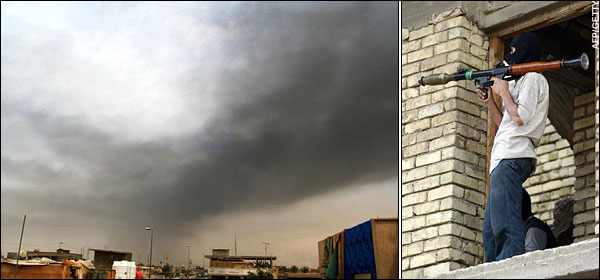
a montage of scenes for the battles in Basra

Over at Crooked Timber, Daniel Davies thinks the battle for Basra is good news because:

So if the al-Maliki government is really having a big push on Basra with 15,000 of its own troops, then that is actually a very positive sign indeed in terms of the government’s subjective assessment of its own stability. On the other hand, this is assuming that they are actually going to win — if they don’t it’s a disaster.

But that doesn’t explain why this push is happening now. As is widely known by now though rarely acknowledged, much of the succes of The Surge ™ was due to a ceasefire between the occupiers/Iraqi government, the main nationalist Sunni groups and the Sadrist movement. During this ceasefire everybody’s number one enemy, “Al Queda in Iraq”, was attacked and almost completely destroyed but with this destruction new opportunities arouse for the SCIRI and Dawa factions in the Iraqi government to take care of their other enemies as well. Chief one of which is the Sadrist movement, led by Muqtade al-Sadr, which is neither tied to the American occupation nor Iran and hence could make a reasonable claim to being the legitamite Iraqi resistance. It’s the Fadilha faction of this movement, big in Basra, who have been the main target of this governmental offensive.

Why? Because Basra is of course the key to control of the southern Iraqi oil fields; having control of its harbour means you control oil export from it, either officially or through smuggling. That’s a big prize to aim for. Lenny thinks that behind this offensive might also be pressure from the US government on behalf of their oil industry, made more plausible by the timing of it, just after Cheney’s visit…

But it’s not just a struggle for dinar, there’s also a political motive. This is not just that SIDRI and Dawa want the Sadrist movement to be weakened in time for the coming provincial elections. There’s something else going on I think. When The Surge got started early last year, it was always known to be a bit of a desperate measure, another throw of the dice that might just stabilise Iraq long enough for the Americans to be able to withdraw a significant number of troops and scale down their involvement there without making it seem like another Vietnam. It was also clear that if that would happen, it was likely that the Maliki government and especially its SCIRI and Dawa factions, could get in serious problems afterwards. Now might this somewhat halfbaked offensive just be a cynical measure on Maliki’s part to draw the Americans and Brits back into the war?

In which case, they may have misjudged the Sadrist response and the ability of the targeted groups in Basra to defend themselves…