Five years on and nothing’s changed

Despite the sheer inevitability of the coming war, I felt quite optimistic five years ago, in that short period between February 15th, the day the war protests went global and over 15 million people marched against a war on Iraq and March 19th, the day we learned all those protests had achieved nothing. At the time we were all working hard in the day to day organising of protests, as documented here and this left us without too much time to feel pessimistic in. The mood on the ground, even in such a traditional queen, county and navy town like Plymouth was overwhelmingly antiwar and it seemed absurd that it would happen, until it did happen.

Now, five years and a million dead or more later, it’s hard not to feel disillusioned. None of the criminals responsible for the war have had to pay for their crimes. Bush and Blair both got re-elected, a few of the more obvious culprits got to retire early, but nobody above the level of a Lynne England has had to go to prison for warcrimes yet. We’ve failed and I can’t see the situation improving quickly. Like Lebanon in the eighties, Iraq has become a regular staple of our television news, but not something that seems to have much to do with ourselves anymore…

Arthur C. Clarke: 1917 – 2008

Yesterday, at the age of ninety, Arthur C. Clarke died. He was the last of the Big Three of Golden Age science fiction –Asimov, Clarke and Heinlein– to pass away and as such his death is the end of an era. He was there when science fiction as a genre first crystallised out of Hugo Gernsback’s earnest attempts to predict the future, he answered John W. Campbell’s challenge to pull science fiction up by its bootstraps and raise it out of its pulp origins and he remained a constant presence in science fiction for over six decades, as fan, writer and science booster. He was there to see it develop from an almost cultish obsession practised by handful of enthusiasts to become so mainstream that most of the record grossing movies of the last couple of decades are science fiction. Of course, he himself was in large part responsible for making science fiction so
popular and even respectable.

Some of the things he should be remembered for:

  • The idea of stopping time and what opportunities and difficulties that brings with it
  • That he felt the need in childhood’s End to explicitely distance himself from the ideas in the novel
  • That actually, you can survive vacuum for a couple of minutes without a spacesuit
  • “Overhead, without any fuss”…
  • Inspiring Stanley Kubrick to film 2001 and especially its Pan-Am vision of the future
  • “the Star”
  • Geosynchronous orbits.

Clarke was one of the writers who got me into science fiction. I devoured his books when I was twelve and when I started rereading some of them a few years back, I was pleased to discover they still held up. Never known as a great stylist, Clarke nevertheless had a quiet charm all his own. I think Patrick Nielsen Hayden said it best, in his remembrance of Clarke:

in Clarke a practical science-and-engineering outlook coexisted with a mystical streak a mile wide. Indeed, much of his work establishes the basic template for one of modern science fiction’s most evergreen effects: the numinous explosion of mystical awe that’s carefully built up to, step by rational step. So much of Clarke’s best work is about that moment when the universe reveals its true vastness to human observers. And unlike many other writers who’ve wrestled with that wrenching frame shift, for Clarke it was rarely terrifying, rarely an engine of alienation and despair. He was all about the transformational reframe, the cosmic perspective, that step off into the great shining dark. He believed it would improve us. He rejoiced to live in a gigantic universe of unencompassable scale, and he thought the rest of us should rejoice, too.
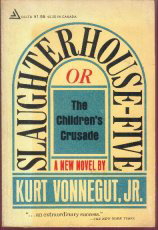
Slaughterhouse-Five – Kurt Vonnegut

Cover of Slaughterhouse-Five


Slaughterhouse-Five
Kurt Vonnegut
215 pages
published in 1969

Back in the days when I read every book in the local library which had that little squiggle on it that meant it was science fiction, I read and reread a hell of a lot of Vonnegut. Books like Breakfast for Champions,God Bless You, Mr. Rosewater, Slapstick and of course Slaughterhouse-Five. At the time I read them without any consideration of their literary status, but simply because Vonnegut was a science fiction author and I read science fiction, even if much of the Vonnegut novels I read weren’t quite science fiction. I liked them for their cynical black humour and inventive, seemingly slapdash plots.

Rereading Slaughterhouse-Five some twenty years later it’s easy to see why it made such an impression as a work of literature and why it’s so popular with generations of English students. It’s chock full of the sort of symbolism that makes it an easy book to dissect in a student essay. However, that also makes it hard to write about now, almost forty years after its first publication, because so much has been written about it already. I don’t want to write a review that comes over as yet another student paper.

Read more…

June 2002!

More evidence, if any was needed, that the War on Iraq was planned long before the “WMD crisis” erupted:

Col. John Agoglia, who served as a war planner for Gen. Tommy Franks at the United States Central Command, said the idea of using the Iraqi Army had long been an element of the invasion strategy.

“Starting in June 2002 we conducted targeted psychological operations using pamphlet drops, broadcasts and all sort of means to get the message to the regular army troops that they should surrender or desert and that if they did we would bring them back as part of a new Iraq without Saddam,” said Colonel Agoglia, who serves as the director of the Peacekeeping and Stability Operations Institute of the Army.

Once the war got under way and many members of the Iraqi Army began to desert their posts, a different vision on how to proceed began to emerge at the Defense Department.

We knew that everything was in readiness for war in mid-2002, but “you don’t launch a new product in August”. This account seems to confirm that. (via Atrios).

Celebrating the War on Iraq with the New York Times

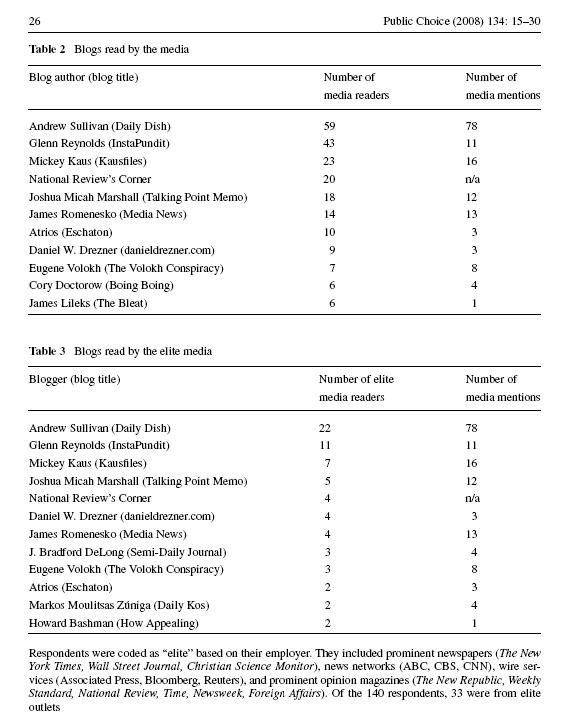
list of blogs read by the US media

Here are the clowns they booked to help the party started: Paul Bremer, Richard Perle, Kenneth Pollack, Danielle Pletka, Frederick Kagan… Yes, these are all people who were either incredibly, stomach churningly wrong about the war, or people who actively helped bring it about. No, nobody from the anti-war side was invited for this. That would’ve drawn too much attention to what the NYT itself was up at the time; better to stay safe in the bubble of likeminded fools and pretend “nobody could’ve known” the claims about weapons of mass destruction were false.

Perhaps not unrelated: Henrry Farrell and Daniel Drezner’s study (PDF) on the power of blogs which reveals which bloggers the “elite media” (their term) were reading in late 2003, as shown in the chart above. Not the most inspiring of lists, with Atrois being the most outspoken anti-war blogger on it. The elite media was for the most part cheerleading the war and it seems their favourite blogs did the same. At the time it was not hard to find evidence that Bush and co were lying about the war, that it was an incredibly bad idea with horrific onsequences, but if you don’t go looking for it, you’ll never find it…