Ammonite – Nicola Griffith

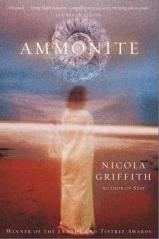
Cover of Ammonite


Ammonite
Nicola Griffith
386 pages
published in 1993

Nicola Griffith is a writer I’ve heard a great deal of but so far had never read anything by. Ammonite was her first novel and immediately made a strong impression on publication, winning both the James Tiptree Award and the Lambda Award. As these awards confirm, Ammonite is a classic feminist science fiction novel, straight in the tradition of writers like Ursula Le Guin (Left Hand of Darkness), Joanna Russ (The Female Man) and Sheri Tepper (The Gate to Women’s Country).

The world created in Ammonite is also a classic feminist science fiction trope: that of a world without men. In this case, it’s the colony world of Jeep where an alien virus killed off all men and a large percentage of women, leaving the survivors to rebuilt their societies on a one gender basis. How they’ve managed to do so is the central mystery of Ammonite, which is partially a puzzle story and partially a leisurely planetary romance as our protagonist, anthropologist Marghe Taishan, travels the planet in search of answers. Marghe is working for SEC, the government agency that was set up to safeguard the interests of indigenes of rediscovered colony worlds like Jeep from exploitation by the Company, which has a monopoly on space exploration and which whom Marghe has some unpleasant history…
Read more…

The Decentist philosophy in a nutshell

Jamie has it, in a quote from one Paul Rogers taken from a review in the house organ of the English cruise missile left, Decentiya:

What wretched timing for Rogers then, that his book should be released at a time when American success in prosecuting the War on Terror is possibly at its highest point since the halcyon days of early 2003.

What moves it from standard decentist “we so are winning the war on terror! We are! We are!” boilerplate is the phrase “halcyon days of early 2003”. For most of us, the “halycon days of early 2003” was when a disastrious war was started that so far has claimed the lives of a million or so Iraqis, cost literally trillions of dollars and has left Iraq a wasteland. For the decents this was the start of their glorious democratic crusade against totalitarism and the last time they could pretend that it was indeed a glorious crusade, instead of the clusterfuck it really was. Normally, they are self aware enough to realise most of us don’t share their nostalgia and hence temper their longing in public somewhat, but not Rogers.

Israeli defence minister threatens Holocaust

No kidding. That’s what deputy defence minister Matan Vilnai said last week:

Israel’s deputy defence minister has said Israel will have “no choice” but to invade Gaza if Palestinian militants step up rocket attacks.

Matan Vilnai said Palestinians risked a “shoah”, the Hebrew word for a big disaster – and for the Nazi Holocaust.

Mr Vilnai made the comments after rockets hit the city of Ashkelon, 10km (six miles) from Gaza. His colleagues insisted he had not meant “genocide”.

This was immediately followed by a weekend of increased attacks on Gaza, which left over a hundred Palestinians dead, at least half of which were civilians:

According to B’Tselem figures, from 27 February to the afternoon of 3 March, 106 Palestinians were killed in the Gaza Strip. Contrary to the Chief of Staff’s contention that ninety percent were armed, at least fifty-four of the dead (twenty-five of them minors) did not take part in the hostilities. In addition, at least forty-six minors were wounded.

Of course, according to Israel this was all just a response to the rocket attacks launched by Hamas earlier, omitting that these in turn were a response to an earlier Israeli attack that left six Palestinians dead. And so on, ad infinitum, because Israel persists in attempting to create peace exclusively on their terms. Over the decades successive Israeli governments would rather tolerate continuing terror campaigns against their population than deal with the Palestinians on equal terms, refusing to deal with those organisations created by Palestinians to fight for their cause. It used to be Yassir Arafat’s PLO/Fatah that the Israelis considered beyond the pale, until the first Intifada made Arafat the lesser of two evils. Now it’s Hamas that cannot be reasoned with, even though it won the support of a majority of the Palestinians in elections two years ago and even though any “peace” negotiated without Hamas is a farce. Instead Hamas needs to be eliminated, as David Rose made clear.

Why this is? Because Israel want to dictate a peace on the Palestinian people and to be able to do this an ability of the Palestinians to resist needs to be broken. So far this has not yet happened, even with the massive advantages Israel enjoys in money, support and weapons. Which is why we now hear government ministers threatening Holocausts. So far this is just rhetoric.

So far.

Orientalism – Edward Said

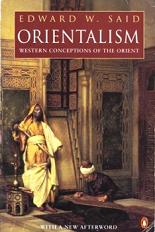
Cover of Orientalism


Orientalism
Edward Said
396 pages including index
published in 1978

There are some books that I’m sort of ashamed to review, not because the books themselves are so bad but just because I should’ve read them years ago. Orientalism is one such book. Both it and its author are so often namechecked by leftwing bloggers that I felt a slight twinge of embarassement for only reading it now. Also, I don’t know how it is with you, but I’m often wary to read such widely acclaimed books anyway, as there’s something so “Rik the people’s poet” about reading Said, or Chomsky for that matter. It can look poseurish and nobody wants to come over as that.

Nevertheless, Orientalism is a genuinely important book, even now, thirty years after its first publication. It’s main argument — that Asia in general and the Middle East in particular have long been misrepresented in the west as “the Orient”, an exotic world filled with prejudices and cliches in order to serve imperialist goals in the region — may look a bit obvious now, not as radical as it was at first publication, but this is in great part because Orientalism laid out this argument so convincingly first. In fact it had such an impact, that even thirty years onwards there are still people trying to cut it down to size, as a quick Google search shows. It touched a nerve, perhaps not in the least because Said was an outsider to the academic orientalist tradition he was criticising.

Read more…