“I think Martin has suffered terribly at the hands of the Guardian”

Martin being Martin Amis, the quote being from his writer pal Ian McEwan, refering to Mart’s growing reputation as a racist and/or Islamophobe, because of remarks like these:

caricature of Martin Amis

“What can we do to raise the price of them doing this? There’s a definite urge – don’t you have it? – to say, ‘The Muslim community will have to suffer until it gets its house in order.’ What sort of suff­­er­­­ing? Not letting them travel. Deportation – further down the road. Curtailing of freedoms. Strip-searching people who look like they’re from the Middle East or from Pakistan… Discriminatory stuff, until it hurts the whole community and they start getting tough with their children. They hate us for letting our children have sex and take drugs – well, they’ve got to stop their children killing people. It’s a huge dereliction on their part. I suppose they justify it on the grounds that they have suffered from state terrorism in the past, but I don’t think that’s wholly irrational. It’s their own past they’re pissed off about; their great decline. It’s also masculinity, isn’t it?”

McEwan, who is slightly but not much less nuts than Amis on this subject seems to blame the Guardian for publishing articles like the age of horrorism rather than Amis for opening his gob in the first place, which seems a bit unfair. The man himself meanwhile has hit back at his critics with a spectacularly incoherent piece in, you guessed it, the despised Guardian itself:

I want to talk about the discourse, and about the kind of public conversation we should be hoping to have. But before I do that, I will pay my Islamic readers – and I know I have a few – the elementary courtesy of saying that I DO NOT “ADVOCATE” ANY DISCRIMINATORY TREATMENT OF MUSLIMS. AND I NEVER HAVE. And no one with the slightest respect for truth can claim otherwise.

Has he read his earlier remarks quoted above, or does he think that if he denies them hard enough they will go away? Because, you know, that blaming of an entire population for the acts of a few seems awfully close to racism to me, especially considering the context. Ever since the September 11 attacks Amis has left no opportunity unused to discuss his disgust at the ideology behind it and over time he has done so in increasingly general terms, culminating in that awful “Age of horrorism” article which came very close indeed in blaming all of Islam for the misdeeds of September 11.

So is Amis a racist? Not in the sense that he’ll be sticking burning crescents on the council estates of Birmingham perhaps, but at the very least he’s an arrogant, self-absorbed ignorant blowhard who mistakes his regurgitation of whichever book he last read for insight. Very telling indeed in this context is the second paragraph of his “I’m no racist, honest” piece, which begins with “When I was five or six years old, my father took me to meet a black man.” That’s the level of self-absorption we’re dealing with here.
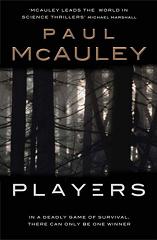
Players – Paul J. McAuley

Cover of Players


Players
Paul J. McAuley
390 pages
published in 2007

Paul J. McAuley used to be one of my favourite science fiction writers. Used to be, because unfortunately he seems to have chucked it in favour of writing crime and thriller novels. Probably for some silly reason as that they sell better. Not that I mind writers trying out other genres, but whereas I devoured McAuley’s science fiction novels, I couldn’t finish Mind’s Eye, the first of his thrillers I try, stopping halfway through and returned it to the library after it had been lying on my shelves accusively for a few weeks. It’s therefore with some trepidation that I approached Players, but I wanted to give him another chance. And it worked, in as far as that I finished this one.

What’s interesting is that Players shares its opening gimmick, a crime in an online game having repercussions in the real world, with Charlie Stross’ very different Halting State, which was also published this year. But whereas Charlie’s novel is set some years in the future and is quite clearly science fiction, Players is set in the here and now and quite clearly is not.

Read more…

Norman Mailer

I can’t really say anything about Norman Mailer or his death because I never read anything by him, nor was ever tempted to do until now. To post something now just because the man died recently seems a bit too bandwagonesque, so I won’t say anything about it. The only thing what I do want to comment on is that if both Roy Edroso and Ellis Sharp recommend the same novel, it must have something going for it. Here’s first Ellis, then Roy on cite>Why Are We in Vietnam?.

It’s too early to assess Mailer’s career either in itself or in relation to his contemporaries (it will take thirty or forty years for the noise to die down and the vested interests to fade). That said, it’s middle period Mailer that interests me the most. Did he ever achieve his ambition of writing a novel which fused those electrifying influences set out above? Yes, I believe he did. It may be significant that he did so in a book which is not only his shortest novel (143 pages in my Panther edition) but also perhaps his least typical: Why Are We in Vietnam? It is a narrative which repeatedly contemplates its own making, through a voice which fractures and takes on a dizzying variety of registers. The cover blurb heartily proclaims it Rabelaisian (preparing the reader for Mailer’s interest in assholes, dicks and bodily matters) but at times it reminds me of Joyce; at others of later James Ellroy.

[….]

Critics generally prefer Mailer’s more disciplined books like The Executioner’s Song and Harlot’s Ghost, in which Mailer’s madness is a thrumming engine set safely deep inside the work, sending energy steadily up into the well-ordered prose, with sudden power surges occasionally electrifying the surface. In passages like this one, we see what Mailer was like when nothing was stopping him. It’s the first Mailer book that grabbed me, and I still like it. There’s glory in it as well as absurdity; it’s compelling and not quite convincing; it is colloquial without being conversational. It is inventive to a fault.

I just might look out in the local library for that one.

Voting computers

Somewhat of an old story this, but still important. For some years now there have been doubts about the vulnerability of the voting computers used in Dutch elections which came to a head in last years national elections when several voting districts decided to use the oldfashioned red pencil again. In response a studygroup was set up to look at the whole voting process and recommend ways to make it more transparant. Almost three weeks ago this group gave its recommendation, which the responsible minister followed: to stop using the current voting computers. Instead, the study group recommended using a two stage process. The voter makes their choice using a voting computer which prints their ballot. The ballot is checked by the voter and if everything’s in order, put in the ballot box. Votes are counted electronically using these ballots and Optical Character Recognition technology; if in doubt these ballots can also be handcounted. So for the voter you have the convenience of voting electronically, without the vulnerability that this has, as the computer used by the voter does not record the vote…

Does this sound like something the US can use?

Books are terrorist material now?

It seems like, judging from the press reports on the conviction of the socalled “lyrical terrorist, in real life a not too bright 23 year old woman working in a WH Smiths at Heathrow:

In a box file in the family lounge was a printed version of the “declaration of war” by Osama bin Laden.

One of Malik’s poems, entitled The Living Martyrs, said: “Let us make Jihad/ Move to the front line/
To chop chop head of kuffar swine”.

A second poem was called How to Behead. “It’s not as messy or as hard as some may think/ It’s all about the flow of the wrist,” it read.

The Mujaheddin Poisoner’s Handbook, Encyclopaedia Jihad, How To Win In Hand To Hand Combat, and How To Make Bombs and Sniper Manual were found on her computer.

The court heard Malik joined an extremist organisation called Jihad Way, set up explicitly to disseminate terrorist propaganda and support for al Qaida.

Jonathan Sharp, prosecuting, said she was an “unlikely” but “committed” Islamic extremist: “She had a library of material that she had collected for terrorist purposes. That collection would be extremely useful for someone planning terrorist activity.”

Do something for me, willya? Just put these titles mentioned above in Google and see what comes up? Take “How To Make Bombs” for example: quite a few hits there. That’s because this whole conviction is utter bollocks, in which this confused young woman who gets just a bit too involved in playing muhajedin is just
railroaded as an example of how tough British justice is on terrorism. This doesn’t make the country any safer.