It’s not the album version, but it’ll do. Germany’s favourite power metal band Helloween with their classic (for some values of classic) song “Halloween”.
Russia’s Air Power in Crisis
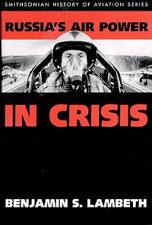
Russia’s Air Power in Crisis
Benjamin S. Lambeth
233 pages including index
published in 1999
The end of the Cold War was strange, because it wasn’t the nuclear holocaust we all imagined it was going to be, the final confrontation between the free west and the communist east. Instead it ended with a whimper, not a bang, as the Soviet empire collapses from the inside. With it crumbled the Russian army, which went from being an unstoppable menace to a laughing stock in the space of less than a year. Budgets were slashed, careful gathered stockpiles of weapons were destroyed or sold, units were brought back from Eastern Europe and when the USSR itself split, suddenly not just hte army was split over a dozen different countries, but also its supporting infrastructure of weapon plants, repair depots and design bureaus…
The various new Russian army branches therefore had to meet formidable challenges in the post-Soviet era, perhaps none more so than its airforces. It’s this that’s the subject of Russia’s Air Power in Crisis, which looks at these problems through a somewhat American lens. This is most visible in the constant references the author makes to the role American airpower played during the First Gulf War and the impression this made on the Russians. More subtly, it’s also visible in the assumption of how airpower should be used, in that a proper airforce should be like the USAF and adhere to its philosophy. It speaks for Lambeth that he recognises this tendency in himself, when he discusses what might have been the outcome if the balloon had gone up and the Soviet and NATO airforces had met each other in the skies above Western Europe.
Silly solutions for serious problems
via Unfogged, comes this absolutely fucked-up “solution” for the Israel-Palestine conflict only an economist could love:
Bueno de Mesquita’s answer to this dilemma, which he discussed with the former Israeli prime minister and recently elected Labor leader Ehud Barak, is a formula that guarantees mutual incentives to cooperate. “In a peaceful world, what do the Palestinians anticipate will be their main source of economic viability? Tourism. This is what their own documents say. And, of course, the Israelis make a lot of money from tourism, and that revenue is very easy to track. As a starting point requiring no trust, no mutual cooperation, I would suggest that all tourist revenue be [divided by] a fixed formula based on the current population of the region, which is roughly 40 percent Palestinian, 60 percent Israeli. The money would go automatically to each side. Now, when there is violence, tourists don’t come. So the tourist revenue is automatically responsive to the level of violence on either side for both sides. You have an accounting firm that both sides agree to, you let the U.N. do it, whatever. It’s completely self-enforcing, it requires no cooperation except the initial agreement by the Israelis that they are going to turn this part of the revenue over, on a fixed formula based on population, to some international agency, and that’s that.”
Even if you can take the underlying and unarticulated assumptions of this solution seriously, there’s plenty of criticism to be leveled at this, but the fundamental flaw lies deeper. Mesquita’s solution ignores the realities of the conflict for the politically correct view of it, which is that both parties are equally at fault locked into a conflict neither wants, which mutual distrust keeps going and if only there was some magical formula that could break through the distrust, the conflict could be solved.
Reality is different. The current situation is not the result of two parties desperately wanting peace but afraid to trust each other, but has been deliberately engineered by one of them, Israel. Israel has acceptated that an outright annexation of the occupied territories and/or direct ruling its Palestinian population is now impossible, due in large part to the first Intifada. Instead, why not let a nominally independent Palestinian government do your job for you, while making it impossible for the Palestinian strategies during the First Intifada to work again?
Israel’s post-Oslo strategy therefore has been to force the Palestinians to accept the semblance of an independent state in the territory conquered in 1967, while keeping a firm control of everything of interest within it. So the Westbank has been carved up in a patchwork of Palestinian bantustans, each surrounded by Israeli settler colonies and Israeli only roads, with the Israelis controlling the borders with Israel and Jordan. Which means that each of these statelets can be cut off at will if need be, while the media can be kept outside. Meanwhile the Palestinian Authority only has nominal control over its territority, as it doesn’t control its own airspace, water supplies or even much of its income (with the Israelis e.g. controlling customs and excise). The only real authority the Palestinian government has is the authority to police the population for Israel.
This strategy has made a repeat of the First Intifada, with its emphasis on relatively non-violent direct resistance, impossible, as we’ve seen with the Seconf Intifada, when the suicide bombers took over. If you’re cynical enough, you might say that the emergence of the suicide bomber targeting “soft” civilian targets as the major vector of Palestinian resistance against Israeli rule was an intended side effect of the Israelí strategy, as it kept support at home for repression high, while it got sympathy abroad. Even more so of course for the Palestinian rocket attacks, which are much less lethal than suicide bombings but almost equally dramatic.
The problem therefore is not that both sides are desparately looking for peace but don’t know how, but that one side has already won the conflict, but only in a way that keeps it eternally frozen. So no, silly solutions as “revenue sharing on tourism” will not help here.
The heart of the matter
In an excellent article by Henry Porter on the Guardian’s Comment is Free blog about Gordon Brown’s generous offer to give the British a bill of rights, the following paragraph succintly explains where a large part of New Labour’s authoritarianism is coming from:
In a new paper, Roger Smith, the director of Justice, puts his finger on an important part of the government’s culture. ‘A single thread links together matters as apparently diverse as the Iraq war, Asbos and the Legislative and Regulatory Reform Bill. That thread is an impatience by ministers with due process, either in the legislative process of policy or its execution.’
Which is odd, since so many of New Labour’s top bods are supposed to be lawyers, so they should be familiar with the concept of due process and its importance.
My current obession
Musically speaking.
Yes, I know. But it’s just so perfectly eighties naff and I’m not ashamed for liking this. Better this than Tokio Hotel.