Pity Den Beste

You know, four years ago I would gladly have leapt on the “let’s make fun of Stephen Den Beste bandwagon, but then one of the commentors at D-Squared’s place had to go and point at this cry for help:

Den Beste

Or at least that seems to be my experience. Six years ago I broke up with my last girlfriend after eight years together, and what I’m finding is that there are no women around me anymore. I don’t remember it being like this 14 years ago.

I spent six years trying to accept that I was no longer a man and accepting my role as a male person; trying to become comfortable with the fact that I would spend the rest of my life alone, surrounded by female persons but not having any contact with women, any kind of contact at all, physical or otherwise.

[…]

So for six long years I tried to get used to being a male person and tried to become comfortable with the idea that there would only be no women around, only female persons. And for six years the only women in my life were encoded in JPEG.

And then three weeks ago I took a trip to Vegas and blew that all to hell.

[…]

There are things which women and men can do with each other that female persons never do with male persons. A woman’s face lights up when she sees her special man. She hugs him. She puts her arm around his waist and holds him. They sit next to each other with no gap between them. There’s no 3-foot privacy boundary between them. They cuddle. They sleep together. They call each other on the phone just to hear the other’s voice. They share their triumphs and tragedies. They love each other. They care about each other. They’re special to each other.

And I realized that I can’t live without that. I don’t want to meet female persons. I want to meet, get to know, and learn to love a woman and have her love me back as a man.

[…]

A strip club. Yup, a place where men go and pay women to take their clothes off. At such a sleazy place, I was actually at peace with myself for the first time in six years.

[…]

Now it’s true that this is somewhat exaggerated. You’re reading the writings of a middle-aged man who is dreadfully lonely. But there’s a great deal in this which is true. If I’m standing in line next to an attractive woman and after talking to her for a while and discovering that I like her and that we seem to be getting along well, I cannot follow the engineer’s way, and say to her “You seem to be intelligent, articulate, and well educated, and I would consider myself extraordinarily lucky to become romantically involved with you. My intentions are strictly honorable. May I see you again?” That’s what my inclination is to do: very straightforward, very honest, completely unambiguous — it’s the engineer’s way. Say it and get it out, communicate clearly. (I tried this once and it was an abject
failure.)

And what is he doing now? blogging about anime; I felt such a pity reading that plea for understanding masquerading as an essay. There but for the grace of god (and not being a complete asshole) go I. So yeah, I pity him, but not as much as I pity the poor woman who becomes thefocus of his attentions. If I learned one thing, it’s that it is rarely the “nice guys”, (ie. the guys who always have to shout from the rooftops about how nice they are and they don’t understand why they’re still single) who are good for you.
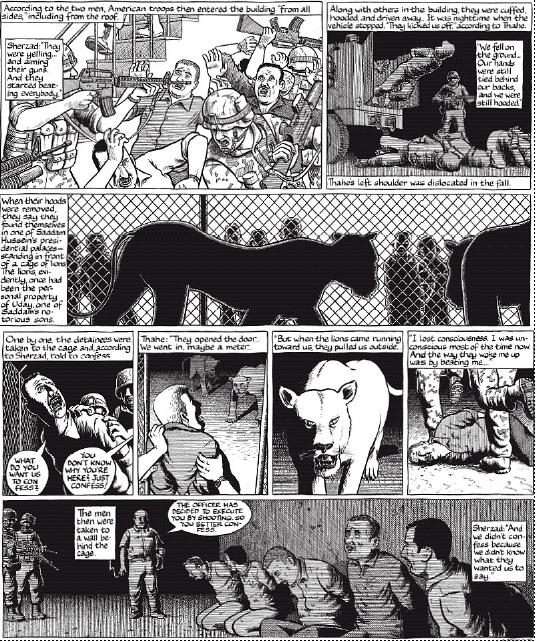

Joe Sacco on US torture in Iraq

page from Joe Sacco's strip on the testimony of Iraqi victims of US torture


If you don’t know Joe Sacco’s work, you have missed some of the best and most politically engaged comix of the past twenty years. He started out as yet another autobiographer, a Crumb-lite, but then he got distracted by the first Gulf War. Since then he has pioneered his own brand of comics journalism, going to Palestine and Bosnia, talking to people, getting their stories on paper.

His latest piece, of which the above page is an extract, is available as a 3.3 Mb PDF file from The Guardian website. Sacco talked to two victims of US torture, when they came to the US recently to bring suit against Donald Rumsfeld for their torture. Sacco manages to capture their experiences in a way no photographs could ever do.

Inquiry in the Menezes murder is finished

Menezes lying in the carriage after his murder

The BBC reports that the “Independent” Police Complaints Commission has finished its inquiry into the murder of Jean Charles de Menezes, the Brazilian electrician mistaken for a terrorist and murdered by gung-ho Metropolitan police officers, though of course they don’t call it a murder. That it was murder proves the eyewitness report quoted by the BBC:

The BBC has obtained an eyewitness statement, given to the IPCC, which described how anti-terror
officers shot at Mr Menezes 11 times.

The statement read: “The shots were evenly spaced, with about three seconds between the shots
for the first few shots.

“Then a gap of a little longer. Then the shots were evenly spaced again.”

Mr Menezes, an electrician from Gonzaga in south-eastern Brazil, was hit seven times in the head.

On the six o’clock news, it was said that if prosecutions of the police officers were started, most if not all Metropolitan gun officers would refuse to carry them any longer, once more confirmed that the police think themselves above the law. Here’s hoping the prosecution services will not given in to this common blackmail.

Earlier posts about the murder of Menezes:

Good books read in 2005

Since I’m doing something complicated but not very interesting tonight, I’ll make it easy on myself and just list some of the good books I’ve read last year. I read some 78 books in 2005, slightly more non-fiction than fiction. As regular readers know, I try and keep track of what I’m reading on my booklog but unfortunately I still have to review most of the books I read last year. However, I still managed to scrape up ten books I think you all should read:

  • Forging a New Medium — Charles Dierick & Pascal Lefévre (editors)
    Proof positive that it is possible to write about comics without mentioning biff pow zap or even superheroes. Proof positive also that there were comics long before The Yellow Kid, even outside the US.
  • Stalingrad — Antony Beevor
    Perhaps the most important battle of World War II, the turning point of the entire war, treated by one of the best British warfare writers.
  • A Room of One’s Own — Virginia Woolf
    “But, you may say, we asked you to speak about women and fiction — what has that got to do with a room of one’s own?” Virginia Woolf spents the rest of this slim volume answering this question. Despite its age it’s still relevant today.
  • Lord Kalvan of Otherwhen — H. Beam Piper
    This might not be the best science fiction novel I’ve read this year, but it was certainly the most enjoyable. All modern military science fiction is just a pale imitation of this.
  • Jonathan Strange and Mr Norrell — Susanna Clarke
    The adult literary equivalent of the Harry Potter craze perhaps, but also one of the best fantasy novels I’ve read in a long time. Also look up Crooked Timber to see why it is such a good book.
  • War Stars — H. Bruce Franklin
    How science fiction helped shape the nuclear arms race, long before Arthur C. Clarke and Robert Heinlein came to blows about SDI.
  • Call for the Dead — John Le Carré
    The novel that introduced George Smiley to the worl is a detective novel rather than a spy novel. Very sombre, very much of its time.
  • A Problem from Hell — Samantha Power
    The history of genocide in the 20th century, as well as the history of the concept itself and America’s responses to genocide. Not a cheerful book.
  • Ordeal — Nevil Shute
    What happens when a future war novel is published just as the war it predicted started…
  • The Mediterranean in the Age of Philip II — Fernand Braudel
    Best history I read in years, but very very dense and not exactly the right sort of light Underground reading.

Will the US attack Iran?

Back in March-April 2003, when it looked like the US/UK coalition had won the war on Iraq relatively quick and easy, there were well justified fears that the Bush regime would take this easy victory as an incentive to go on other adventures in the region. At the time it looked like Syria would be the next target, with Iran a close second. Fortunately, the US “victory” quickly turned into a quagmire and the threat of further attacks receded into the background. However, we might have been too complacent in assuming that with the greater part of its army stuck in Iraq the US would be unable to indulge in further adventurism, as Ken MacLeod makes clear.

The war drums have certainly not been silent this past year, with threats against Iran coming not just from the US, but also from its pilot fish in the Middle East, Israel, with both nations making noises about taking out Iran’s alleged nuclear weapons program. The situation is not helped by Iran’s new president and his rather stupid remarks about Israel.

It is probably true that Iran is in pursuit of an a-bomb of its own; it only makes sense, what with Iraq next door as the perfect example of what happens to annoying countries without nuclear weapons, not to mention the threat of the Israeli atomics. However, Iran’s nuclear program is as much excuse as it would be reason for any US attacks. If Bush attacks Iran, it is as it was with Iraq, because he had wanted to do so from the start.

The question now is not does the US want to attack Iran, but can it? At first glance, it looks unlikely, what with the massive overstretch the US army find itself in in Iraq, but then again, it’s the army that’s overstretched, much less so the US navy and airforce. The US does not necessarily need to invade Iran to get what it wants; a series of well chosen airstrikes may do. Especially when the option to make those strikes nuclear is on the table…

Drawing Iran into the war might actually alleviate the US’ troubles in Iraq. Rightly or wrongly, the US thinks Iran, as well as Syria, is behind much of the resistance against the Occupation. In the best possible case for the US, military action or the threat of military action would lead to the overthrow of the Ayatollahs’ regime in Iran and the subsequent collapse of much of the resistance in Iraq, as well as keep any other troublesome Middle Eastern country nice and fearful. In one fell swoop, the fortunes of the US would’ve been transformed from near-failure into succes.

It is a strategy the Americans have used before, in Vietnam. When the US became involved in what was until then a relatively straightforward war of national liberation, the US took the deliberate step of first drawing North Vietnam into the war and when that did not solve its troubles, by extending the war into Laos and Cambodia. Though the US still lost Vietnam, as well as Cambodia and Laos, it succeeded in so far that it kept its other client states — Thailand, Taiwan, Indonesia, South Korea — under control, kept the dominos from falling and kept its loss from being Vietnam’s win, as the country was left devastated by the war.

Of course, the chance that everything will actually work out in the US’ favour if it would attack Iran are vanishingly small and rational sane people would never take that chance, but the people in charge of the US at the moment are far from rational and sane. For Bush and co, the clock is ticking; with now only two more years before the next presidential elections, this might be the last best throw of the dice. In their view, even a slim chance might be better than just muddling through.