A new climate of union militancy?

It might just be that I’m paying more attention to it, but it does seem to me that 2005 saw a rise in union militancy, at least in the Netherlands. There were several big strikes this year and even better, several union victories as a result. In this context, 2005 may have seen the end of union complacency, after more than a decade of compliant negotiating and ever crumbling workers rights.

  • Ongoing throughout the year and continuing from last year were the municipality workers strikes for a
    better collective working agreement, with as highpoint the garbage collectors’ actions in Amsterdam
    during SAIL 2005, the biggest tourist event of the year. Keeping the municipalities under pressure
    throughout the year worked in forcing through a more generous agreement.
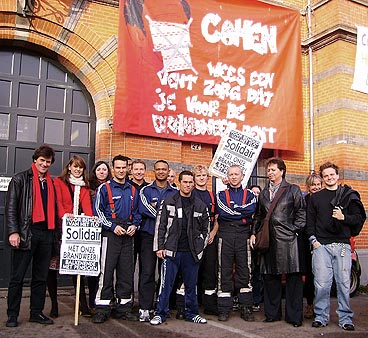
striking firefighters in Amsterdam

  • After the unions and the municipalities finally reached an agreement, there was still one sticking point:
    mandatory retirement at 55 for workers in high risk jobs like firefighters or ambulance staff. The unions and municipalities had agreed to end this, but the firefighters themselves went on a wildcat strike to protect this right. They won a modest victory by forcing through partial retirement at 55 and full retirement at 59, rather than having to work fulltime in “a low risk function” after 55.
  • The restructuring of Avebe, an agricultural company specialising in potato products, which had been in
    trouble for some years now, led to one of the longest continuing strikes of the year. The restructuring
    would lead to loss of some 150 jobs. The dispute was not about the job loss perse as it was about how
    it would be achieved. The two and a half week strike resulted in a more generous social plan for the fired employees, with 15 months of continued employment instead of six. What is more, the company
    lost the lawsuit it had filed against the union in order to force an end to the strike. If the company had
    won the suit, it would’ve made it that much more difficult for unions to strike elsewhere.
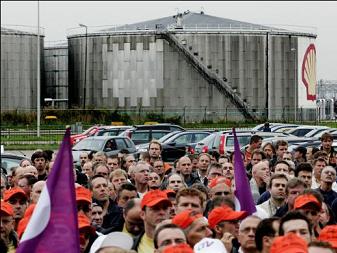
strikers at Shell

  • At Shell, the strike for better pension rights, achieved a partial succes. The retirement age for current workers stays at 60 like the unions wanted, but will still be set to 65 for new employes; however, the unions managed to get Shell to still (partially) pay for workers who want to retire at 60. Thanks to this strike the union also managed to get similar results for the workers of the Total and Nerefco oil refineries.
  • At Smit Tak, perhaps the world’s biggest salvage and harbour towage company, three strikes were
    necessary to get better deals for both salvage and towage workers. This included not just an above
    inflation wage rise, but also better compensations for working abroad, overtime and a better disability
    compensation scheme.
  • Finally, harbour workers in general have been in action several times this year to protest against the
    abandonment of ILO convention 137, whicharranges that only qualified, registrered harbour workers can load and unload ships. Both government andemployers have declared to be no longer committed to this convention, to “ensure a better competitive position for the Dutch harbours”. At the same time, the harbour workers are also
    resisting the EU Port Package 2 directive, which again would weaken the strong position of harbour workers throughout Europe. Historically, harbour workers, thanks to Europe and even worldwide conventions have not had to engage in the kind of “race to the bottom” competition their employers would like to see, so it is no wonder they are now forcefully resisting attempts to instigate this through European law.

So will this newfound militancy last and have consequences beyond the immediate improvement of some workers’ rights? The Netherlands is still ruled by a rightwing, neoliberal government bent on enforcing a “sound business climate” on the country and the same holds for the European Union. Its encouraging to see the unions think beyond the short term and to fight for more than just immediate benefits for their members, but a hell of a lot more needs to be done both nationally and internationally, will they be able to cure the rot that set in during the last decades. At the moment the unions are still largely defending previously won rights, not gaining new ones.

Victory to the firefighters?

striking firefighters in Amsterdam

For the past two years the public service unions have been in negotiation with the council of Dutch municipalities for a new collective working agreement. The process has been acrimonious to say the least, with several high profile strike actions by public transport workers, harbour employees and even sanitation workers during Sail 2005. The negotiation point that caused the most difficulties, was the ending the right to retirement at age 55 for those workers in professions which are recognised as being risky and strenuous, workers like firefighters or ambulance crews. Back in the summer, the council of municipalities, which had been dragging its feet on the negotiations, made further negotiations conditional on the unions giving up this right. This was not appreciated, to say the least…

As a result the negotiations dragged out until last week –and the previous agreement terminates this month. The council of municipalities held firm to its desire to scrap the right to retire at 55, partially because it was pressured by the national government to do so, because according to the new age discrimination laws coming into action in January 2006, this sort of arraignment is illegal..

Last week a new agreement was finally reached by the union negotiators and the municipalities, in which those employees who would’ve been able to retire at 55 under the old rules and who had worked for more twenty years would still be able to do so, but everybody else would have to stay on after 55. Workers with less than twenty service years would be forced to trade their job for something less strenuous.

The unions might have agreed to this, but the workers, especially, the firefighters, were less than impressed and started a series of wildcat strikes. The good news is that the pressure of these forced the unions to renegotiate to reach a less onerous settlement. In the new agreement, those firefighters with less than twenty years of service now will be able to partially retire at 55 and fully retire at 59, rather than being forced to work fulltime until 59. A modest victory, as this is still worse than what the firefighters had, but a victory nonetheless.

There are two things that we can learn from this whole fiasco. The first is the dubious role the central
government played in the negotiation process. It is clear that a large reason why the unions failed to keep the right to retirement at 55 was the pressure of the new age discrimination laws, which allegedly would make this agreement illegal. The municipalities made grateful use of this to pressure the unions, but it seems to me this agreement could still be kept by making it voluntary rather than a mandatory retirement. I’m not a lawyer though. At the same time, the central government helped pressure the unions even more by making it financially less attractive for both employer and employees to keep these sort of arraignments in place. All this is not surprising, as the Balkenende government has made a fetish of keeping people working longer.

The second, more hopeful aspect iof this is that it is still possible for workers to put pressure to employers and unions, by not going meekly along with what the union bosses think is good for them, but striking for their rights. It does show the enormous gap there is between the union and the workers though, as you would expect it would not be necessary for the workers to have to do this.

War lies: there is little support for the Iraqi insurgency

The resistance in Iraqi against the US occupation is still being described as consisting mostly of foreign Jihadis and Al-Quida supporters, as well as disgruntled Saddam supporters. Therefore, so the reasoning goes, it has little support amongst the Iraqi population. Simultaneously, the Iraqi people are forever intoned as supporting the coalition, with the US/UK coalition working in their interests. The truth is different, as even a secret British military poll, recently revealed, made clear:

The survey was conducted by an Iraqi university research team that, for security reasons, was not told the data it compiled would be used by coalition forces. It reveals:

  • Forty-five per cent of Iraqis believe attacks against British and American troops are justified – rising to 65 per cent in the British-controlled Maysan province;
  • 82 per cent are “strongly opposed” to the presence of coalition troops;
  • less than one per cent of the population believes coalition forces are responsible for any improvement in security;
  • 67 per cent of Iraqis feel less secure because of the occupation;
  • 43 per cent of Iraqis believe conditions for peace and stability have worsened;
  • 72 per cent do not have confidence in the multi-national forces.

News surprising to no-one but the “pro-war left”, I’m sure. Yet still the various news media tend to report about Iraq in terms defined by the occupiers, describing the resistance as Al Queda supporters, or talking about various US activities as being in the interests of the Iraqi people. It just seems there’s this increasing gap between reality and the officially sanctioned version of it, even with people or institutions not beholden to Bush ‘n Blair.

CIA flights via Schiphol?

Last week, the Volkskrant reported (link in Dutch) that an alleged CIA plane had been stationed on Schiphol for two days, on 17 and 18 November, before leaving for Rekjavik. The plane in question is a DHC-8 or “Dash-8” plane, with registration number N505LL and owned by the Path Corporation, allegedly a CIA front.

picture of the DHC-8 N505LL taken in Afghanistan in 2002
The airplane in question, photographed in afghanistan in 2002

On the Spyflight website, the same plane that visited Schiphol two weeks ago is identified as having been stationed in Kabul, Afghanistan. According to Spyflight it is “used to transport US SF personnel around the country to various small airstrips”.

So what was it doing at Schiphol? This report says it had arrived from Istanbul and had previously visited Baku, in Azerbaijan, which could point at its origin indeed being Afghanistan. It wasn’t supposed to have any passengers when it landed at Istanbul, but that information could be wrong. All of this might very well be benign, but could also fit the extraction and movement of prisoners from Afghanistan to parts unknown…

CIA admits it has secret prisons in Eastern Europe

Current CIA director Porter Goss admitted in the Washington Post yesterday that the CIA does indeed have a secret prison system outside the USA, including on locations in Eastern Europe:

Goss did not deny the existence — reported earlier this month by The Washington Post — of a secret CIA prison system overseas that has included sites in Eastern Europe. Asked why the United States needed secret prisons, Goss said: “We’re fighting a war on terror. We’re doing quite well in it. Inevitably, we are going to have to capture some terrorists, and inevitably, they are going to have to have some due process, and inevitably, that is going to happen, and it’s going to be done lawfully and under all of the law and order and protections of due process that this country affords.”

In the same article, Condi Rice is also quoted, displaying the same historical insight and intelligence that made her Secretary of State:

In an interview published today in USA Today, Rice indicated she intends to remind Europeans that “we are fighting a war on terror” and that the United States must take certain actions “in order to protect not just ourselves but to protect others.”

She added: “We haven’t ever fought a war like this before. We’ve never fought a war before . . . where you can’t allow somebody to commit the crime before you detain them, because if they commit the crime, then thousands of innocent people die.”

Meanwhile, the European Union is less than happy with this situation, as it is hinted that one of the countries in which these prisons are located is a memberstate (Poland) and one is a candidate member state (Romania). So unhappy in fact, it’s threatening sanctions against any memberstate involved in this:

Franco Frattini, the European commissioner for justice and home affairs, warned that any countries found to be allowing the CIA to operate the detention centres – part of a global secret gulag used to hold al-Qa’ida suspects and other “ghost detainees” – could have its voting rights suspended.

It’s uncertain how real these threats are, but Romania at the very least could see itself stuck outside the EU for considerably longer than otherwise would’ve been the case. Smartarses can of course wonder what exactly the difference is between these CIA prisons and something like Belmarsh Prison… Poland could at least strike back by demanding inquiries into which EU countries participated in extraordinary rendition.

Meanwhile, closer at home, all the furore about how exactly the US is treating its detainees has caused problems for the Dutch government. Dutch forces are still active in Afghanistan as part of the peace force there and the Netherlands has been asked to extend its mission for at least another two years, to form part of a stablisation force in the province of Uruzgan, not the most safe of provinces. Already wary of becoming embroiled in internal Afghan conflicts, which may lead to numerous Dutch casualties and resulting political fallout, parliament has also become wary of the American treatment of Afghani prisoners.

And not just parliament. The minister of Foreign Affairs, who had earlier said he thought the war on Iraq was a “mistake”, also has his doubts about this. Granted, for many parliamentaries the risk of Dutch casualties will be the main reason to vote against extending the Dutch mission in Afghanistan, but at the very least the concern about American treatment of prisoners will make a good excuse to refuse.