Shell workers strike for pension rights

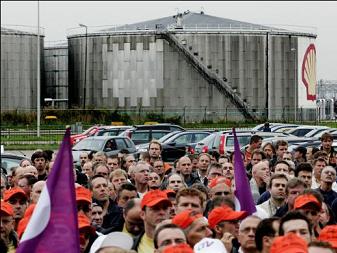
strikers at Shell

Yesterday the evening crew at the Shell Pernis oil refinery –the largest in Europe apparantly– started the process of shutting down production. (You can judge the scale of the operation by the fact that it will take a week to completely shut down the plants.) They will be joined by their co-workers at the Nederlandse Aardolie Maatschappij (Dutch Oil Company) from Wednesday. Both the unions and the Shell bosses have warned that the strike will lead to higher petrol prices if it continues for long.

The Shell workers are fighting Shell’s plans to reduce their pension rights. At the moment, Shell workers
retire at full pension at age sixty, with their pension premiums being paid entirely by Shell. Shell now
wants to move the retirement age to sixty-five and oblige its workers to start paying premiums themselves. This is already in place for new employees, but Shell now wants to extend it to all its workers.

Not unreasonable you might think, as this is the case with the majority of workers anyway. Why should Shell workers get a better deal than the rest of us? If we are expected to work till 65, why not them? Why should we suffer this strike?

As one worker set it on the NOS news last night, “Shell expects us to keep to the agreements we made, so we expect Shell to do the same.” If you want to, there is always a case to be made against striking, but if you never strike you cannot defend workers rights. If we meekly allow the bosses to redefine benefits with the argument that it is “no worse than what the rest of us get”, there will be a race to the bottom. There are always workers who have won more benefits than you have: the answer is not to push down their benefits to your level, but to push up your benefits to theirs.

And Shell is in no position to complain about the costs of all this, with record profit levels in the third
quarter of this year…

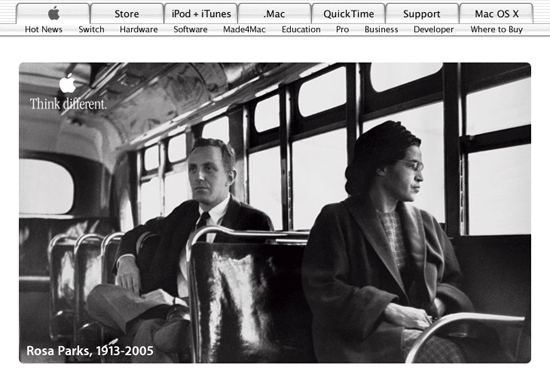
Apple’s disgusting use of Rosa Parks

The famous picture of Rosa Parks in a bus with the Apple logo attached

Disgusting. Barely a day dead and Apple thinks it has the right to use her name in ad to shift more bloody ipods. Think different! As if there’s any comparison between selling computers and, you know, fighting for the right to be treated as a normal human being.

I knew capitalism tends to co-opt revolution, but who thought it could be this blatant about it?

Picture found at Michel Vuijlsteke’s excellent blog (in Flemish).

Science fiction and socialism

More evidence socialism in science fiction was present long before Ken MacLeod and China Miéville:

MICHELISM (“MISH-el-ism”) At the Third Eastern in October 1937, Don Wollheim read a speech written by John Michel, which denounced the “Gernsback Delusion” and declared that stf had made idealists and dreamers of fans, since it is the best form of escape literature ever invented. Since we cannot escape from the world, science-fiction has failed in not facing the realities being fought out in Madrid and Shanghai [and later in other locations we’ll leave you to fill in as events unprogress] and in the battles between reaction and progressive forces at home and abroad. “THEREFORE: Be it moved that this, the Third Eastern Science Fiction Convention, shall place itself on record as opposing all forces leading to barbarism, the advancement of pseudo-sciences and militaristic ideologies [referring to the racist notions of Naziism], and shall further resolve that science-fiction should by nature stand for all forces working for a more unified world, a more Utopian existence, the application of science to human happiness, and a saner outlook on life.” Hot debate followed and the motion was defeated 12 to 8 (the 8 being the Futurians, voting en bloc).

From Fancyclopedia II, first published in 1959, a large encyclopedia of science fiction fandom and fanspeak. You’ll have to scroll down a bit to find this, as there are no links to the individual entries. Found thanks to mr rasfw, James Nicoll.

Three by Ellis

Ellis Sharp, over at the Sharp Side has in recent weeks written some excellent posts. Here are three of them:

First up, short post on the politics of remembering:

And contrast the Bali memorial (which will apparently be a large stone globe) with the memorial to the
victims of the 1987 Kings Cross fire. It’s a perfunctory, obscure, barely-noticeable plaque which says
nothing at all about the tragedy and does not list the names of those who died, even though many of them were residents of the capital. But then the Kings Cross fire resulted from the under-funding and undervaluing of public transport, with rubbish allowed to accumulate under ancient wooden escalators, and an easygoing attitude to smoking in confined public spaces which was a tribute to the lobbying power of the tobacco industry and its political pimps (QV Margaret Thatcher and Ken Clarke).

Then there was this post on Aldeburgh, a small seatown resort in Suffolk, which reminds me quite a lot of similar towns on the Dutch coast in Zeeland, towns like Veere or Middelburg. Towns that look nice, elegant and cultured at first, but are largely ruled by provincialism, where the idea of having a work of art in your house is reduced to a reproduction of a 17th century map of the province hanging in your hallway, next to the clothes rack.

You’d expect an independent bookshop to be a bit, well, arty and liberal. Not in Aldeburgh. The shop seemed to be run by ghastly braying Tory women. My deep distaste for the shop hit new depths as I discovered it didn’t have any Crabbe in stock. No edition of his poetry; no biography; nothing. I was looking forward to buying a Crabbe edition, which would then inspire me to read my second hand biography. But they didn’t even have Crabbe in the slimline £2 Everyman Poetry series, let alone a more substantial edition. Yet Crabbe’s closest associations as a poet are with Aldeburgh. I hate bookshops which don’t carry the work of local writers and the absence of Crabbe plus the cretinous petition made me stomp furiously out again, determined not to buy anything.

Most recently, he reprinted an excellent review of Ian McEwan’s Saturday by John Banville:

Saturday is a dismayingly bad book. The numerous set pieces — brain operations, squash game, the encounters with Baxter, etc. –are hinged together with the subtlety of a child’s Erector Set. The characters too, for all the nuzzling and cuddling and punching and manhandling in which they are made to indulge, drift in their separate spheres, together but never touching, like the dim stars of a lost galaxy. The politics of the book is banal, of the sort that is to be heard at any middle-class Saturday-night dinner party, before the talk moves on to property prices and recipes for fish stew. There are good things here, for instance the scene when Perowne visits his senile mother in an old-folks’ home, in which the writing is genuinely affecting in its simplicity and empathetic force. Overall, however, Saturday has the feel of a neoliberal polemic gone badly wrong; if Tony Blair — who makes a fleeting personal appearance in the book, oozing insincerity –were to appoint a committee to produce a “novel for our time,” the result would surely be something like this.

Every time I read extracts from Saturday, my gorge rises. I haven’t got a high opinion of McEwan to start with and these excerpts confirm my opinion. Yet I still know I will need to read this book sooner or later if only to be able to pan it with a clear consciousness.

Bijlmerramp

On October 4th, 1992, at 18:35 in the evening, an El Al Boeing 747 freight plane landed on two flat buildings in Amsterdam South East, in the Bijlmer district. At least 43 people died in this disaster. It was a disaster that struck hard in the poor, close knit Bijlmer community, with many people losing nnot just a friend, family member or co-worker, but also their homes. A horrible tragedy, but nothing special: aircraft accidents do happen after all. However, there’s more to it than that…

Some months after the accident, rumours leaked out and were published in the newspapers about men in moonsuits having been on the accident site. Though later research would officially state that these rumours were just confused eyewitness reports about rescue workers, doubt kept existing about these sightings.

After the accident, the Amsterdam health care organisations arranged aftercare for the survivors of the disaster and the people living nearby. They started noticing that a lot of people came to them with strange physical complaints: sleeping disorders, chronical pulmonary infections, impotence, bowel and stomach pains. At around the same time, it became known that the Boeing carried depleted uranium as counterbalance weights; not unknown in airplanes but not very reassuring to the people suffering from those complains. Official reactions to questions about this stressed that no toxic, dangerous or radioactive cargo had been on board of the plane. However, what kind of cargo the plane carried exactly was still unclear. Officially it was all harmless stuff: fruit, perfume and “machine parts”, but there were other rumours.

Especially when it turned out that much of the cargo had not been checked, with not even the
documentation spot checked. Rumours that this cargo did contain dangerous elements therefore kept appearing. And then it became clear that the depleted uranium probably did release harmful toxins during the crash and resulting fire, with medical research done on survivors in march of 1998 showed they had higher levels of uranium in their bodies then was normal.

So what was El Al hiding and why did the Dutch government seem to support them in trying to cover
this up?

Well, we still don’t really know, though we do now know that the plane’s cargo was not as innocent as it first seemed. It’s only in 1999, seven years after the disaster that the whole truth becomes known. It turns out that there was some 6,5000 kilogram of dangerous substances on board, mostly flammable substances of one kind or another, as well as some toxic substances. Alos on board are two shipments of military cargo destined for the Israeli army. This cargo would largely consist of spare parts for DC3 cargo planes. More interestingly, the cargo also contained dimethyl methylphosphonate, a precursor chemical for the production of Sarin nerve gas… No wonder El Al tried to hide this.

All of this finally came to light during the parliamentary inquiry held in 1998-1999 (PDF report in Dutch here), after more and more had been reported or rumoured in the press and earlier inquiries. But is was only due to the consistent badgering by survivors and their supporters in the press and parliament (with my own party, the Dutch Socialist Party playing its part) that the inquiries came so far. If it had been for the then governments, El-Al and the aerospace establishment, all this would still be hidden.

Because that’s the default for the powers that be. With almost any disaster there will be hidden sides to the story, things They don’t want us, the public to know: because they fucked up, because of corruption or powerful commercial interests doing the wrong thing, deliberately or not. Politics will always play a role and if the victims are poor, they will be screwed over…