Reactions to Labour’s treatment of the heckler

The BBC have, as is their wont, been collecting responses to the treatment of that 82 year old heckler at Jack Straw’s speech at the Labour Conference. Some interesting points were made and much of the usual know-nothing rightwing blather was absent. Sure, there are some confused souls who think political speeches are like sermons and it’s impolite to heckle, but the overwhelming majority is both angry and scared at the treatment of this man, especially his subsequent arrest under the prevention of terrorism act.

The following response I thought hit the nail on the head:

The key issue here is that laws promoted as defending us from murderous fanatics are already being used to suppress anti-Government opinion. To look at this issue as being about anything else – the quality of stewarding, the rights and wrongs of heckling etc – is to dangerously miss the point.
Chandra, England

All in all, even with the swift almost-apology issued by Tony Blair, it seems Labour has shot itself firmly in the foot with this incident, awaking a lot of people to the dangers of this government which preaches a lot about democracy and respect, but does not practise either.

Blogs will not revolutionise the world

At least not the way the hypemasters want you to think. Tom Coates is using a small controversy about bloggers trying their hands at viral marketing to spew his gall about the incessentant hype about how the latest New Internet Thing is going to change the world forever:

I’m totally fed up of people standing up and waving a flag for the death of institutions based on sketchy information and a vague belief in the rightness of their cause – and I’m also slightly sick of more moderate voices being drowned out under the revolutionary fervour of people fresh with their first wave of excitement about user-generated content on the web. Weblogs suffer from this enormously. Someone said that every journalist that writes about weblogs thinks that the year they discovered them is the year weblogs went mainstream. I’ve watched this for almost six years now. I now need people to think about what’s more likely to happen – that big media organisations, and governments and businesses will dry up and evaporate, or that some of them will adapt and change to a new ecology, renegotiate their place in the world and have a role in fashioning and supporting whatever it is that’s coming?

Whatever is on the horizon – social software, social media, ubiquitous and pervasive computing, technology everywhere, permanent connectivity, media distribution, mass amateurisation, disintermediation – it’s going to have an enormous impact on our lives. But that impact will probably seem relatively subtle and gradual to those people living through it, and its true effects will probably not be fully recognised for a hell of a long time. So let’s try and be a bit humble about the whole thing, eh? Let’s get excited about possible futures, let’s argue for the changes we think should happen, let’s present ideas and theories and ideas and business models and look to the future and test them and explore them. But please, no more religious wars of us versus them, big versus small, old versus new… We’ve got enough entrenched dogmatic opinions in the world already without creating new ones…

Hear hear. I’ve been on the internet since 1994, not that long compared to some, and I’ve seen so many of these hypes come past. The internet itself, the web, push technology (remember this?) Java, Linux, Open Source, blogs, RSS, etc. etc. None of these things changed the world “forever”, but all of them (except push) changed the world in ways we still barely understand and won’t understand until at
least half a century or more has passed. Just like Zhou Enlai said of the French Revolution, it is still “too early to tell” what the impact of the internet is.

Science fiction magazines as innovators?

I’m reading The Cambridge Companion to Science Fiction, a collection of deadly serious essays aimed at an audience aware of, but not that familiar with science fiction. It includes the usual history of the genre and the chapter on the sf magazines ends with the following statement:

A magazine was like the small independent film as opposed to the Hollywood blockbuster, which has to meet the expectations of the broadest possible audience. Magazines have subscribers and more-or-less guaranteed space on newsstands. Books must be promoted. Even now, well after the heyday of the magazines, most innovation within the field takes place in the remaining magazines or in their contemporary equivalents. The latter include small press volumes, semi-professional publications and on-line publishers.

In the first place does this analogy not hold water. Written science fiction in any form is a niche market; a profitable niche market, but still small peanuts. To compare any book publication to a Hollywood blockbuster is just absurd, as the pressures on a science fiction book to perform well are several magnitudes less than they are on even a “cheap” Hollywood film. This comparison is needlessly disparaging.

I consider myself reasonably well read within the genre, but I do not see the innovation within magazines that is supposedly not present in books. The best modern sf writers, like Iain (M.) Banks, Ken MacLeod, China Miéville, Liz Williams, Lois McMaster Bujold or Jon Courtenay Grimwood, started primarily as novelists, not short story writers and skipped the magazines more or less entirely. In the last five years or so I can only think of Charlie Stross as a writer whose reputation was largely made through his short stories.

Looking at the magazines, or at least at the various Year’s Best anthologies I do not see the innovation there. These anthologies should have the best in short fiction published in science fiction in a given year and should therefore particularly showcase innovative works, should they not? But looking at the stories published in them first seen in the core magazines (Asimov, Magazine of Fantasy and Science Fiction, Analog and Interzone) there are quite a number of good stories there, but nothing as gloriously new as the best novels of MacLeod, Banks, Grimwood, Williams, Stross or Miéville.

So am I missing something? Or was this just so much blather?
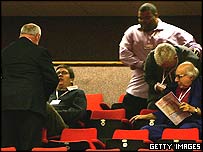
Handling criticism with dignity: the Labour way

At the Labour conference today, an eighty-two year old man was dragged from the conference, his conference card taken away and arrested under the Prevention of Terrorism Act, all for heckling Jack “boots” Straw during his speech on Iraq. Another man underwent the same treatment after protesting this spectacle:

security thugs removed an 82 year old man after he heckled Straw

Jack Straw was heckled today as he told the Labour party conference Britain was in Iraq “for one reason only: to help the elected Iraqi government build a secure, democratic and stable nation”.

A delegate, who was 82 years old and has been a Labour party member for 60 years, was bundled out by security guards after he shouted, “That’s a lie,” during the foreign secretary’s keynote conference address.

The outburst came during one of the few mentions of Iraq in the conference hall this week.

A second delegate was expelled for complaining at the treatment of the first heckler.

Fascistic, petty and arrogant this action was, it is also an unmistakable symptom of Labour’s weakinging grasp on reality and power. A confident party does not need to be this heavy handed. As unpleasant as it was for the persons involved –the main victim actually came to the UK from nazi Germany in 1937– I can’t help but gloat over this…

Vimes on chess

From Terry Pratchett’s latest, Thud!:

Vimes had never got on with any game much more complex than darts. Chess in particular had always annoyed him. It was the dumb way the pawns went off and slaughtered their fellow pawns while the kings lounged about doing nothing that always got to him; if only the pawns united, maybe talked the rooks around, the whole board could’ve been a republic in a dozen moves.

Courtesy of Outside a Dog