Science fiction magazines as innovators?

I’m reading The Cambridge Companion to Science Fiction, a collection of deadly serious essays aimed at an audience aware of, but not that familiar with science fiction. It includes the usual history of the genre and the chapter on the sf magazines ends with the following statement:

A magazine was like the small independent film as opposed to the Hollywood blockbuster, which has to meet the expectations of the broadest possible audience. Magazines have subscribers and more-or-less guaranteed space on newsstands. Books must be promoted. Even now, well after the heyday of the magazines, most innovation within the field takes place in the remaining magazines or in their contemporary equivalents. The latter include small press volumes, semi-professional publications and on-line publishers.

In the first place does this analogy not hold water. Written science fiction in any form is a niche market; a profitable niche market, but still small peanuts. To compare any book publication to a Hollywood blockbuster is just absurd, as the pressures on a science fiction book to perform well are several magnitudes less than they are on even a “cheap” Hollywood film. This comparison is needlessly disparaging.

I consider myself reasonably well read within the genre, but I do not see the innovation within magazines that is supposedly not present in books. The best modern sf writers, like Iain (M.) Banks, Ken MacLeod, China Miéville, Liz Williams, Lois McMaster Bujold or Jon Courtenay Grimwood, started primarily as novelists, not short story writers and skipped the magazines more or less entirely. In the last five years or so I can only think of Charlie Stross as a writer whose reputation was largely made through his short stories.

Looking at the magazines, or at least at the various Year’s Best anthologies I do not see the innovation there. These anthologies should have the best in short fiction published in science fiction in a given year and should therefore particularly showcase innovative works, should they not? But looking at the stories published in them first seen in the core magazines (Asimov, Magazine of Fantasy and Science Fiction, Analog and Interzone) there are quite a number of good stories there, but nothing as gloriously new as the best novels of MacLeod, Banks, Grimwood, Williams, Stross or Miéville.

So am I missing something? Or was this just so much blather?
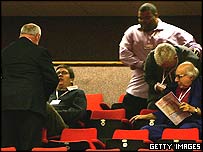
Handling criticism with dignity: the Labour way

At the Labour conference today, an eighty-two year old man was dragged from the conference, his conference card taken away and arrested under the Prevention of Terrorism Act, all for heckling Jack “boots” Straw during his speech on Iraq. Another man underwent the same treatment after protesting this spectacle:

security thugs removed an 82 year old man after he heckled Straw

Jack Straw was heckled today as he told the Labour party conference Britain was in Iraq “for one reason only: to help the elected Iraqi government build a secure, democratic and stable nation”.

A delegate, who was 82 years old and has been a Labour party member for 60 years, was bundled out by security guards after he shouted, “That’s a lie,” during the foreign secretary’s keynote conference address.

The outburst came during one of the few mentions of Iraq in the conference hall this week.

A second delegate was expelled for complaining at the treatment of the first heckler.

Fascistic, petty and arrogant this action was, it is also an unmistakable symptom of Labour’s weakinging grasp on reality and power. A confident party does not need to be this heavy handed. As unpleasant as it was for the persons involved –the main victim actually came to the UK from nazi Germany in 1937– I can’t help but gloat over this…

Vimes on chess

From Terry Pratchett’s latest, Thud!:

Vimes had never got on with any game much more complex than darts. Chess in particular had always annoyed him. It was the dumb way the pawns went off and slaughtered their fellow pawns while the kings lounged about doing nothing that always got to him; if only the pawns united, maybe talked the rooks around, the whole board could’ve been a republic in a dozen moves.

Courtesy of Outside a Dog

Deepsea dentures

Pharyngula answers the age old question: how is it squids can bite so hard without an internal or external skeleton?

If you think about it, though, cephalopods don’t have a rigid internal skeleton. How do they get the leverage to move a pair of sharp-edged beaks relative to one another, and what the heck are they doing with a hard beak anyway? There’s a whole paper on the anatomy of just the buccal mass, the complex of beak, muscle, connective tissue, and ganglia that powers the cephalopod bite.

I just love this kind of stuff.

Suspicious behaviour: if he was Brazilian he would be dead by now

PC plod hasn’t learned much from the shooting of Jean Charles de Menezes it seems, as the experiences of David Mery, arrested for suspicious behaviour on the Underground, shows:

7.21 pm: I enter Southwark tube station, passing uniformed police by the entrance, and more police beyond the gate. I walk down to the platform, peering down at the steps as, thanks to a small eye infection, I’m wearing specs instead of my usual contact lenses. The next train is scheduled to arrive in a few minutes. As other people drift on to the platform, I sit down against the wall with my rucksack still on my back. I check for messages on my phone, then take out a printout of an article about Wikipedia from inside my jacket and begin to read.

The train enters the station. Uniformed police officers appear on the platform and surround me. They must immediately notice my French accent, still strong after living more than 12 years in London.

They handcuff me, hands behind my back, and take my rucksack out of my sight. They explain that this is for my safety, and that they are acting under the authority of the Terrorism Act. I am told that I am being stopped and searched because:

  • they found my behaviour suspicious from direct observation and then from watching me on the CCTV system;
  • I went into the station without looking at the police officers at the entrance or by the gates;
  • two other men entered the station at about the same time as me;
  • I am wearing a jacket “too warm for the season”;
  • I am carrying a bulky rucksack, and kept my rucksack with me at all times;
  • I looked at people coming on the platform;
  • I played with my phone and then took a paper from inside my jacket.

This is not a list of suspicious behaviour, this is a list of pretexts under which anybody can be arrested. In fact, one of those criteria, keeping a “bulky rucksack” with you at all times is in direct conflict with what every Londoner has been taught for over twenty years, to always keep your luggage with you in case it is mistaken for an IRA bomb! If you can be arrested for that, you can be arrested for anything and any pretence at living in a free society is gone.

What is worse, as the article makes clear, this whole incident will be kept in police databases, in the UK and abroad for an unknown period of time, marking Mery as a suspicious character –in other words this wrongful arrest will in itself make it much more likely Mery will be arrested again! No smoke without a fire after all and if the police stopped you once, they must have had a good reason…