Police kill innocent man: the system works

Seems to be the conclusion reached by the idiot below, as linked to by Avedon Carol (I’m not giving this moron a link myself):

Many people will take this time to second-guess the London police and British special services. They will note the tragic consequences of a shoot-first policy that killed an apparently innocent man just trying to get to work, although one would expect that an innocent man would have stopped when commanded to do so instead of running for the nearest subway car. The police themselves will now second-guess themselves when it comes to making split-second decisions that could mean death in either direction.

Debate on tactics has its place and its benefits, but when such debate comes, it has to take place in the proper context — and that context is the war which Islamofascist terrorists have declared on the West.

In its way, this shows the folly of treating captured terrorists as if they were POWs. The Geneva Conventions exist to prevent civilian authorities to make these kinds of choices. It forces nations engaged in warfare to clothe their soldiers in recognizable uniforms so that civilians do not face these deadly consequences. The death of Menezes shows the wisdom of summary executions of infiltrators, spies, and saboteurs during wartime in order to discourage their use. The use of deadly force on people in civilian life in part because of a poor choice of outerwear during a hot summer season directly relates to the kinds of attacks that al-Qaeda has conducted on civilian populations.

A healthy dose of blame-the-victim there, with some nice pseudo-macho talk about sacrifices the blogger himself is very unlikely to make. It’s the quintessential rightwing reaction to any incident in which the wrong people –i.e. not themselves or their friends– are victims of the state. I’ve seen a lot of people elsewhere as well saying Menezes was to blame for his own death for wearing bulky clothes and running away when armed people ordered him to stop –and here I thought the death penalty had been abolished in the UK, but apparantly an exception has been made for wearing warm clothing on what is allegedly a summer day.
Police murder innocent man

This was bad enough when we could still pretend the victim was a dangerous terrorist suspect:

“I saw an Asian guy. He ran on to the train, he was hotly pursued by three plain clothes officers, one of them was wielding a black handgun.

“He half tripped… they pushed him to the floor and basically unloaded five shots into him,” he told BBC News 24.

“As [the suspect] got onto the train I looked at his face, he looked sort of left and right, but he basically looked like a cornered rabbit, a cornered fox.

“He looked absolutely petrified and then he sort of tripped, but they were hotly pursuing him, [they] couldn’t have been any more than two or three feet behind him at this time and he half tripped and was half pushed to the floor and the policeman nearest to me had the black automatic pistol in his left hand.

“He held it down to the guy and unloaded five shots into him.

But then it turned out this was just an innocent Brazilian electrician:

A man shot dead by police hunting the bombers behind Thursday’s London attacks was a Brazilian electrician unconnected to the incidents.

The man, who died at Stockwell Tube on Friday, has been named by police as Jean Charles de Menezes, 27.

Cue many mealy mouthed apologies and talk about “tragedies”, as if this was some kind of unavoidable natural disaster, rather than the murder it was. The BBC on Radio 4 was particularly offensive, with its handwringing about the poor police men who had to take these hard decisions –murder is hard, as the Einsatzgruppen could tell you as well. Oh, and more innocent people might be killed, but you can’t make an omelet without breaking eggs, so says police commissioner Ian Blair.

All of which is eagerly lapped up by the media establishment and the pro-war “left”, who swallow everything held in front of them. But blaming the victim is so much easier than resisting the police state now created in Britain. All in the name of fighting terrorism –but what about state terrorism?

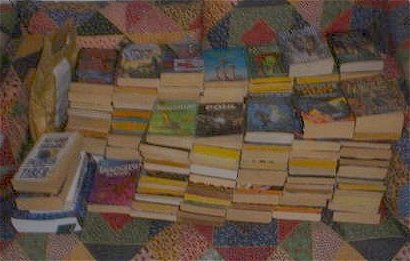
25 books in 25 days

pile of books

You may know that apart from this blog, I also got a booklog. A while back I made a bet with myself, to review 25 books in 25 days. I did this because I had quite a backlog of unfinished and half finished reviews waiting to be completed and put on the site and the white spots on the booklog were getting embarassing… I started on May 20th and it is now June 13rd and I’ve just completed my 25th review, so I thought I’d present them to you, my adoring public, now:

There you go, 25 reviews of books of varying qualities and genres: “voor elck wat wils” and for you to exclaim about, praise or mock me over. It’s been fun, if somewhat wearing.

Miéville on fantasy

I know I’m banging on a bit about China Miéville, with two entries on him in one day, but I missed this article in The Independent when it came out last year:

The real distinction between the tourists and what has become the “generic” fantasy tradition shows up in the weaknesses of the mainstream. When writers don’t respect the field from which they borrow, let alone when (cough, Theroux, cough) they despise it, their work doesn’t believe itself. On every page, nervously scrawled in invisible ink, are the words “It’s ok! It’s not fantasy! It’s really about oppression/marginalisation/exploitation/etc!” The curiously philistine and simplistic belief is that fantasy is only “meaningful” so far as it’s narrowly allegorical.

By contrast, writers within genres know perfectly well that they are writing about refugees, or economics, or gender oppression, or whatever else, but they also enjoy the strangeness they create for its own sake. And they always have done. Gulliver’s Travels is a vicious satire on various social ills, but it also revels in the uncanny spectacles it creates: squadrons of tiny people tethering a man to the ground; talking horses; islands floating with a giant lodestone. It trusts the reader to get on with the tasks of understanding, and of enjoying the strange. It is a book that delights in fantasy.

One of the great signs of fantasy’s health is that often these days, those who borrow its tropes from
outside genre, like David Mitchell, the hot favourite to win Man Booker prize, do so with facility and
respect. Mitchell writes brilliantly about human society and emotion, and about ghosts, sentient computers and transmigrating souls, without sneer, anxiety or generic despite.

Those allegations against Galloway

So an US Senate committee has accused of having received “allocations” of oil under the “oil-for-food” programme:

The US report concludes: “The evidence obtained by the sub-committee, including Hussein-era documents from the ministry of oil and testimony from senior Hussein officials, shows that Iraq granted George Galloway allocations for millions of barrels of oil under the oil-for-food programme.

“Moreover, some evidence indicates that Galloway appeared to use a charity for children’s leukaemia to
conceal payments associated with at least one such allocation.”

As the blogger known as Sonic said as well, you’d think this much oil would leave some trace:

[…] If Galloway was allocated “millions of barrels of oil under the oil-for-food programme” there seems
to me there would be clear evidence of it (transaction records, invoices etc) and if there was were is it?

But it all seems to be a
mishash
of earlier accusations, including accusations Galloway already won a libel suit over:

A spokesman for the Telegraph said: “The committee appears to be confusing our documents with a set of alleged receipts that emerged in Baghdad some days after our story appeared. These purported to record direct payments to Mr Galloway in the early 1990s. They were offered to the Daily Telegraph but, as they were clearly crude forgeries, we declined to publish them.”

The committee, which of course had not contacted Galloway before making the accusations, has now deigned to receive him, to which Galloway has responded with his usual charm:

The committee said it would be “pleased” for Mr Galloway to appear at a hearing in Washington on 17 May.

The MP accepted, declaring he would take “them on in their own lions’ den”.

He told the BBC: “I’ll be Daniel and I’ll be triumphant”.

In all, this whole farce smells like a slightly ill timed “october surprise”. Oona King must be pretty miffed this kerfuffle didn’t erupt a week earlier, eh?