Akagi Squared is what you get when you create an Azur Lane fan comic, lay it out like an American newspaper strip and apply a Bill Wattersoneqsue, Calvin & Hobbes inspired sensibility to it:
Originally published on Reddit, the strip is now also available on Mangadex. The inspiration for this was an event in the game last year, in which for …reasons kid versions of some of the most popular ship girls were created. Ethan Forsythe took that idea and ran with it. Akagi-chan herself is a happy little floof who just wants the love of her big sister, but her original doesn’t want anything to do with her. One thing leads to another and she defects to the American faction.
Both the art style and the stories remind me of Bill Watterson’s work on Calvin & Hobbes. It has the same sort of anarchistic humour, just cuter. As it is a fan comic, it requires some knowledge of the game and its characters, but on the whole I feel you could enjoy it without this knowledge too.
There’s a cute scene at the end of Infinite Stratos II episode ten. One of the main haremettes has spent most of the episode attemping to learn to cook, in the process putting most of her rivals in the hospital by accident. Finally, it’s the protagonist’s turn to teach her and he wisely decides that they’re going to make rice balls. When she struggles making a rice ball, he moves behind her and gently guides her hands to do it properly. Which leads to her self-immolating on the spot, our dense hero having no clue why she gets all flustered. It’s a sweet moment, romantic and actually funny as well. A standout scene in a series that usually goes for the most cliched of harem antics.
Infinite Stratos is a “only boy in magic school” harem show, only here the magic is mecha exoskeletons that normally only women can operate. The protagonist, Orimura Ichika, is the only boy in the world who can do it too. But unlike most such protagonists, there’s a good reason for him being so special. It turns out the inventor of the Stratos is the older sister of his childhood friend, who put in a special exception just for him. There is some sort of loose plot about his status as the sole male Stratos wearer in the background of the series, but you can ignore it. The real focus is on those harem antics.
Which are mostly a pain. The endless scenes of Ichika doing something “perverted” by accident only to be hit for it are on Love Hina levels of unfunny. Ichika being dense as one of his harem wants to jump his bones bores quickly too. It’s a bit strange how all these harem shows never show their protagonist actualy enjoying his harem. Maybe just the idea of being attractive to multiple girls is enough for its intended audience? Let’s be clear: Infinite Stratos is not a good show. Not even if all you’re looking for is some harem anime fun. Yet the original was just entertaining enough to watch all the way through. Likewise, this sequel was there when I couldn’t be bothered to watch anything that demanded actual attention. Just a pity it didn’t have more moments like this.
Which raises a difficult question: What exactly is so queer about Springsteen? Is it his extreme butchness, so practiced and so precise that he might as well have learned it from the oldest lesbian at a gay bar? Is it because his hard-earned, roughly hewn version of love is recognizable to those of us for whom desire has often meant sacrifice? Or is it something simpler? Do many queers love Springsteen because nearly every song he has produced in his 50-year career reflects a crushing, unabiding sense of alienation and longing—and what could be more queer than that?
The story of Bruce Springsteen is well known. Two albums that made him and the E-Street Band Jersey stars, a breakthrough album after the band got tweaked a bit with Born to Run, crowned the future of rock and roll, then fucked over by his first manager and forbidden from recording for a few years. The band spent the three years between Born to Run and Darkness on the Edge of Town touring, honing their craft. Once they re-emerged, older and more cynical, most of Bruce’s original optimism had disappeared.
It’s that backstory that makes his music so much more grounded than many of his rock contemporaries. His songs don’t offer fantasies, though they can offer hope. His most famous hit sounds so much like a patriotic anthem Ronald Reagan wanted it as a campaign song, but is actually a seering indictment of the realities of his “Morning in America”. Even at his most insufferable, on Human Touch/Lucky Town he still can’t quite forget his working class roots. He walks the walk too: doing fund raisers for the Democrats, tours for Amnesty International and the like. He has spoken out against police violence and for Black Lives Matter and of course wrote the above song about the murder of Amadou Diallo. He isn’t perfect, but his heart is in the right place.
I became a fan when I was ten, eleven. One of the first albums of his I owned, was the live boxset he brought out in 1985, a compilation of ten years of touring. That was at the height of his popularity, deep in the dark heart of Reagan America and what’s on it? Woody Guthrie’s “This Land is Your Land”, Edwin Starr’s “War”, a warning that “because in 1985, blind faith in your leaders, or in anyone can get you killed”. He’s deeply subversive on a level I didn’t understand then, but unconsciously seeped into me.
Naomi Gordon-Loebl argues that the pain he puts in his songs is what makes him resonate with queer people like her. Not being queer myself I can’t judge, but to me he is the lightning example of how to be butch, how to be masculine without being macho. It’s a masculinity that is available to anybody who feels attracted to it, not reserved just for cis men. It’s part of what keeps me coming back to Bruce Springsteen again and again too.
Welt Am Draht is basically what you get if you imagine The Matrix done in 1973, directed by a German auteur director more interested in philosophy than action and made as a two part television movie for a West German television channel.
How can you know the impact of a movie like this, fortyseven years after the fact and with its own remake having come out in the same year as The Matrix, itself already twentyone years old? I’m sure you can guess the core idea of this movie just from me having compared it to The Matrix. And yes, this is a movie about reality as a simulation, and yes that is the big reveal at the middle of it. But that television audience which sat down to watch it that October night in 1973, what would they have made of it? Was this intended to have been a surprise, or something that you were expected to have deduced from the hints the movie dropped, long before the protagonist did?
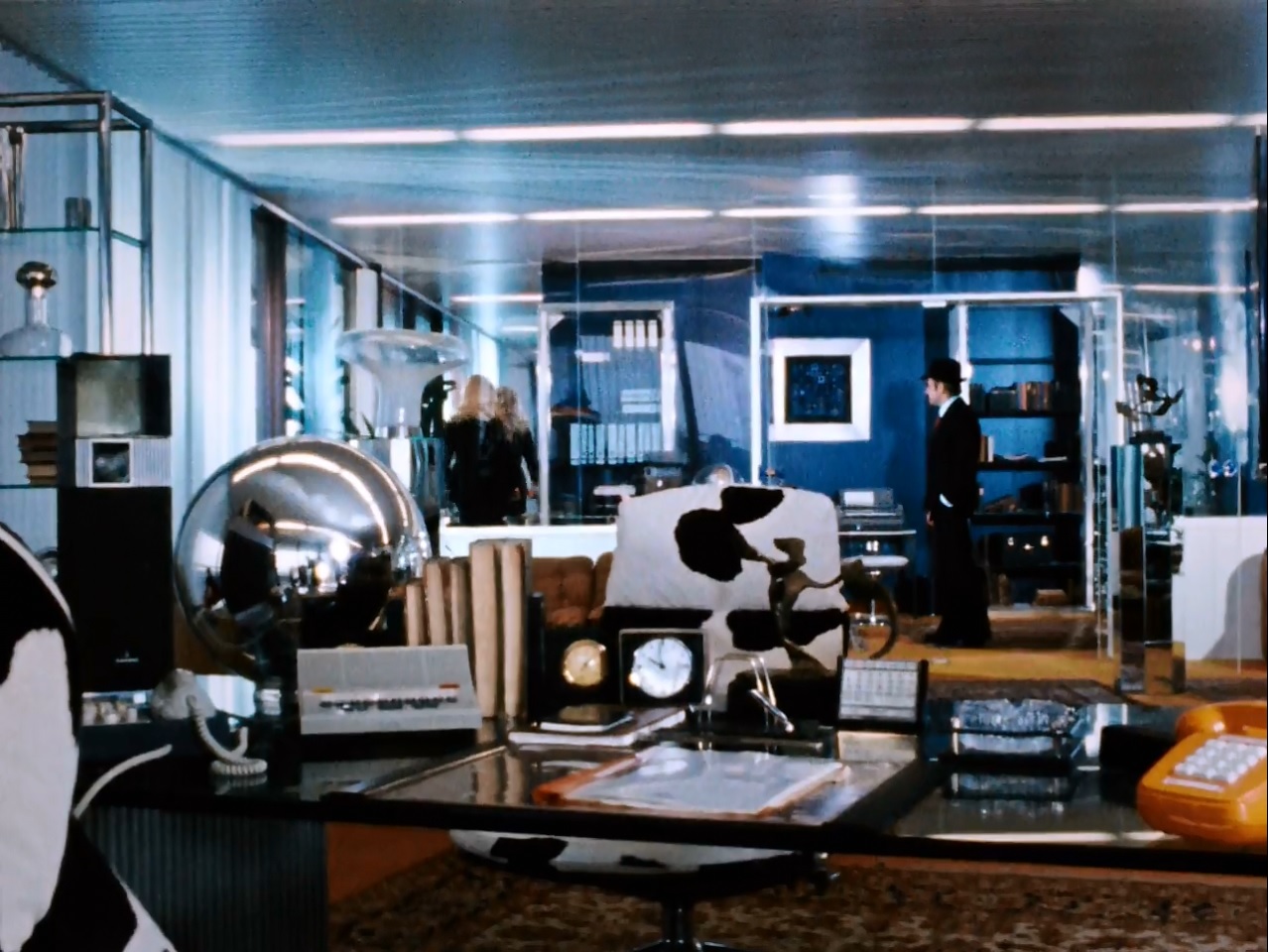
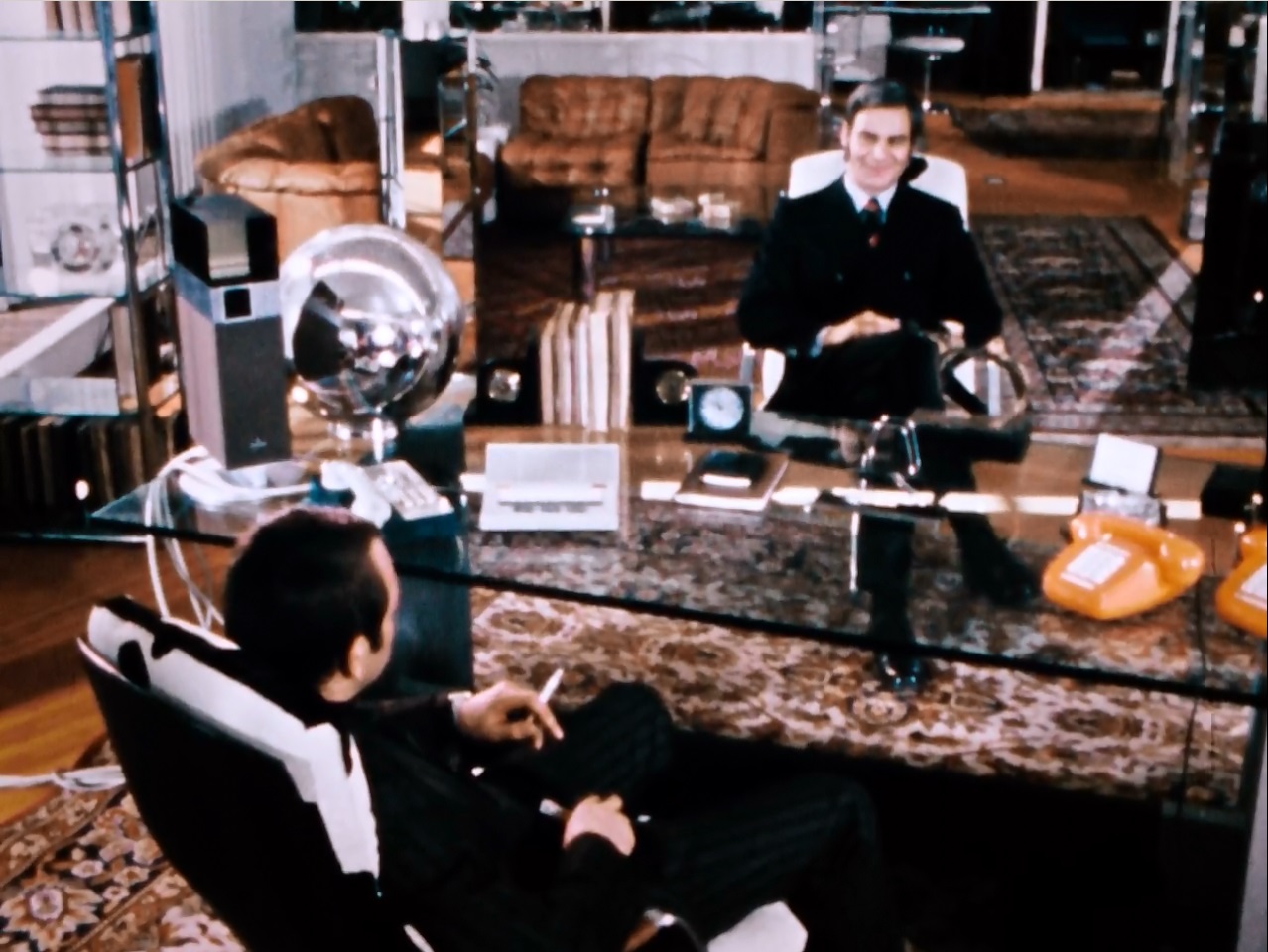
Another thing difficult to judge: the set dressing. This is a gorgeous office, sumptuous in its “seventies retrofuturism” as the Criterion trailer has it. But would you have seen it that way had you watched it in 1973, when all this would be far more the stuff of everyday life, or was this absurd even for 1973? Certainly the outsized ties our protagonist wears wouldn’t have been that ludicrous in their original context as they seem now. In any case throughout the movie I found myself admiring the sets and cinematography as much as I followed the plot. It is all so incredibly lush, so rich. As such it slots in neatly with the seventies science fiction cinema boom of big budget, big sets movies. But unlike some, it has more going for it than that.
The director, Rainer Werner Fassbinder, was one of the giants of West-German cinema; this is his only science fiction movie. It’s interesting how he manages to avoid the pitfalls of science fiction movie making that so many contemporary movies fell into. Set in the present day, present time, it has no outlandish costuming (those flared ties notwithstanding) nor much easily dated sci-fi gadgetry. It doesn’t waste time and credibility explaining how its central conceit works, but rather focuses on working through its implications. If we’re capable of creating a computer simulation that is so realistic that its inhabitants never suspect that they are living in one, who is to say we ourselves are not living in one too?
Welt Am Draht is a slow, slow movie. As said, it takes its protagonist an hour and a half of the movie to get the realisation that indeed he’s not living in any real world. That’s almost the same running time as The Thirteenth Floor its remake and it still has two hours more to run. But while it is slow, it never feels slow, because it uses its running time to throroughly consider that idea of living in a simulation, what it would mean to discover that you do so. Though it flirts with the traditional idea of that sort of revelation driving you mad, it never quite gets there. It even has a happy ending.
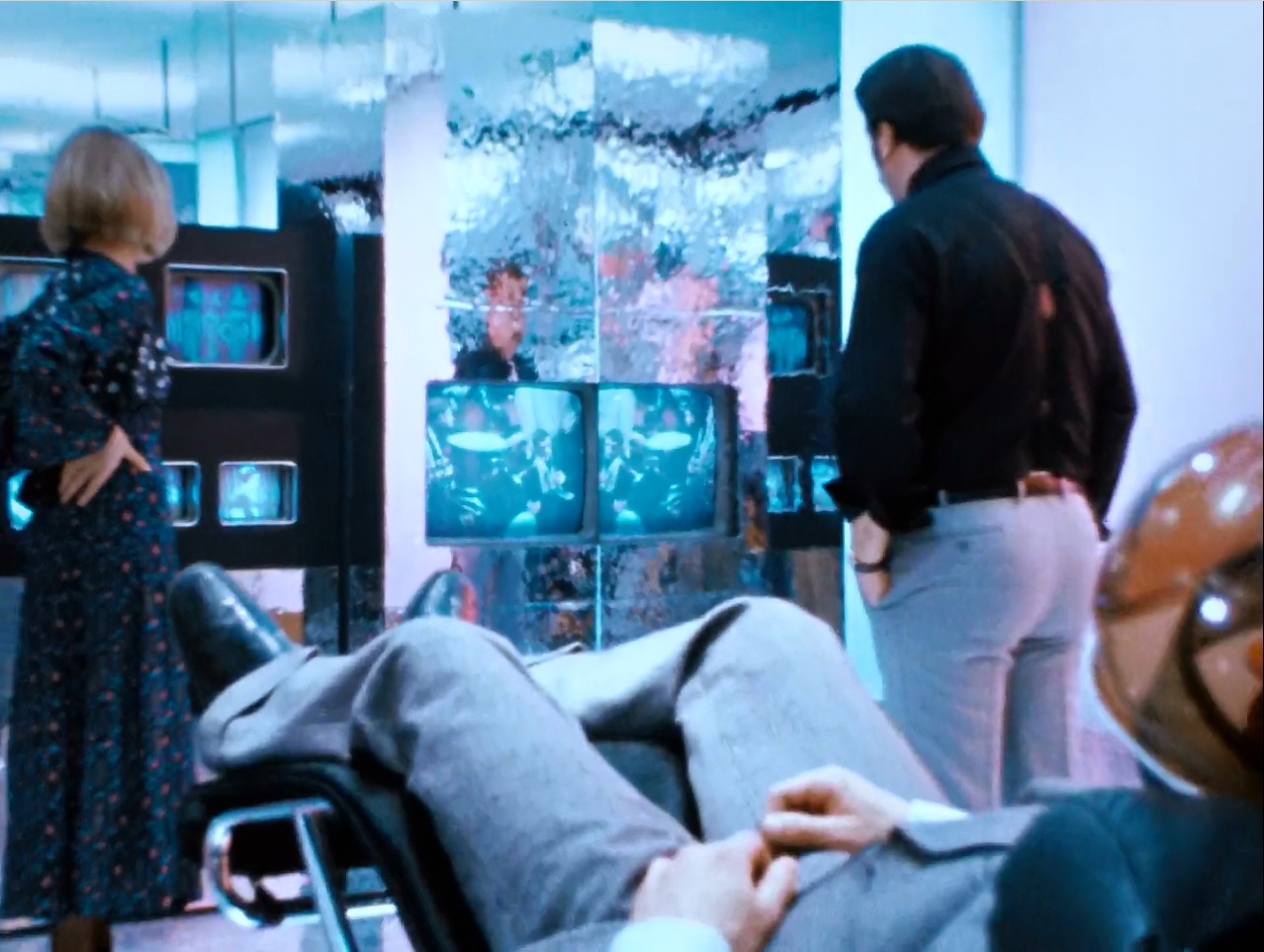
Welt Am Draht ends with the protagonist’s escape from his simulacrum to what’s presumably the real world. The problem of the simulacrum remains unsolved, its philosophical questions swapped for a more mundane love affair. With no real catharsis, this is an unsettling movie, much more so than most of the other movies mining the same vein of technopessimism and paranoia that came out at the same time. Because it’s set in a world that’s recognisably our contemporary world, the feeling of alienation brought on by the high modernist clutter in the otherwise sterile office landscape it mostly takes part in, works so well. Because it keeps the futuristic to a minimum, the distortions caused by it hit all the harder when it is introduced.
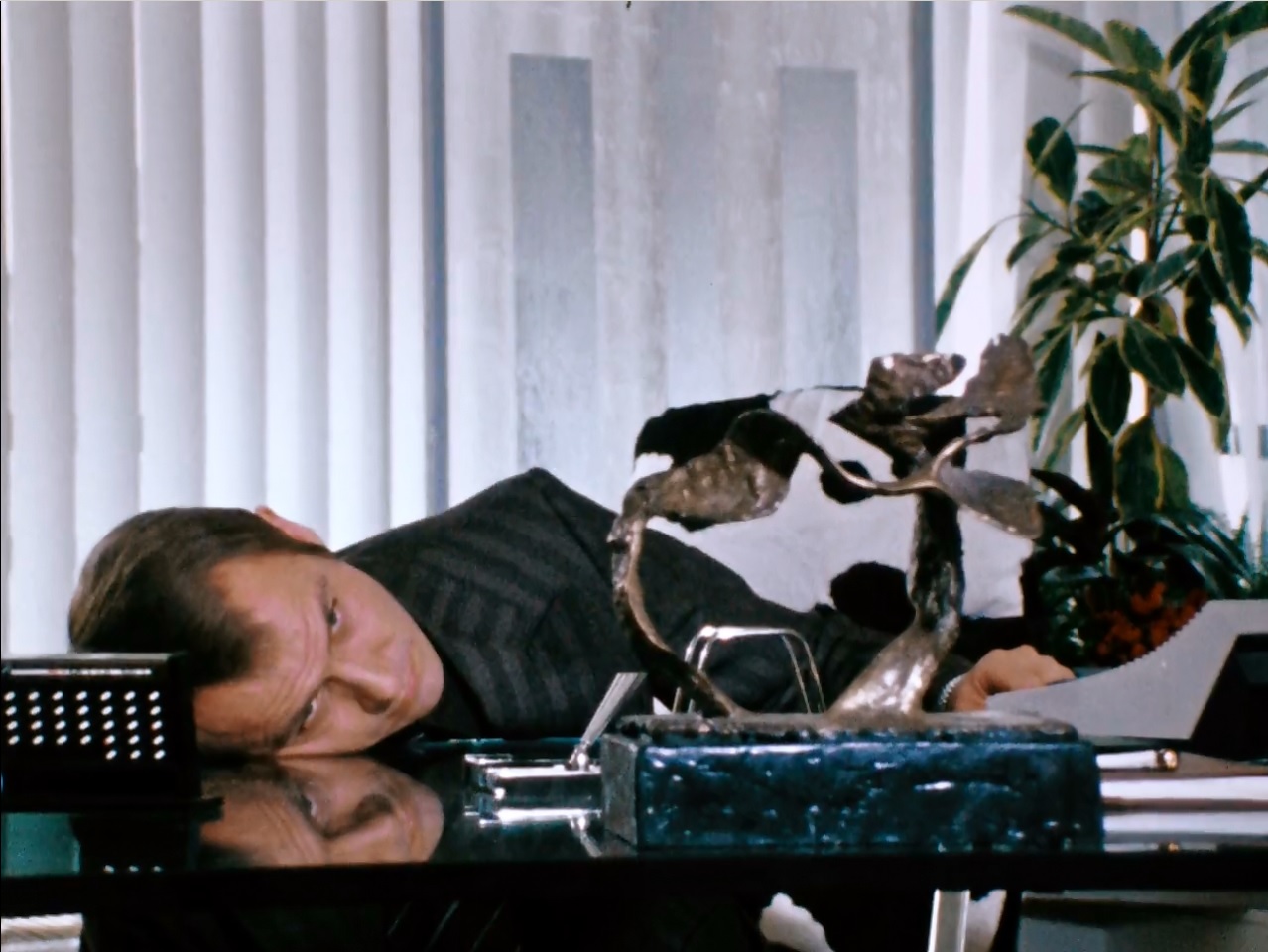
The use of mirrors and other reflecting surfaces by Fassbinder to shoot his characters in, the extraordinary stillness of the supporting cast in crowd scenes until called into action by the script, the way the protagonist constantly keeps moving, a discordant note among the rest of the cast, it all adds to this alienation. Especially those opening minutes made me uncomfortable watching, the thought kept nagging that something was wrong with this world, without ever knowing why. The repeated use of cabaret, with all its intonations of queerness, just reinforced this feeling. What it reminded me of was not so much The Matrix, but rather Videodrome, whic is similarly unsettling. It is very much a movie you would need to see if you like the latter.
What do we mean when we talk about listening to new music? I’m currently listening to the album the song below was taken off, ABC’s 1987 comeback attempt, Alphabet City. I do have the vinyl of that, but this is the first time I’ve listened to it in decades. Arguable this is new music to me, but is it?
Probably not, eh? But I have never listened to ABC’s sophomore album, Beauty Stab. When I play it today, does that mean I’m listening to new music, or is there more to it? The idea after all is that you stop listening to new music after a certain age (thirty, thirtyfive, in any case an age I passed a while ago). You no longer have the mental flexibility to appreciate new things, and are forever doomed to wallow in the nostalgia of the music of your youth. A horrible fate.
But what does count as listening to new music? Ont he one hand Beauty Stab is new music for me. On the other hand it’s more of the same music from a band I already know I like. Not very adventurous. But what if you discover an overlooked artist or group in the same genre of pop music? Is that new music? Or does that still fall under nostalgic wallowing? Surely discovering an entire new (sub)genre of music does count, right?
Alcest is a French band/project driven by metal prodigy Neige, which with its first EP created a new genre: blackgaze. A hideous mutant recombination of black metal and shoegaze and I’d be surprised if you can find two more unlikely musical genres to merge. Nevertheless it’s ultimately still heavy metal, a music genre I’m well familiar with. Alcest sounds a lot different from the Iron Maiden and Anthrax I grew up with, but ultimately it’s still metal. And to be honest, it is rare for me to start listening to any kind of music that is completely alien to me. Getting into Japanese pop and rock music by way of anime was the last major discovery for me, but even that is not that alien.
Ironically, the newest sort of music I may have listened to recently is actually the oldest piece of music we know how to play, a hymn to Nikkal, the goddes of orchards and fertility from Ugarit, an ancient port city in what is now Syria. Almost 3500 years old, it’s oldest discovered song with surviving musical notation. It’s older than anything we know, a product from an almost alien world, yet put a synth under it or use the right sort of guitar and it could just as well be a modern noise or gothic song.