Jack in for adventure — First Impressions

Why is this boy lifting up the skirt of the girl he just rescued from being buried in a garbage dump, to show his sister her hole?

Listeners: It Is! This hole is just like I saw in the books!

Because this amnesiac girl is a Player and he’s not looking at what the anime wants you to think he’s looking at. He’s looking at her output jack, something only Players have. It’s what controls the giant mecha they fight the Earless with, the shadow monsters that are slowly destroying the world. Echo Rec, our hero, is a bit of a Players fanboy so he’s …less than tactful when it comes to sharing his enthusiasm. But he knows his place. He’s just a lowly trash collecter in Liverchester, a run down town almost destroyed in battle ten years ago, now only surviving as the garbage dump for the rest of the world. No way somebody like him can have anything to do with Players. Even when they turn up unconscious and amnesiac at his workplace.

Listeners: Echo and Mu on their giant robot

Imagine my surprise when by the end of the episode, he was fighting the monsters! Though he spent most of the episode insisting he was happy where he was, at the end he rode into the sunset with the Player girl. Who is now called μ/Mu because she’s a big Love Live fan for the symbol on her neck chain. A bit predictable, but executed well. I like that Echo isn’t the usual hot headed idiot champing at the bit to go on an adventure. His hesitation and attempts of talking himself into in staying put rather than go on adventure when it’s thrown in his lap are relatable. I would like to have a pretty amnesiac girl take me on an adventure, but if push came to shove?

Listeners: plug into the amplifiers

Every other anime reviewer seems to compare this to Eureka Seven, mainly because the main writer for that series also worked on this one. But since I never got further than episode three, what it reminded me off instead was Megalo Box. Same slightly gritty feel, same sort of slum setting. And like that series protagonist, Echo here seems to be a person of colour? Or at least not quite looking like the usual anime protagonist. There’s also an obvious rock undertone to the show: Players plug into amplifiers, the Earless are defeated by bursts of loud noises, a lot of retro tech like vacuum tubes on display. And finally, do we need to mention the obvious sexual imagery of Mu plugging in Echo’s jack?

Not all that original, but if the quality of the series stays this high, I’ll take it.

Dog in a manger — First Impressions

Gleipnir is beautiful trash:


As Bless tweeted, Gleipnir has great character designs even for minor characters, well animated and with a great physicality to its setting. You can almost feel the summer heat through the screen. If only it was in service to a better story. From the first episode it looks like Gleipnir is just another edgy death game story, with an extra helping of fanservice. Of the four girls with speaking parts this episode, we got pantyshots of three of them.

Gleipnir: xtreme furry

Kagaya Shuichi is the sort of protagonist who wants nothing more than to lead a normal life, self effacing to the point of being a doormat. Too bad he has recently gotten the dubious power of being able to transform into a monstreous dog like mascot figure, complete with zipper on his back. As a side effect his eye sight has become perfect, he’s super strong when in mascot form and his sense of smell has improved. A lot. It’s just that this means he can smell the dead tanuki laying at the side of the road even from within the class room. So he’s not too happy about his powers and he seems to punish himself for having them.

Gleipnir: nice smile

But one night it comes in handy when he notices a fire on the hills behind his hometown, goes to check it out and discovers a girl lying unconscious in the middle of it. He saves her, but his animal instincts (?) play up and he starts to sniff his panties before stopping himself. The next morning she tracks him down at school and blackmails him into coming home with her. It turns out she’s been looking for a monster like him for a long time. No sooner are they at her flat, when they’re attacked by a girl with the same powers as him. Who looks a bit like the protagonist from Killing Bites. The game is on…

Gleipnir: strip in front of the loser protagonist

Gleipnir was originally a manga. I read the first few chapters of that a couple of years ago and what bothered me then is bothering me with the anime adaptation too. I just can’t care about Shuichi. He’s a boring doormat with no personality who spents the entire episode being sad. Is it too much to ask if we could’ve gotten this series with Claire, the blackmailing girl he saves, as the protagonis? Because she’s awesome. Few people would be so mad as to push a boy off a school building just to see if he transforms into a monster. She’s driven, tough and doesn’t let anything get in the way of her goal. But Claire is not entirely free of anime bullshit. We get the old “let’s strip in front of him to see how little I think of him” routine and it’s as exploitative as it ever is. Guilt free fanservice because the protagonist couldn’t help it.

So. Technically excellent, but ultimately trash. A loser protagonist I’d rather not spent time with, but a good supporting cast and Claire is awesome. Will I keep watching?

Azur Lane: ‘a hornier KanColle”

That’s how Azur Lane was introduced to me when I started playing it in September 2018 and they were not wrong:

Atago bikini skin

What with the anime version of it having finished recently, I thought it was a good time to talk about why I like it. I realise a “hornier KanColle” doesn’t mean anything to most of y’all, so let’s explain a little bit of backstory. KanColle, or “Kantai Collection” (Fleet Collection) is a browser game that was the result of some clever clog realising that if otaku liked WWII warships and otaku liked cute girls, they’ll love WWII warships reimagined as cute girls. Which they did. Released in 2013, KanColle dominated Japanese fandom for a good number of years, spawning off manga adaptations, an anime series and movies and tonnes and tonnes of fan mader material, often lewd.

Cleveland: knight of the sea

Azur Lane took the core idea from KanColle, traded in the nationalism of the original game for 200 percent more horniness and made the game mobile native rather than browser based. What it also did, unlike the original, was included WWII ships of all nationalities, not just Japan and made the Allied countries the explicit good guys. Kancolle always had a bit too many hairy handed nationalists as its fans, Azur Lane just has an international community of moral degenerates. and while all the loli FBI jokes grow tiresome quickly, I prefer it to WII revisionism.

Light cruiser Chapayev of the Northern Parliament

Azur Lane’s core gameplay is as a bullet hell side scrolling shoot-em-up. You have a fleet of six ship girls, three in the frontline (either destroyers, light or heavy cruisers) with three backline (battleships/cruisers and aircraft carriers) ships off screen you can call in for support. You manoeuvre your ships to avoid as much as possible enemy fire while they shoot automatically at them, then call in an air strike or bombardment when ready, or launch torpedoes. If you’re lazy like me and your fleet is strong enough, you can do this on autopilot. Ships level up through battle and each won battle drops loot of various kinds which you can use to strengthen the ship or their equipment. You can also get new ships this way. The main story has thirteen chapters, each with four maps, each of which needs three to six or seven battles to resolve. Combat is relatively easy as long as you level your ships properly, make sure their equipment is decent quality and you have upgraded their skills. There’s a lot of min-maxing you can do if you’re so inclined, or you can just brute force your way through by over levelling.

Laffy is best bunny

But of course the true gameplay isn’t the battling; it’s the collecting. If you play this long enough, most of the time you will do the battles on autopilot while doing other things. The combat is fun, but the real pleasure for me is growing my collection, getting that little dopamine hit when a new ship girl is acquired. Fortunately Azur Lane makes it relatively pain free. The gacha currencies (‘wisdom cubes’ and coins) can be easily harvested in game and buying new ships is cheap, either 1 cube/600 coins for the light pool (destroyers/light cruisers) or 2 cubes/1500 coins for the other pools (heavy cruisers, battleships, carriers and subs). There are also the event pools, which is where you usually do your gacha once you’ve played the game for a while. This is where the limited event ships can be got, usually at a slightly higher percentage than normal.

Dido is very insecure and needs headpats

Apart from that, you can also get news ships from drops during combat, with some being exclusive map drops event. Most infamous are the fox sisters, Kaga and Akagi, who drop from level 3-4, so you will encounter them relatively early in your playing. With only a 0.75 percent change of either of them dropping, you’ll spent a long time there if you want them both. It took me four, five months to get them. And they’re just the first of several good map drop only ships you want to have. In total the English version of the game has 438 ships, though a fair few of those are retrofits, leveled up ships that get new artwork and sometimes voice lines.

Ryuuhou: legs for days

I’ll admit, I’m just playing this for the sake of collecting all the ships and because of the cute ship girls. There isn’t that much depth to Azur Lane; the actual story is a mess. But it’s entertaining, hits that collecting bug I got and the content is diverse enough to keep interesting. Be aware though that it’s very heteronormative and full of the usual unsavoury elements you can expect with any otaku orientated game like this.

Not even an 8th son of an 8th son — First Impressions

With Hachi-Nan Tte, Sore Wa Nai Deshou!, isekai anime has evolved! Truck-kun is no longer needed. This time our protagonist is reincarnated in another world by the simple method of coming home dead tired one night, cooking a very good looking dinner for himself, then falling asleep at the dinner table before he can even start to eat. The next moment he’s a six year old boy in an aristocratic family in your typical Medeivaloid fantasy world. Hey, at least the food is good when you’re a noble.

Hachi-Nan: Well looks with joy at the high class steak in front of him

Well, that only turned out to be the case because his older brother is getting married and the family has to keep up appearances. His cozy life as a noble turns out to be not so cozy when your family is rich in tradition but not so much in actual wealth. Worse, your prospects as the youngest brother are so low you’ll have to leave the family altogether at some point and make your way in the world as just a lowly commoner, just like your brothers before. And in the meantime, your daily meal looks like this…

Hachi-Nan: stale bread and watery soup

But we don’t need to worry too much about our hero. The series went out of its way to make sure we knew from the start young Well (full name: Wendelin von Benno Baumeister) will avoid this ghastly fate. Before we get to the actual story this episode, we got an intro scene with him all grown up, a powerful magicial and Count, with the usual Isekai harem waiting on him. Nice to remove all narrative tension from the start, so we can just vegetate while watching this. From this and the opening, shown halfway through the episode, we can conclude this will turn into a typical battle isekai. How long Well’s socio-economic concerns will remain relevant is unclear.

Hachi-Nan: Well and his battle harem

Animation and character design are typically budget isekai, not very interesting. Lots of shots of characters standing in front of a low detail background. A great many talking heads delivering exposition. Action scenes mainly having characters point and shooting beams. That sort of thing. But there are some interesting little hints that the team behind this is capable of more. Having Well open a door in his mansion in the intro scene to flashback to him opening the door of his flat in real life is a neat touch. The joy with which Well eats was fun too. And whle most of the scenery is medievaloid beige, every now and again a background is actually pretty. Low bars for sure.

To be honest, a low bar is all an isekai needs to clear for me anyway. As long as the protagonist isn’t a total douchebag, the story isn’t too dull, I’m happy. I may drop this in two episodes, but for now let’s keep watching.

Nuclear Nightmares — Nigel Calder

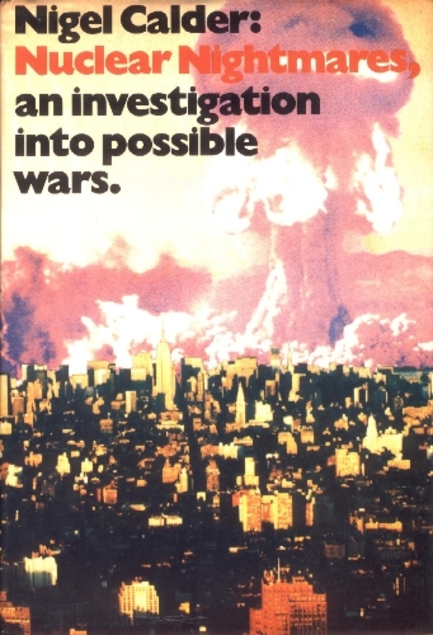
Cover of Nuclear Nightmares


Nuclear Nightmares: an Investigation into Possible Wars
Nigel Calder
168 pages including index
published in 1979

To distract myself from the current state of the covid-19 ravaged world, I read this cheery little treatise on the machinery for nuclear war. Many many years ago, sometime in the early eighties, I bought the Dutch edition for a guilder at a church fair. And boy was it worth it: I had nightmares for years. Not that you needed much to have nuclear nightmares in the early eighties; if you ever wonder why late Gen-Xers and early millennials are so cynical, it’s because we grew up with the idea that the nuclear holocaust could happen every minute just because some world leader was a bit too gung ho. Or some seemingly small mistake makes the Soviets think an American missile barage is on its way and this time there isn’t a junior officer brave enough to wait for confirmation before he launches a counterstrike…

But that is not the nightmare that Nigel Calder sketches in this book. His is a technocratic world, a world of rational men tending carefully balanced machinery designed to deliver megadeath on the enemy. Men who do not want to murder millions of people, but who will do so if and when it is asked of them. A world full of acronym littered dry, bureaucratic language that conceals the existentialist horror at the heart of it. An orderly world that calmly makes plan to destory or cripple the enemy’s ability to wage nuclear war, that worries about the vulnerability of MIRVED Minutemen III and whether they were safe enough and good enough to hit back at the Soviets after a first strike. Can we depend on the survivability of our systesm to give our leaders time enough to think about whether they want to strike back?

Read more…