Subtle and not so subtle horniness — Friday Funnies

Sometimes you can tell from a throwaway panel like this what really gets the mangaka out of bed each day:

Neko no Otera no Chion-san: two girls in working trousers on their knees in a shed seen from the rear only their butts in shot

It is clear from the shot (and the many similar shots throughout this series) that Ojiro Makoto likes her butts. Some extra time and care has been taken to render those buttocks. Of course the same is true for roughly 100 percent of cartoonists and their particular fetishes, but what I like about this is how mundane Ojiro makes it. This is the third panel of the first page of the twelfth chapter of Neko no Otera no Chion-san, a manga about a teenage boy who moves to live with his distant, slightly older cousin and grandma. While he’s the protagonist, he’s not in the scene. Instead the page opens with a shot of cardboard boxes filled with crap, left over cleaning material and the like before the second panel shows a crowded garden shed, more a storage unit than anything else, with two girls dressed in typical work clothing talking about cleaning it. The final panel then, the one above, is a logical progression, rather than a staged cheesecake shot. There’s no posing, the clothing conceals as much as it highlights and Chion and Hiruma are pretty rather than beautiful. An everyday sort of horniness.

Azur Lane Slow Ahead: a 4-koma gag strip interrupted by a cheesecake drawing

Compare and contrast with a typical chapter from Hori no Su’s Azur Lane 4-koma: Slow ahead, a gag strip where every page has a bit of cheesecake on it like this. Unlike in Chion-san, the fan service is strong in this one, your eyes immediately drawn to that intrusive panel of Cygnet posing. It’s not bad, but it interrupts the flow of the comic. Cygnet both poses and is dressed for fan service, thighs and breasts on prominent display. For what it is, basically an advert for the Azur Lane game, very much a waifu collector game, it’s not bad, but it lacks the subtlety of Chion-san. And for me, that makes the latter all the more stronger. Because ultimately Neko no Otera no Chion-san is about a teenage boy moving in with his attractive, not that much older cousin, that sort of everyday horniness fits the mood of the series far more than an intrusive shot like the above would, even if it’s nominally “sexier”.
Cool Japan at Tropenmuseum

Last year I went to the Cool Japan exhibition at the Amsterdam Tropenmuseum on literally the last day it was on.

The first room of the exhibition set the tone for the rest of it, featuring a video wall looping various famous anime movie clips (which is why the above is so noisy) and this magnificent display of various well known Japanese pop culture icons.

It Came from Outer Space — Sci-Fi Sundaze

The trailer for It Came from Outer Space really wanted to let you know how awesome its 3-D effects are:

Pity that the version I watched missed them. What remains is a plodding, dull, dragging story that takes far too long to get to the conclusion.

A meteor falls to Earth near Sandy Hook, Arizona and a local amateur astronomer and his school teacher fiancee get their neighbour to take his helicopter to take a look at it. He climbs into the crater and discovers it’s actually a crashed space ship, but before he can show it to the other two the crater collapses and the ship vanishes underground. Already tought of as a bit of a heads in the clouds egghead, nobody believes him, certainly not the local sherrif. But then people start disappearing, some coming back but not entirely themselves. When the astronomer’s fiancee disappears too, the sheriff organises a posse to capture or kill the aliens. Meanwhile our astronomer hero himself has managed to make contact with the aliens and realises they are not hostile, just ‘borrowed’ the towns people to help them make repairs to the ship. The climax is a race against time as the posse closes in and the astronomer tries to stop them long enough for the aliens to get away.

This could’ve just as well been told as an half hour Outer Limits or Twilight Zone episode, instead of an eighty minute movie. There’s too little plot for too much time and the suspense doesn’t hold up for me. I do like that the aliens here are mostly benign, if rather impolite to kidnap and then duplicate people without consent. You can’t argue the paranoid sheriff is entirely in the wrong to mistrust their motives. This being based on a Ray Bradbury idea I have the feeling that the moral is supposed to be that humanity has to grow up before being able to actually meet other civilisations, but the aliens didn’t cover themselves in glory either.

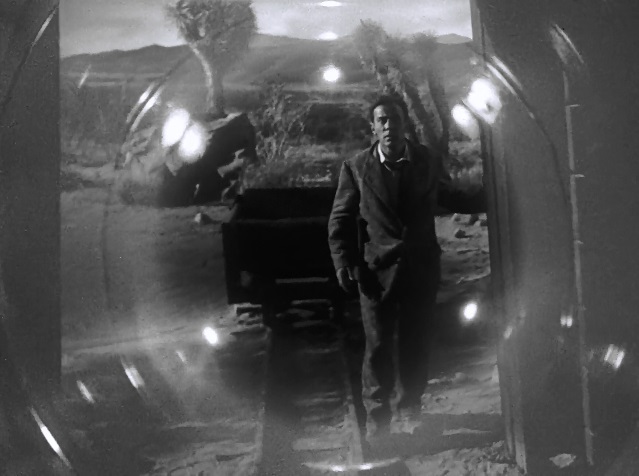
It Came from Outer Space: the astronomer hero as seen through the eye of the alien

Shot in black and white in 1953, based on an idea of Ray Bradbury, this is at least a good looking movie. Not sure how much difference the 3-D effects would’ve made, but in the 2-D version they are sparse. We get shots of the ship crashing and leaving, but the most ambitious scene is when the astronomer finally comes face to face with an actual alien, rather than an alien possessed human. We first get a shot of him through the alien’s eye, then slowly his body is revealed to the astronomer and us. While it looks a bit naff, it’s at least an attempt at a non-human looking alien.

It Came from Outer Space can be seen as part of that 1950ties wave of Cold War paranoia sci-fi movies, but doesn’t fit neatly in it. The aliens do not kill or hurt anybody, are ultimately benign and not here to take over. They just want to go home.

Sci-Fi Sundaze is an attempt to get me to watch more classic science fiction movies and blog about them. Sci-fi is a bit of a curse word in echt-fandom circles of course, something Forry Ackerman couldn’t have expected when he coined it to give science fiction a cool new name ala hi-fi. Sci-fi is shlock, all the bad stuff ‘we’ left behind in the pulps, proof that media sf could never catch up to the written stuff. That’s all bollocks of course.

What I’m interested in is taking a closer look at three long maligned waves of sci-fi schlock. First, like with this entry, that whole flood of quickly and cheaply made 1950ties science fiction thrillers, the purest expression of ‘sci-fi’. Second, there are the pre-Star Wars seventies dystopias like Rollerball or Logan’s Run. Sometimes these had little more going for them than awesome sets, but it’s still worth looking closer at them. Finally, there’s the eighties science fiction boom. Star Wars, Close Encounters of the Third Kind and Alien had made science fiction a blockbuster genre and boy were people ready to cash in. So let’s look at all the Star Wars ripoffs, the nuclear war armageddon Mad Max clones, all the sci-fi horror movies winking at Aliens. These are the movies I’d get from the videoshop once I saw all the good sf movies.

What I’m actually watching this season

There’s some twentyeight series I’m interested in this season, but here’s what I’m actually watching week by week:

Eizouken!
Best series of the season, made with a love for animation that made me fall in love with anime myself all those years ago. Just look at that video. Six episodes in and the magic of that first episode hasn’t faded yet. Every episode is basically a thesis on how to animate and it always shows off the techniques it talks about while it is talking about it.

Bofuri
Cute girls playing MMOs in virtual reality; not a new concept but one of the few such series that actually feels like they’re playing a game rather than wandering about yet another medievaloid fantasy world. Maple and Sally are very cute together and feel like proper friends.

Koisurue Asteroid
A slice of moe series about girls in the combined astronomy/geology school club doing club activities together. To be honest, I keep forgetting who the characters are week by week. The premise of the series, that two childhood friends find each other in high school and want to find an asteroid together seems to have been forgotten as well. Nevertheless, a mellow series to start the weekend with. Very well animated as well for a series like this.

Nekopara
Based on a visual novel that has you raise cat girls and then fuck them, the anime wisely drops that second part and focuses instead on the cute cat girls doing cute cat girl things. You sort of have to ignore the setting (see link above) to enjoy this and there are a few too many pee jokes for me, but this is an enjoyable time waster.

Mashumairesh: these girls have so much hair I worry for their shower drains

Show By Rock!! Mashumairesh!!
New series new band. Four cute animal girls form a rock band together in a world ruled by music. So far little from the original series has shown up but the setting, but the story is similar. A newcomer to the city, in this case a sweet farm girl from the sticks, runs into an already established but struggling band and eventually joins them. And just like in the original, the prickliest character in the band falls for our new girl. The hair styles are on point but I dread what these do to their poor shower drains.

Oshi ga Budoukan Ittekuretara Shinu
If you’d make it to Budokan I would just die, as a literal translation would have it. An idol show from the perspective of the obsessive fan/borderline stalker. The idol she follows is the lowest ranked of a struggling idol group, while she herself just does part time jobs only to have money to buy her merchandise. Idol and fan are sort of in love with each other, but can only see it through that lens of idol and fan. It is surprisingly melancholy.

22/7
22/7 meanwhile is another sort of idol story altogether, about several girls chosen for a mysterious idol project. I’m still not sure whether or not this is meant to be satire or not. It’s based on a real life idol group though so I don’t think it will peek in the darker corners of the idol industry much.

BanG Dream! 3rd Season
A straigh sequel to the second season and a good example of what 3D animation can do when it’s used properly. More Ako though!

Toaru Kagaku no Railgun T
After the disappointment of Index S3 and the Accelerator anime, it’s great to see that Railgun is as good as ever. More grounded in everyday life it makes the stakes higher. Seeing Misaka get separated from Kuroko and have her other friend Kongō Mitsuko, the ara-araa princess step in.

Kyokou Suiri
A young girl sacrifises an eye and a leg to become a mediator between the world of youkai and humans. A very talky series yet one that never bores despite it.

Jibaku Shounen Hanako-kun
Hanako, the ghost in the toilet, is a well known Japanese urban legend, but this time he’s a boy. And the girl that came to him to find a way to win the love of the snepai she admired now has to be his assistant. I love this sort of series and I love the animation style in this.

And that’s about it. Not mentioned, the new Precure, which had a good start and short series like Heya Camp, which is just too short to say much about.

Battle of the MMOs! Bofuri v Dendogram!

The third episode of Infinite Dendogram opens with the protagonist being told about how much stronger players than he had solved the problem of the player killers he himself fell victim them to last episode.

The third episode of Bofuri opens with the protagonist complaining to her best friend about the new rules introduced by the game that nerf her powers after she came third in the first big event it had launched.

Nothing shows the contrast between what should be very similar series better than this. In Infinite Dendogram the protagonist has things happen to him. He starts playing the game his brother has already been playing for years and lets him guide him through his first adventure. He get things just for being there, most notably his “Embryo”, the unique gimmick of the game, which predictably turns out to be a young girl. He gets attacked by player killers and by coincidence meets a super high level player shortly after who promises to do something about it. He hears about what other people are doing but does nothing of note himself in this episode. In Bofuri the protagonist is active. After she let herself be convinced to start playing the game her best friend wanted to play with her, she spent the first episode on her own, deciding how she wanted to play the game. Once she had decided, she then set out to create exactly the type of character she wanted to play: somebody so strong in defence and vitality she could never be hurt. Through this she came third in the game’s first tournament, at the cost of having her powers debuffed because they turned out horribly game destabilising. And in this episode she sets out to find new ways of using her skills to compensate for this nerfing.

What also becomes very clear in these third episodes is the difference in how each series treats their setup. In the first, the world it takes place in is very much a fantasy world with some gaming elements laid on top of it, with little thought on how it would work as a game. In the second, it feels much more of a game. Events happen, rules get modified when abilities turn out to be game breaking and we see the protagonist and her friend talking in real life about the game. Infinite Dendogram wants us to forget it’s a game; Bofuri revels in it.

Both series are about having relaxing adventures in a MMORPG virtual reality game. Both games are set in the sort of medievaloid fantasy world we already know from dozens of similar anime and manga series, only this time nobody is trapped inside them. Their protagonists are sort of similar too. Both are gaming newbies who have just started playing this VR MMO, who have more experienced friends to give them advice. But Infinite Dendogram puts me to sleep while Bofuri, (full title: Itai no wa Iya nano de Bougyoryoku ni Kyokufuri Shitai to Omoimasu or I Don’t Want to Get Hurt, so I’ll Max Out My Defense keeps on charming me with each episode.