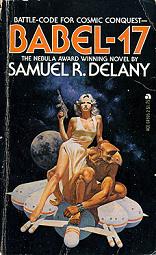
Babel 17 — Samuel Delany

Cover of Babel 17


Babel 17
Samuel R. Delany
158 pages
published in 1966

Babel 17 was the first Delany novel I ever read, some ten years ago or so; this was the first time I’ve reread it. It might be considered, together with The Einstein Intersection, as his breakthrough novel, the novel that made his name as a writer of literary, innovative science fiction. Unlike some of his later novels, it is not yet so experimental in style or subject matter that it scares of hardcore science fiction eaders, sometimes a notoriously conservative bunch. Babel 17 is in fact one of the earliest examples of the New Space Opera, which reinvigorated this old subgenre by keeping its strengths (large canvas, sense of wonder, gripping adventure) but losing its weaknesses (cardboard characters, weak writing, simplistic morals). Babel 17 therefore had something for every science fiction fan.

The plot of the novel is typical for space opera. It’s sometime in the future and humanity, united in the Earth Alliance is fighting a war against the socalled Invaders, a war which has been going on for decades. Lately there has been a spate of mysterious attacks and sabotage incidents whose only connection is that just before such an attack starts, the area in which it happens is saturated with radio broadcasts. These broadcasts are in code, which is dubbed Babel 17 and has so far proven to be unbreakable. The army therefore turns to Rydra Wong, the most fashionable and famous poet in existence, who used to work for the Earth Alliance’s intelligence services and still has a reputation of being able to break even the most complicated codes. It is she who realises Babel 17 is not a code or a cypher, but a language. She also realises that in order to learn to speak the language, she has to be at the site of attacks as they happen and immerse herself in the language. So she assembles a crew to run her spaceship and goes off. Through a series of encounters she gradually learns both the language and the terrible secret that is Babel 17.

Even in his earliest, most journeyman like work Delany had a knack for creating exotic yet believable worlds to set his stories in, immersing the reader in them through a wealth of well chosen detail. With Babel 17 this knack has come into full blossom, further maturing in later novels like Nova. What Delany had that a lot of his contemporaries lacked was a feeling for culture and the arts as just as important subjects for science fiction as science and technology traditionally are. In Bab bel 17 Delany manages to merge these two subjects, science and culture, as the story revolves around language, which can be understood both scientifically and culturally.

More specific, Babel 17‘s central concept revolves around the Sapir-Whorf hypothesis, the idea that language determines thought; in its strongest variant that no thought is possible outside of language. The hypothesis also suggests that difference in what language you speak shapes how you think; which is part of the plot here. Babel 17 is supposed to be the ultimate logical language, in which you cannot make mistakes; the language in fact forces you to think logically.

This is something that even at the time was dodgy and since then has been debunked pretty thoroughly, as the Wikipedia article linked to above should make clear. If you are likely to be outraged by such clearly wrong science, avoid this book. On the other hand, it is no more outrageous than some of the physics howlers committed by other authors, certainly no more so than John Brunner making Pi equal 3 in one of his novels (later retconned as taking part in an universe with different laws of nature). Science fiction may after all pretend to be all about science, but it’s just as likely to use pseudoscience if it makes for a better story…

The ballad of Beta 2 — Samuel R. Delany

Cover of The ballad of Beta 2


The ballad of Beta 2
Samuel R. Delany
124 pages
published in 1965

The Ballad of Beta 2 is one of Delany’s earliest novels, after The Jewels of Aptor and the Fall of the Towers trilogy. It is incredibly short, an artefact of first appearing as an Ace Double Novel. This does nothing for the quality of the story, I’m sad to say: it reads more like a plot outline than a proper novel. The Ballad of Beta 2 is a disappointment compared to The Jewels of Aptor (though I’ve only read the latter in its 1968, extended edition). Delany is an author who needs some room to work, some space to showcase his qualities and here he just doesn’t have that.

Which doesn’t mean that this was a complete waste of time to read; I’ll gladly read any Delany book I can get my hands on and despite the skeletal plot, there were still a couple of genuine Delany touches that made this worth reading. Heck, any halfway accomplished reader can read this in an hour or two anyway.

The story revolves around anthropology student Joneny, who has reluctantly accepted his teacher’s assignment to study the mystery of the Star Folk, the only group of people who ever crossed interstellar space, as the hyperdrive had made this unnecessary. Of the twelve ships that set out from Earth to the Leffer system, only ten arrive and two of those were empty. What could the remnants of these primitive spacefarers teach a galaxy teeming with much richer, much more interesting cultures? Nothing, is Joneny’s view; he’s convinced they have not contributed one original cultural idea to broader human culture. Unfortunately for him, his professor disagrees and sets him to provide a complete analysis of the Star Folk’s best known ballad, the Ballad of Beta 2. It is in this ballad that Delany is able to put his customary cultural touches:

“She walked through the gates and the children cried,
She walked through the Market and the voices died,
She walked past the court house and the judge so still,
She walked to the bottom of Death’s Head hill…”

But how does this ballad, with its mentions of cities, sand, sea, markets and courthouses relate to the life on board of these generation ships? And what has it to do with the mystery of the Beta 2 itself, arriving devoid of people after its long journey? Those are the central mysteries of the book, but as I said the length of the novel drastically limits the depth to which these can be explored. The various questions asked are as quickly solved as they are raised; as if you’re reading a sub-Agatha-Christie mystery.

Unlike The Jewels of Aptor then, this is a novel that will only be of interest to people who are already Delany fans. It is very much a journeyman’s work, hampered by its short length and with only the occasional flash of Delany’s brilliance to make up for it.

Now Wait for Last Year — Philip K. Dick

Cover of Now Wait for Last Year


Now Wait for Last Year
Philip K. Dick
225 pages
published in 1966

Now Wait for Last Year is one of those books I first read in Dutch. Philip K. Dick was quite popular in the Netherlands in the seventies and his books were still around the local library when I started reading science fiction, a decade or so later. I can remember liking it at the time, though little about the plot other than that it involved time travel; it has been about twenty years since I last read it after all.

Rereading it now I still like it. Now Wait for Last Year is early Dick, from before he had his “road to Damascus” experience and relatively straightforward for a Dick book. Nevertheless, many of the typical Dick themes and concerns crop up here, something that goes for most if not all of his books.

Though written in 1966, this feels like a fifties novel, as its concerns are so typical for the science fiction of the time. American science fiction of the fifties reflected the obsessions of the time: the pressure to conform, the paranoia (“reds under the beds”), the fear of nuclear war, the march of pop psychology, all of which are obsessions Dick made his own through all his works. Now Wait for Last Year shares some of them.

The outer plot of the book is about the fix Earth (“Terra”) has found itself in, allied to the losing side in a centuries old interstellar war, Lilistar. It wasn’t surprising Gino Molinari, supreme elected leader of Terra had signed a Pact of Peace with the ‘starmen rather then their enemy, the Reegs, as the latter looked like four-armed, blue chitinous monsters, while the ‘starmen were actually related to Terrans (through the hoary old cliche of Earth as lost colony). Unfortunately, the ‘starmen are not quite what they seem, treat Earth as something to exploit and are still losing the war. Is it a coincidence that the Lilistar leader, Frenesky, has a vaguely Russian name?

The inner plot is about Dr Eric Sweetscent, artiforg surgeon to Virgil Ackerman, over 130 years old and one of secretary Molinari’s most important political allies, and his relationship with his wife, Kathy Sweetscent, who works as an antiques dealer for Ackerman. Their marriage is not a happy one; she is an addict and practises pop psychology on him, he lets her.

It is when Eric gets to work for Molinari himself, to keep the hypochondriac perpetually ill leader from dying again and Kathy gets her hands on a new drug, JJ-180, which lets you experience time travel, that matters come to a head. Kathy hooks Eric on the drug as well, by putting it in his coffee; it is immediately addictive and worse will kill you in 48 hours if you do not take another dose…

Eric meanwhile discovers that Molinari is not just hypochondriac and on the verge of death regularly, but died at least once already; a bullet riddled corpse is on display in a secret cold chamber in Molinari’s Cheyenne headquarters. Even stranger, a third Molinari, much younger and much more energetic, is making video speeches. What is going on and what does it have to do with JJ-180?

So there you have it, a typical Dick novel perhaps, with many of the obsessions and themes Dick had worked on before and would revisit in greater detail later. The plasticity of reality and the struggle to determine what is real and what’s just a stage set, the way psychology is used, Earth caught in an interstellar war, ruled by a democratically elected but still tyrannical regime and at the mercy of much more powerful allies, time travel and hallocinations, etc. All present but in a somewhat diluted form. If there is any novel which is both accessible to readers new to Philip K. Dick’s writing, yet still representative of it, Now Wait for Last Year is it.

The Jewels of Aptor — Samuel R. Delany

Cover of The Jewels of Aptor


The Jewels of Aptor
Samuel R. Delany
159 pages
Published in 1962, extended version in 1968

This was Delany’s first published novel, written when he was only nineteen. In fact, according to the Encyclopedia of Science Fiction, this was Delany’s first published fiction, at a time when the normal career path for a sf novelist was through writing short fiction for the various magazines. The Jewels of Aptor first came out in 1962 but had its text cut by a third to fit the rigid Ace books format. The edition I read is the restored 1968 one, also published by Ace Books. Ironically, nowadays this book would probably be too short to be published on its own.

For a first book this is quite good, not brilliant or very original, but an enjoyable read and just that little bit better then it needed to be. At heart, this is a quest story, with a small group of companions fighting off the dangerous of a forboding land to get the treasure and return home. In this case, home is the land of Leptar, some untold number of years after the Atomic Holocaust.

Geo is a poet, his companion Urson a sailor. Together with a four armed mutan boy named Snake, they muster on an expedition to the land of Aptor, to steal back the daughter of the Goddes Argo from the Dark God Hama, as wel as his jewels, which have strange powers. A fairly straight forward tale, but things are not as black and white as they seem at first sight.

What I liked about this post apocalyptic story is that the apocalypse is handled so matter of factly. The Great Fire happened long ago, but civilisation has restarted, if at a lower level and there are few if any of the usual cliches present. I also like is the lush way in which Delany describes things:

As they turned it emerged under the white and flaring lamps. Translucent insides bubble-pocked and quivering, it slipped forward, across the road, towards the skeletons. Impaling itself on the bones, it flowed around them, covered them, molded to them. A final surge, and its shapelessness contracted into arms, a head, legs. The naked man-thing pushed itself to its knees and then stood, its flesh now opaque. Eye sockets caved into the face. A mouth ripped low on the skull, and the chest began to move. A wet, steamy sound came from the mouth hole in irregular gasps.

All in all, certainly worth a look.