Gabriel’s Ghost — Linnea Sinclair

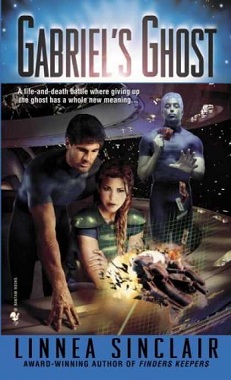
Cover of Gabriel's Ghost


Gabriel’s Ghost
Linnea Sinclair
447 pages
published in 2005

I’d never heard of Linnea Sinclair before I picked Gabriel’s Ghost up in a secondhand bookstore, but the cover and plot looked interesting. Also, I’m still trying to read more female authors. Googling Sinclair made clear she’s a science fiction romance writer and indeed Gabriel’s Ghost won the 2006 Romance Writers of America’s RITA award for Best Paranormal Romance. Neither this nor the title however means there’s anything paranormal about this novel. Rather, it’s a science fiction adventure story with a somewhat greater emphasis on the romance between the two main characters than usual, which does have some consequences for the rest of the plot.

Gabriel’s Ghost starts imperial fleet captain Chasidah Bergren banished to the prison planet Moabar for crime she didn’t commit. Barely arrived, she had to kill a guard who tried to rape her and only then the real danger began, as the next person she met turned out to be somebody from her past, somebody she thought long dead. Gabriel Sullivan is a rogue and a smuggler she had clashed with repeatedly when she was still a frigate captain, until he died a few years ago. Now he’s back and offering her escape, if she helps him with one little job…

It turns out that somebody high in the empire’s hierarchy is once again breeding a long outlawed biological super weapon: the jukor, a murderous animal originally bred to destroy alien telepaths. Sullivan needs Chasidah for her knowledge of how the imperial navy thinks to help him infiltrate the project and destroy the jukors. She’s not the only one on his team; there’s also one of those alien telepaths, Ren, a Stolorth. In the mepire these are the creatures of nightmares, mindstealers, even seen as demons by the Englarian church and yet this same church has raised him from childhood. It helps that he’s blind and hence unable to use his powers; the Stolorth themselves normally kill their blind kind.

Between Chasidah and Gabriel Sullivan there’s a sexual tension from the start. They not only share a past as nominal enemies, but Gabriel also hides a dark secret he needs to get Chasidah to know and trust him about. He clearly sees her as much more than just a tool; she is skeptical and suspicious and needs to learn to trust him, but it’s hard when he doesn’t tell her even half of what she needs to know and worse, might be actively manipulating her. Ren might not be the only telepath on the team…

Basically then Gabriel’s Ghost has two separate plots running. The first is that of the blossoming romance between Chasidah and Gabriel, while the second is a science fiction adventure of escaping prison planets, stealing spaceships and infiltrating imperial space stations to blow up genetic labs. The two are not always integrated successfully, with the latter at times coming to a halt to explore Chasidah and Gabriel’s romance more.

To be honest, the whole jukor threat doesn’t make much sense anyway. They’re basically hard to kill super predators, but they’re still just animals and you can’t help but think a decently equipped modern day army platoon could make mincemeat of them. They’re certainly not convincing as something that could upset the balance of power in the empire. What also doesn’t make sense, for such a secret project is that so many people know or suspect about it. Chasidah’s almost rape actually turns out to have been attempted because the jukor project uses alien Takan women as brood mares for them, with the poor women dying while giving birth. Apparantly the Takan know this is going on and some of them have decided to rape human women as revenge.

The romance also has some problems. Since Gabriel’s Ghost is told purely through Chasidah’s point of view, we never really get to know just why Gabriel Sullivan is and seemingly always was so in love with her. She herself certainly isn’t clear on this. She thinks she’s plain looking at best, not all that interesting or smart and yet at the same time not only has Gabriel after her, there also turns out to be an ex-husband who still loves her even though she divorced him to choose her career over his wish to get children. Not to mention that Ren the Stolorth, who’s described as being a very male sort of alien, also has something of a thing for her, even if only platonic.

There are also some consent issues playing a role here, as Gabriel not only insists that she asks him no questions about who or what he is, but several times manipulates her perception and memory. It’s not out and out mindrape and she does take him to task for it later on, but it’s uncomfortable and she is slightly too forgiving of it to my taste. It all is a bit too reminiscent of certain outdated romance cliches.

There’s also a lack of female characters other than Chasidah. There’s a jealous ex of Gabriel who shows up in one scene, the ship’s cook who gets a couple of lines and a cliche religious fanatic who turns up on the villain’s side. It barely passes the Bechdel test and emphasises how unique Chasidah is to be able to keep up with the boys.

Despite these flaws, which made Gabriel’s Ghost into a lesser novel than it could’ve been, I still enjoyed reading this. Linnea Sinclair is a good enough writer to keep you engaged throughout the story and it’s only afterwards that you start thinking, hang on, that’s a bit dodgy. What for me in the end made the novel was Chasidah who, while sometimes taking a turn to the cliche, still is a smart, interesting character. She’s unsure of herself, but she does take charge when she needs to and keeps a cool head in danger. Ultimately she is the hero of her own story and she is instrumental in stopping the plot to breed jukors. I wouldn’t mind spending more time with her.
Dragonsong — Anne McCaffrey

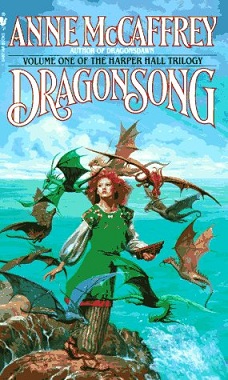
Cover of Dragonsong


Dragonsong
Anne McCaffrey
192 pages
published in 1976

Dragonsong is the first novel in the Harper Hall trilogy of novels that Ann McCaffrey wrote in 1976-1978 as a continuation of the original Pern novels, cite>Dragonflight and Dragonquest, weaving in and out of the main series. The heroine of the series, Menolly, would also show up in the later Dragonriders books, e.g in The White Dragon as a supporting character, occassionally hinting at her adventures in her own series. I hadn’t actually read this particular subseries before, as I never came across them until recently. All I knew was that the Harper Hall books had been consciously written for a young adult audience, unlike the original Pern books.

And reading Dragonsong that impression turned out to be right. This is as close to the platonic ideal of a certain kind of adolescent power fantasy as I’ve ever read. It’s even better than Harry Potter in this regard. You have the young heroine, on the verge of becoming an adult, with a special talent that’s not only unappreciated by her family, but actively suppressed and forbidden from practising it. She of course runs away from home, only to find people who do appreciate her and to find out she’s capable of more than not just her family, but she herself thought she was capable of. That’s the daydream of almost every misunderstood teenager at one point or another.

Menolly is the youngest daughter of the masterfisher Yanus, Sea Holder of Half-Circle Seahold, who is a dour, rigidly conservative man and who rules his hold and family in the same manner. In this he does not differ much from most of his subjects, all focused on the hard task of fishing in Pern’s oceans. Menolly is different, encouraged in her musical talents by the Hold’s resident harper, Petiron, as she works as his assistant in teaching the children of the Hold proper music and songs. Petiron was an old man and over the years Menolly took over more and more of his tasks, but after his death is forbidden by her father to practise her music anymore, especially not where the new harper can hear her.

One of the ways in which Menolly instead flees her miserable existence at the Hold is to undertake all the long, dreary foraging tasks that take her outside for most of the day, away from her family, none of whom are all that sympathetic to her plight. On one of those outings she discovers a group of fire-lizards flying over a cove, where a steep cliff leads down to a sandy beach. These are the creatures that the original Pern colonists genetically engineered to create dragons from, but of course the Pernese don’t know this yet. For Menolly, they’re magical enough on their own.

Meanwhile at home her situation worses and after an illness caused by an infection when she cut herself gutting fish, she decides to run away early one morning. Unfortunately that’s the day that Thread is due to fall. Thread is the reason the dragons were created in the first place, alien spores drifting in from one of Pern’s neighbour planets when its orbits are close enough. Caught out in the open during Threadfall is a good way to get killed. For Menolly there’s no other option than to head to the cave in the cove where the firelizards are living. She arrives there at the same point as the queen’s eggs are hatching and she frantically tries to feed the newly hatched fire-lizards to stop them from flying out into Threadfall. She manages to save nine of them, all of whom imprint and bond with her…

In the wider world meanwhile, the harpers from Harper Hall are busily searching for the mysterious apprentice Petiron was raving about, not realising “he” is a girl. Things come to a head when Menolly is out during a second Threadfall and is rescued by a dragonrider and taken to one of the dragonriders’ Weyrs, at Benden. There she finally realises there is a future for her outside the seahold and that there are other options open to her than either living miserably at home or all alone in a fire-lizard cave…

So yeah, this really is a story in which everything is set up to drive home how special Menolly is. The people who oppress her are all dull, miserable, loathsome if not actively evil, while all the cool people — dragonriders, masterbards, fire-lizards — all recognise her talents immediately. In the hands of a lesser writer, even a J. K. Rowling, this would’ve been tedious, but McCaffrey is good enough to overcome this. This is nowhere near as good a novel as the original two Dragonriders ones, but I would’ve eaten this up when I was twelve.

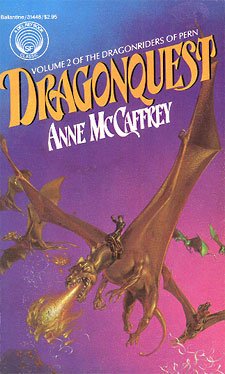
Dragonquest — Anne McCaffrey

Cover of Dragonquest


Dragonquest
Anne McCaffrey
303 pages
published in 1968

Rereading Dragonflight/Dragonquest I realised something: Anne McCaffrey’s influence on modern fantasy is highly underrated. The Dragonriders of Pern after all was a bestselling series long before a Robert Jordan, J. K. Rowling or Stephenie Meyer had even started writing, functioning as a gateway drug into fantasy and science fiction for a lot of young teenagers the way e.g. the Potter books do now. Yet she is rarely mentioned when we’re talking about the evolution of fantasy, with the potted histories of the genre usually starting with Tolkien, lightly touching on an Eddings or Brooks before getting to the fantasy boom of the nineties and beyond with Jordan, Goodkind, Rowling, Martin et all. Is it just because when the Pern books were first published fantasy was still science fiction’s poor cousin and they were therefore sold as sf?

Certainly the streamlining of genre history often has the side effect of erasing all the awkward, not quite fitting parts of it, in favour of a more teleological approach and too often these awkward fits are female pioneers like McCaffrey. More so than Tolkien she helped shape what modern epic fantasy looks like. The loner, young adult hero or heroine, in telepathic contact with his or her dragon, saviour of the world though looking extremely unlikely to be so at first, all taking place in a largely medivaloid world, that’s all McCaffrey. But there are differences with modern fantasy as well: her dragons were made by science, not magic.

What’s more, her world did not stay medievaloid for long. I didn’t remember it happening so soon, but already here, in the second book in the series, the Pernese start exploring their planet and heritage, rediscovering some of the technology and science their ancestors had to abandon because of Threadfall. This is also a common trope in epic fantasy, but McCaffrey goes further: her characters do not just rediscover, they also research and discover.

Unlike the first book in the series, Dragonquest from the start was written as a single novel, rather than a fixup of shorter stories, but is still somewhat episodic in nature. Most of the plot is driven by the conflict between the old timers, the dragon riders brought back by Lessa in the previous novel, who can’t get used to a more democratic minded Pern where dragon riders no longer get the automatic respect and deference they are used to.

If there’s one flaw McCaffrey had, it was inventing believable villains for her stories, with the more obnoxious old timers never quite convincing and almost completely ineffectual. She just never could really concieve of why anybody would want to harm her heroes…

McCaffrey’s writing is like a warm bath, comfortable and easy to slip into. She was never the greatest stylist in science fiction, but is still a cut above the workman like prose of e.g. an Asimov or Clarke. She’s the sort of writer you do want to read at twelve.

Faust Eric — Terry Pratchett

Cover of Eric


Faust Eric
Terry Pratchett
155 pages
published in 1990

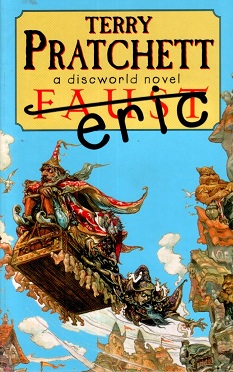
Eric is a bit of an odd duck in the Discworld, out of place amongst the increasing sophistication of the last couple of novels coming before it, almost a throwback to the very first few books. It’s a lot shorter, a lot less serious and a lot more written for comedic effect than its immediate predecessors were. All of which can be explained by the simple fact that it was first published as an illustrated book, written around a series of Josh Kirby illustrations, which was later adapted into standard Discworld paperback format, losing most of its charm in the process.

A word about Josh Kirby is needed at this place. Kirby was of course the cover artist for all the Discworld novels up until his death, Thief of Time being his last novel. His work was incredibly caricatural in nature, with very exaggerated figures and bright colours, not really to everybody’s tastes. Some might have found it a bit childish even, but I always liked it. To me his covers were Discworld, especially the early novels when it wasn’t all taken that seriously yet even by Pratchett himself. Therefore it made perfect sense to do an illustrated Discworld story with his drawings, just like his replacement as cover artist, Paul Kidby, would do with The Last Hero.

Without Kirby’s illustrations, what’s left is a slight but still fun story, a clever parody of the story of Faust. It all starts when a young wannabe demonologist, Eric, tries to summon a demon from the foulest regions of hell, but through one of those million to one chances that crop up nine times out of ten, he gets Rincewind. It’s unclear who’s more shocked to find this out, him or Rincewind. But certainly no one is more shocked than Rincewind when it turns out he is indeed bound by the summoning just as a real demon would’ve been…

So he has no choice but to try and grant Eric his three wishes: mastery foa ll the kingdoms of the Earth, to meet the most beautiful woman who ever lived and to live forever. In proper Discworld fashion, none of these three wishes turn out like you’d expect, but what remains unanswered is just where Rincewind is getting the power to even attempt them. It’s all a trick of course, with Rincewind and Eric no more than pawns in a power struggle in hell, as more traditional minded demon aristocrats attempt to overthrown their current overlord, who is slightly too impressed with modern human management theories.

Eric‘s portrayal of hell reminded me a lot of Terry Pratchett’s earlier collaboration with Neil Gaiman, Good Omens, particularly in how hell’s old fashioned evil doing is no match to modern, impersonal human invented evil. As a story it’s not up to the standard set by the preceding few Discworld novel, in feel it’s more in line with the earliest ones.

Guards! Guards! — Terry Pratchett

Cover of Guards! Guards!


Guards! Guards!
Terry Pratchett
317 pages
published in 1989

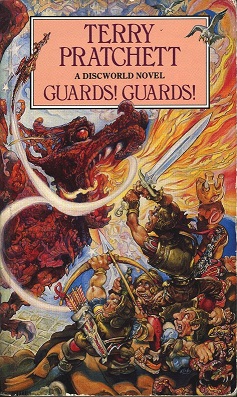
For me Guards! Guards! is the last novel you can describe as an early Discworld novel. From here on all the major subseries have appeared: Rincewind, Death, the Witches and now the Night Watch/Sam Vimes novels. It’s the first novel in which Ankh-Morpork becomes more than generic, somewhat over the top fantasy city, with the first extended cameo for the Patrician and the first insights in how he rules the city. Over time Ankh-Morpork and the Night Watch would come to dominate the Discworld series of course; every novel in the main series since The Fifth Elephant either set in Ankh-Morpolk or featuring the Watch or both, but of course we didn’t know that at the time. Back then it was just Pratchett taking the mickey out of yet another set of fantasy cliches.

In Guards! Guards!‘s case, he did that by importing another set of cliches, that of the hardboiled police procedural. Sam Vimes is a hero straight out of an Ian Rankin novel: the grizzled, older, cynical detective staying in the Night Watch because he has no other place to go. He remained in his post even as the watch has degenerated into a farce and he has become a captain of only three men: Fred Colon, a fat sergeant, Nobby Nobbs, a weassely corporal and a new dwarf recruit called Carrot Ironfoundersson.

Well, I say dwarf recruit, but turns out, to his own shock, that Carrot was adopted, which might be why he’s over six feet tall; somewhat on the big side for a dwarf. Culturally though, if not physically Carrot is dwarvish to the core: honest, loyal, law abiding and extremely literal. He’s actually naive enough to want to enforce the law, which awakes something in Vimes he thought was long dead.

Meanwhile there’s a conspiracy afoot. This is not new; conspiracies are always afoot in Ankh-Morpork, whether occult or otherwise, but this is a different kind of conspiracy. It’s a conspiracy of the petty, the spiteful, the narrow minded little people unsatisfied with their lot in life, jealous of others. Their plan is simple: summon a dragon to threaten the city, so that the true king of Ankh-Morpork may return and chase the patrician, Havelock Vetinari, from his throne.

The Night Watch is of course caught in the middle and are in fact the first to run into the dragon. Investigating its appearance Sam Vimes makes the acquaintance of Sybil Ramkin, dragon breeder and high nob. The meeting between the two is not so much love as mutual fascination at first sight. Vimes quickly realises what a powerful ally she is.

What’s interesting about Guards! Guards! is the number of strong characters in it. Not just Sam Vimes, but Sybil, the Patrician and corporal Carrot are all very strong in their own way. Carrot’s strenght is the simplest, a good humoured force of nature, while Vetinari and Vimes both are much more devious and cynical, with the former more willing to accept the consequences of his cynicism, while the latter has an inner core of decentness that is its own strength. Sybil finally has that jolly hockeystick strength of the old (English) aristocracy, that ability to keep a cool head in a crisis.

There’s more of Pratchett’s evolving humanitarianism on display here as well, which would become a persistent theme with the Vimes novels. It’s not so much here that Pratchett objects to autocratic rulers — Vetinari certainly isn’t a democrat — as that he objects to unthinking veneration and rulers who just want to rule with no thought to the country they rule. Vetinari is intensly concerned about Ankh-Morpork, while the shadowy master behind the conspiracy is willing to let it be destroyed if it means power. It’s something we saw in Wyrd Sisters as well.

It’s of course an inherently conservative worldview, though it has its attractions to more liberal minded people as well, that idea of the benevolent, enlightened despot. This is what, more so than the presences of trolls and dwarves and dragons that makes the Discworld a fantasy novel, this idea that this could work.