Pyramids — Terry Pratchett

A reader asks:

I’ve uh, never read any Pratchett before and have been wanting to tackle the Discworld novels for sometime but I’ve been intimidated by the reading order issue. It actually doesn’t help matters any that this is one of the most frequently asked questions, it all seems so confusing. Where to begin?
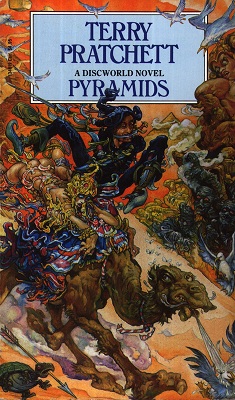
Cover of Pyramids


Pyramids
Terry Pratchett
380 pages
published in 1989

A good question. With a series that has almost forty novels, quite a few spinoff books and theatre, movie and television adaptations, the Discworld can look daunting to get into. Yet it’s not as bad as it looks. There are a couple of natural starting points: The Colour of Magic of course, but that’s not very representative for the rest of the series. A better starting point might be Guards! Guards! as that is the novel in which the whole Sam Vines/Night Watch/Ankh Morpork sub series was set up that has dominated the Discworld ever since. But of course since we’re discussing this question in a review of Pyramids, I’m going to make a case for it as the best starting point for getting into the Discworld.

the problem with the earliest Discworld books, especially the first two, is that they’re not as good as the later entries in the series, so they give you a wrong impression of it. Pyramids on the other hand is as good as any other Discworld book. What’s more it stands alone, you don’t need to have read any other book first, or after to get the whole story. Finally, more so than some, it’s drenched in Pratchett’s ideas about humanity, his philosophy so to speak. A good litmus test than for whether you’d approve of it or reject it.

The story starts with Teppic, heir to the ancient kingdom of Djelibeybi and student assassin in Ankh Morpork, that being the education suitable to the Discworld aristocracy. When he gets the news that his father the king has died, he returns to Djelibeybi to become the new king. But his time in Ankh-Morpork has changed him, modernised him and coming back he runs smack dab in the unchanging force of tradition you get in a ten-thousand year old kingdom, as personified in the head priest Dios. When this tradition meant sacrificing his father’s favourite handmaiden, Ptraci, at his funeral, Teppic revolts, to no avail..

Meanwhile one of his first deeds as king is to build a pyramid for his father, ten times as big as any pyramid ever seen in the country. But, while the pyramids can be seen flaring off time at night, the knowledge of why they do this or why it’s dangerous to build them too big has been lost. Soon the pyramid begins to warp time and space and the whole country revolves itself ninety degrees in spacetime, in the process making real everything the Djelibeybis believed in as the gods come to visit. And because the kingdom was the only thing that stood between Tsort and Ephebe, which would’ve otherwise be neighbours: its disappearance meant war… It’s up to Teppic and Ptraci to stop the war, sort out the kingdom and solve the riddle of the pyramids.

The theme that runs through Pyramids is that of sloppy, emotional individual people having to battle throuhg, in this case, hidebound tradition. The main villain of the story, Dios, genuinely cares about Djelibeybi as a kingdom, but not really about its people, whereas Teppic for the most part doesn’t care about the kingdom or his role in it until he meets Ptraci when it’s her personal plight that moves him. It’s the sort of thing Pratchett writes about a lot, of systemic unhumanity coming up against illogical, sloppy humanity and losing. It can be a bit smug at times, but here it’s done perfectly, also because Dios is not just a one dimensional villain and you can feel some sympathy for him.

All of which makes Pyramids the ideal discworld starting point: a good, standalone story that doesn’t rely on too much continuity and showcases all of Pratchett’s good sides.
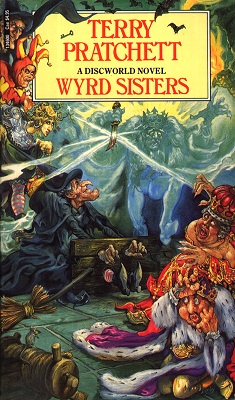
Wyrd Sisters — Terry Pratchett

The wind howled. Lightning stabbed at the earth erratically, like an inefficient assassin. Thunder rolled back and forth across the dark, rain-lashed hills.

The night was as black as the inside of a cat. It was the kind of night, you could believe, on which gods moved men as though they were pawns on the chessboard of fate. In the middle of this elemental storm a fire gleamed among the dripping furze bushes like the madness in a weasel’s eye. It illuminated three hunched figures. As the cauldron bubbled an eldritch voice shrieked: ‘When shall we three meet again?
There was a pause.
Finally another voice said, in for more ordinary tones: ‘Well, I can do next Tuesday’.

Cover of Wyrd Sisters


Wyrd Sisters
Terry Pratchett
331 pages
published in 1988

The opening paragraphs of Wyrd Sisters are a good indication of the rest of the book. This is MacBeth: Discworld style and the witches do not intend to stick to the script. That’s because Granny Weatherwax and Nanny Ogg are sensible witches and while the third member of the coven is a bit wet — as in, she actually believes in such things like covens — Magrat Garlick still has a steel core of good Lancrian common sense. They know better than to meddle in affairs (well, mostly) or dance with demons, never mind doing it skyclad. Yet when the king is murdered, his baby heir disappears and the usurper duke turns out not be just a bit evil, but actually uncaring about the land, they’re dragged into meddling against their own will.

This then is the first proper Witches novel, introducing Nanny Ogg and Margrat Garlick as well as a better worked out Granny Weatherwax than the one we’ve met in Equal Rites. As characters they conform to the old witches stereotype of the maiden (Magrat), the mother (Nanny Ogg) and the other one (’nuff said). Nanny Ogg in particular fills her role well, being earthy and salty and in good humour msot of the time, which you can usually tell by which couplet she has gotten to in the hedgehog song. Magrat on the other hand is the sort of witch who believes in crystals and such, while Granny Weatherwax is not just bossy compared to other people, she’s bossy compared to other witches… They’re some of Pratchett’s best creations.

They’re also representative of his philosophy. They’re stubborn, hardheaded, sometimes obnoxious, emotional, not very friendly, but when push comes to shove they’re on the right side. The duke meanwhile isn’t evil as much as he’s uncaring. He has killed the previous king because he wanted the power of being the ruler, not because he cared for the country he would rule. Whereas the previous king might’ve burned down houses and exercises his droit seigneur (a large dog), he did it in a personal way, rather than just because they were in the way. It’s the sort of evil we’ll encounter a lot more of in the Discworld series and had already seen in Sourcery.

Another Pratchett theme we’d see more is that of the power of speech and how it can change the world as it changes people’s perspectives, here worked out for the first time. The witches are traditionally feared but respected and much of that is due to how they represent themselves. People see the pointy hats and they think witches. So when they speak, people listen. But as the duke finds out, that authority can be challenged by a whisper campaign, by pointing out that these are just a bunch of foolish old women, that they are responsible for evil things, that they’re not very nice. In the end, the struggle between the duke and the witches comes down to who can offer the better narrative.

At this point in the series Pratchett has clearly found his stride and it shows. The writing sparkles, the plot’s tight and it’s all a bit better than earlier novels in the series.

Sourcery — Terry Pratchett

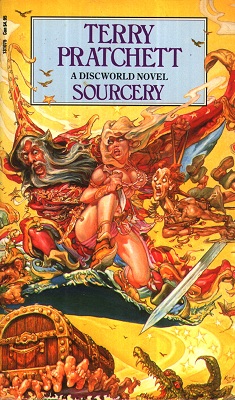
Cover of Sourcery


Sourcery
Terry Pratchett
285 pages
published in 1988

Sourcery is the fifth Discworld novel and the first one after the initial two novels to star Rincewind again. Over time fan opinion has switched to thinking the Rincewind novels are the weakest in the series, but I’ve always liked them myself and I think Sourcery holds up as well as any of the other early novels. It’s the first novel in which there’s a real villain, the first time we get to see what makes a real villain in Pratchett’s eyes.

On a surface level there are some similarities to Equal Rites: again there’s a powerful, untrained magic user coming to Ankh Morpork to shake up the Unseen University, but this time he’s not so benign. Coin is not the eight son of an eight son, but the eight son of a wizard. And when a wizard has an eight son, that son doesn’t become a wizard himself, but a sourcerer, a source of magic. The magic he yields is not the tame, nice magic which is the only kind of magic the Discworld has known for ians, but wild magic, the magic from the dawn of times. Not perhaps the kind of magic you’d want a ten year old boy to have, even if his dead father has possessed his wizard staff to give him counsel.

Needless to say, Rincewind finds himself in the middle of events, even though he does his best not to be. His survival instinct, like those of most of the lower lifeforms at the Unseen Univeristy is good enough that he manages to flee the university just before the sourcerer arrives, taking the Luggage as well as the Librarian to the Mended Drum. Unfortunately, that’s where Conina finds him. Conina, unwilling barbarian heroine due to her father, Cohen the Barbarian, but who’d rather be a hairdresser, has stolen the Archchancellor’s Hat at its own request, to keep it out of hands of the Sourcerer. Now Rincewind is the one wizard who can get it to safety.

If there is any safety to be found on the Disc. With the coming of sourcery, the wizards, who had been more or less peacefully been united in the Unseen University and its complex hierarchy, quickly rediscover the old wizard truth that the natural number of wizards is one. They start building towers and magic wars and the Apocralypse are threatening. And only Rincewind and Conina, as well as wannabe barbarian hero Nijgel the Destroyer, son of Harebut the Provision Merchant, stand against it. Oh dear…

What I’ve said before and will say again about Terry Pratchett is that the real strength in his writing is his humanitarian philosophy, his love of sloppy, sentimental, illogical, emotional humanity, that forms the heart of the Discworld series. His worldview infuses the entire series and it’s hear that for the first time it is made clear, though it would only be spelled out later: the worst evil in the world is seeing people not as people, but as things. Here it’s sourcery that shapes the world according to its whims in search of a supposed magic utopia, without taking any notice of the cost in human life or anybody else’s opinions. It doesn’t want to hurt people, it just doesn’t see them.

Opposed are Pratchett’s all too human heroes and villains, petty, dumb, squabbling, cowardly. They do the right thing because they can do no else, they may be thieves or murderers or worse, but they’re never indifferent. Sourcery is the first Discworld novel in which this basic contradiction is made clear and therefore important in the evolution of the series.

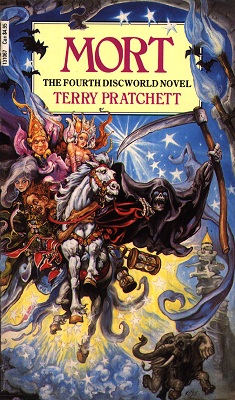
Mort — Terry Pratchett

Cover of Mort


Mort
Terry Pratchett
272 pages
published in 1987

If anybody can lay claim to being the first breakout star of the Discworld series, it has to be Death. Started off as a bog standard personification of an abstract concept, managed to work his way up through several cameos in the first three books to this, his first start turn in a novel. Four more would follow, though none in the past decade. He’s not quite his cuddly self here yet, still a bit on the evil side, not as human as in e.g. Hogfather.

Nevertheless Death is being humanised, or why else would he end up looking for an apprentice? Anthropomorphical personages don’t need successors, now do they? Yet still Death ends up on a dusty market square in a small village at the stroke of midnignt taking on a most unlikely apprentice: Mort. Mort is one of those boys who are all knees and legs, who think too much for what they’re doing. An apprentice with Death is literally his last opportunity, but as his father said, there may be opportunities for a good apprentice to eventually take over his master’s business, though Mort is not sure he wants to.

Somebody who is sure she doesn’t want him to is Ysabel, Death’s adopted sixteen year old daughter, who takes an immediate dislike to Mort from the moment he arrives in Death’s domain. Ysabel is eternally sixteen, somewhat on the plump side and spends most of her days reading the tragic lifestories of princesses. Not a good match for the relentlessly practical minded Mort.

Mort himself is more impressed by the princess he meets when on the duty with his master, when Death comes to claim the life of her father, the king of Sto Lat. Death tells him that she herself is due to die a couple of weeks later, as the result of an assassin hired by the same duke of Sto Helit who killed her father. Said duke is destined to unify Sto Lat and Sto Helit and be remembered as a great ruler. When Mort argues that’s not justice, Death says there’s not justice, there’s just us.

Needless to say, when Mort gets his first job alone as duty Death and one of the people he has to collect is the princess, things don’t go quite according to plan. He saves the princess’ life, but history isn’t stopped that easily. All around the princess people are behaving as if she died, while not too far from Sto Lat, the old history has taken hold, and is moving towards the city….

This sets up a great Pratchettian conflict between doing what is the right thing to do and what’s the human thing to do. The right thing to do would be to let the true history take hold and let the princess die; the human thing to do is to try and cheat destiny in some way. Mort choses the human side, Death has no choice but to be on the side of right.

This is quintessential Pratchett, the first time it has been put so clearly in the series, but not the last time. He’s always on the side of the sticky, complicated, illogical human side of things rather than necessarily the right side of history. It’s what gives heart to his novels.

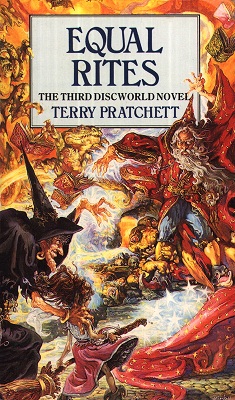
Equal Rites — Terry Pratchett

Cover of Equal Rites


Equal Rites
Terry Pratchett
283 pages
published in 1987

With the third novel in the series, Equal Rites, it became clear that the Discworld was more than just the sum of its characters. Gone were Rincewind, Twoflower and the Luggage, as an entire new setting and cast turned up. This wasn’t something that had been done much — or ever — in fantasy before, not often done after either. It must’ve seemed a bit of a gamble at the time, but this freedom to change protagonists and settings is what made the Discworld series, what has been keeping it from going stale for so long. If you don’t like one particular subseries, there are several others that you can read. Of course it also helps that Pratchett has been such a good writer for so long…

Equal Rites is the first Witches story, though the Granny Weatherwax that shows up here isn’t quite the one we get to know better in the later novels, differing somewhat even from how she’s portrayed in Wyrd Sisters three books onwards. The plot of the story is all about how if you’re a wizard on the verge of dying and looking for an eight son of an eight son to hand your staff over to, it helps to not be too hasty and check that eight son of an eight son isn’t actually a daughter…

Which it turns out to be and Eskarina “Esk” Smith duly turns out to have wizardly powers. Unfortunately, girls can’t be wizards and besides, in Bad Ass there’s nobody to teach her wizardry anyway. Instead, once her talents become too much to be ignored, she’s apprenticed to Granny Weatherwax to become a witch. Witchcraft is very different from wizardry though, much more headology and herb knowledge, less turning people into frogs or spewing flames from a staff.

It turns out to not be enough for Esk, she needs to learn proper magic and runs away to Ankh Morpork, followed by Granny Weatherwax. On the way she meets an apprentice wizard named Simon, one of the greatest magical talents the Unseen University has seen in eons. He’s very good in theoretical magic, where he can explain things so well that he can make his audiences become ignorant on a much more fundamental level than ordinary people. Simon, while brilliant and a decent bloke all around is unfortunately somewhat of a beacon for the things from the Dungeon Dimensions, always looking for a way into the Discworld, which is the dimensional equivalent to close to the shops and near the buses. Of course it’s up to Esk to save him, but she has her own problems as well, starting with the struggle to be actually taken seriously by the wizards of the Unseen University.

Equal Rites is beside the first witches book, also the first Discworld novel in which we get a closer look at non-Rincewind wizards, who don’t come out looking all that well. Chauvenistic, overtly proud, constantly scheming amongst each other to advance their careers (usually by making sure the wizard standing in their way is no longer doing so for reason of death), they’re still a while away from their later portrayals. Wizardry is also somewhat more dangerous than it would be later, with the wizardy death toll not insignificant here and in the next two books…

Though Pratchett is firmly on Esk’s side regarding her ambitions, he’s still fundamentally conservative here: the status quo of female witches and male wizards is quickly reinstated, Esk and Simon get their happy ending and exit stage left and nothing more is heard of female wizards for the rest of the series. There is somewhat of an separate but equal vibe to this whole wizards and witches setup, certainly in these early stages.

On the whole Equal Rites is a giant step forward in Pratchett’s evolution as a writer; it feels much more like a proper Discworld novel than the first two books did.