The Light Fantastic — Terry Pratchett

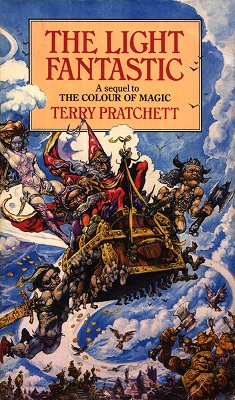
Cover of The Light Fantastic


The Light Fantastic
Terry Pratchett
285 pages
published in 1986

The Light Fantastic is of course the second Discworld novel and a direct sequel to The Colour of Magic starting in media res with Rincewind having fallen off the Disc. To his own amazement he does not actually fall to his death, but is saved by the Great Octavo Spell that had taken up residence in his head. It turns out that this hadn’t actually been an accident all those years ago that had gotten it in his head and all other magic spells afraid to stay near it, but had been in preparation for just this moment. The Discworld is heading towards a huge red star and unless the spell and its seven counterparts are said at exactly the right time, the world will be destroyed…

There’s three years between the publication of The Colour of Magic and The Light Fantastic and it’s noticable in Pratchett’s writing, which has improved a lot between the two novels. It’s also much less parody orientated, but still nowhere near the Discworld we’ve gotten to know and love. We do get a first glimmer of some of the subjects that Pratchett would engage more fully in later novels, including his humanitarianism. For the moment however, the Discworld is still much closer to a standard fantasy world than to what it would later become.

This might be a good point to say something about Pratchett’s humanitarianism. Though he does have a cynical side, in his heart he does seem to believe in the essential goodness and deceny of people. His villains mostly are people who have stopped thinking of other people as people: treating people like things is the original sin in Prachett’s worldview. Against it he puts the essential emotional sloppiness of his heroes, who with all their flaws are to a person willing to take a punt on the needs of the many if it means sacrifising the few. The first time this is really visible is still a few novels away, in Sourcery, but from The Light Fantastic onwards you can already see hints of this worldview coming to the fore.

In this novel, it’s the star people, the fanatics who start organising pogroms against wizards and other magical folk as the red star comes closer to the Discworld and magic starts to fail. These are the archetypical Pratchett villains, thought hey only play a bit part here: organised, systemic evil and firmly set against all the good things in life. Against that he sets the everyday moral failings of his heroes: Rincewind is a coward and the first to admit it, the Luggage is not very nice in general and let’s not even mention Cohen the Barbarian, whose job it is to slaughter pre-eminent religious authorities just because they have a habit of tying up temple maidens as sacrifice for their pet demons…

The Light Fantastic is a better novel than The Colour of Magic, but not yet a good novel. There’s promise, but it’s not being fullfilled yet.

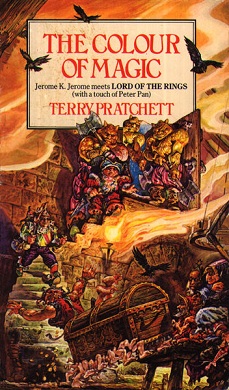
The Colour of Magic — Terry Pratchett

Cover of The Colour of Magic


The Colour of Magic
Terry Pratchett
285 pages
published in 1983

The days are getting shorter, the nights are longer and I got the desire to reread some old favourites. It’s the time of year for comfort reading, as you may notice in my reading patterns from year to year and this time I wanted to lose myself in something actually good, rather than going for something mindless. Which is why I decided to reread the Discworld series from the beginning, though I won’t guarantee I’ll finish the series.

Which brings me to The Colour of Magic, the very first Discworld novel. Over the years it has gotten somewhat of a bad reputation amongst Pratchett fans as not being up to the standards of the series, not being as funny or interesting, not a good place to start the series as a new reader. All of which has a kernel of truth, but at the same time it was the novel that kickstarted the whole series and if it really had no merit, it would’ve been the last book in the series. It is rough and ready, it doesn’t quite fit in with the Discworld as it would evolve over the course of the series, but it still has a certain charm.

Most of this charm of course is due to the Discworld itself, one of the great fantasy creations, an idea so brilliant and yet so obvious you wonder why nobody else thought it up earlier to use as a setting for a fantasy series. The idea of the world being shaped like a disc, rather than a ball and carried by four elephants who themselves stand on the back of a giant turtle, with the moon and sun small satellites of the Disc, is of course inspired by various mythologies about the shape of the earth; Pratchett himself had used the idea of a discworld in a more dark humoured science fiction novel, Strata. But it was only in The Colour of Magic that he put it all together.

What he uses this wonderful setting for is parody,as he moves through several cliched fantasy adventures through the course of the novel, through the travels of the Discworld’s first tourist and his reluctant tour guide. It’s somewhat of a picaresque novel, a series of loosely connected adventures with no real overarching plot. It’s also incomplete, as it ends on a cliffhanger.

It all starts with the arrival of that first tourist, Twoflower in Ankh-Morpork, where luckily for him, he meets up with failed wizard Rincewind, a man who has honed his survival instincts to a fine edge, to the point that he’s already running away when most people would still ask why. As Twoflower takes a liking to him and once the Patrician of Ankh-Morpork explains he’s a citizen of the Agatean Empire, the richest, most powerful and secretive empire on the Discworld, it is in his best interests to steer Twoflower away from danger, Rincewind becomes his guide. Which is sorely needed as Twoflower himselfs believes the best of everything, is convinced that his status as tourist will shield him from all dangers and in general is blind to any danger.

Which is how he ends up selling innsewerants to a landlord for about twenty times the value of his pub, setting into motion a conflageration that consumes the whole city, leaving him and Rincewind to flee for their lives. From there on their travels take them on a tour of the whole Disc. It’s all in service of parody, as they meet up with heroes like Bravd the Hublander and the Weasel, Cohen the Barbarian and others vaguely reminiscent of other, more serious fantasy heroes..

What’s striking about these adventures is how crude it all is. Take Death for example, who is downright cruel is his appearances here, taking great pleasure in spoking Rincewind and actually taking the lives of various animals directly, not at all the mellow Death we learn to know and love only a few novels later. It doesn’t really feel like the real Discworld, with several elements contradicted by later novels (as shorta kinda worked out in Thief of Time).

All in all this is a decent enough read, but reading it in hindsight it’s clear Pratchett is still learning how to make the Discworld work for him, isn’t quite there yet. Reading it on its own will give you the wrong idea of what the Discworld series is really like.

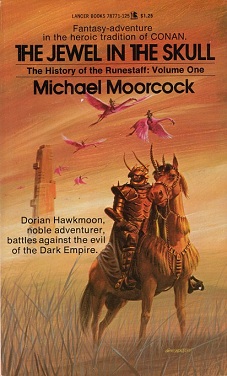
The Jewel in the Skull — Michael Moorcock

Cover of The Jewel in the Skull


The Jewel in the Skull
Michael Moorcock
175 pages
published in 1967

The Jewel in the Skull is another of Michael Moorcock’s seemingly endless number of fantasy series, the first in the History of the Runestaff quartet. It’s also part of Moorcock’s overarching Eternal Champion mythos, with the hero, Dorian Hawkmoon, being yet another reincarnation of the Eternal Champion. Not that this is important in this book, which can easily be read as a standalone adventure. A such it fair zips along, having been published at the tail end of the era when fantasy and science fiction books were considered long if they managed 150 pages.

It’s also a very blokey book. There are only two female characters of note in it, one of which in the role of the hero’s reward, the other a damsel in distress for the hero to rescue. If you don’t notice or can live with that, the Jewel in the Skull is a clever, fun adventure story. It’s set in a far future Europe, some thousands of years after the Tragic Millennium ended our own civilisation. Much of Europe now is under occupation By Granbretan, a tyrranical empire ruled by an immortal corrupt emperor, a tightly controlled, cruel and strictly hierarchical society. Dorian Hawkmoon, the duke of Köln was the last hero to resist their advance, rising up in rebellion against them, and failed. Now he’s a prisoner in Londra, his fate to serve as entertainment for its rulers…

That’s not where it starts though. It starts with count Brass, the ruler of the Kamarg (what remains of the present day Camargue. He’s named Brass for the armour he wears. Once he was a fearsome warrior and adventurer; these days he’s only interested in keeping his own country free. He’s not interested in fighting against Granbretan as long as it leaves Kamarg in peace. But when he thwarts the designs of an Granbretan emissary, Baron Meliadus, he makes an enemy for life — and Baron Meliadus will use Hawkmoon to bring him down.

The Jewel in the Skull is perhaps one of the most straightforward of Moorcock’s fantay stories and as such one of his most accessible too. Even though the story at times borders on formulaic, Moorcock still brings his own touch to it, with the protagonist only making his first appearance some 44 pages into the story. Granbretan as well is fairly Moorcockian, the overtly ordered, insane and evil society still with a certain glamour, slightly reminiscent of the Melnibone of Elric.

In general, it’s been interesting to see how deftly Moorcock can sketch out a whole world with just a few details, suggest a backstory with just a few hints. There is quite a bit of exposition in the story, but it never palls and it’s done lightly, when needed, not just for the sake of “world building”.

In the end this is still only a minor Moorcock, nowhere near as complex or fullfilling as his true masterpieces, a competent story told by a still young writer. Interesting, but not essential.

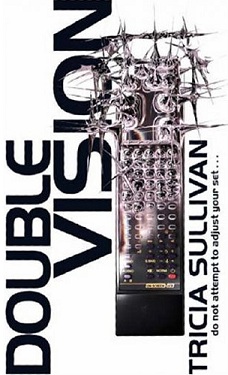
Double Vision — Tricia Sullivan

Cover of Double Vision


Double Vision
Tricia Sullivan
377 pages
published in 2005

Karen “Cookie” Orbach’s life seems fairly mundane when looked at from the ouside: she hasa job with the Foreign Markets Research Division at Dataplex Corp, does karate as a hobby and a weightloss exercise, has no boyfriend or partner but does has a cat, eats too much out of stress and for comfort, reads a lot of science fiction and fantasy. The thing is, Cookie is psychic and while she did offer her services to the police, who believes an overweight Black woman reading too much Anne McCaffrey? Luckily Dataplex did see her potential and engaged her as a Flier, somebody who can see what’s happening in the Grid, an alien world Cookie can see when she watches television, where see can monitor the progress of the military expedition there and work as a reconnaissance flier for Machine Front, which coordinates the offensive.

Cookie’s mundane even boring life stands in shrill contrast to the dangerous glamour of the Grid. Despite being only a passive observer there, it is much more real to her, much more interesting. It matters, while her routine life outside of it doesn’t. It’s a feeling that any science fiction or fantasy fan can recognise, that idea that whatever fantasy world floats your boat is more important than what happens in real life, but for Cookie that fantasy world is real — or is it?

As a science fiction reader you’re obviously biased towards the strange, the potential hallucination to be real, even if there’s a long tradition to use this against the reader. In Double Vision you start off with the default assumption that what Cookie experiences is real, only for Sullivan to sow doubt in your mind as certain inconsistencies become clearer. For example, if the scouting she does in the Grid is so important, why is it that her boss is only interested in which brands she heard mentioned by the soldiers? What is she really used for?

In real life Cookie is not a standard science fiction hero either –being Black and female for starters– as she’s self effacing, content to go along to get along, struggling with her weight, meek but with outbursts of anger. She comes in her own in the end, gets stronger, both physically through her weight training and karate classes and mentally through her experiences in the grid, but it doesn’t gain her much. At the end of Double Vision she’s in prison for having assaulted her sensei in a fit of anger of his coverup of the sexual assault on her friend.

Said sexual assault is the weakest and most problematic part of the book, as it hinges around certain racist cliches about Asian men and their lust for white women. It takes place in the context of a visit by the Okinawan masters of the karate organisation Cookie’s dojo belongs too, who are feted by the dojo’s owner and his students, when one student remains behind to learn more about the history of karate, or that’s what she thinks in her innocence: she’s blonde and tall, he’s short and dark and speaks broken English. It’s blatant enough that even I noticed it, which doesn’t always happen with racial or sexist imagery.

Fortunately, Tricia Sullivan is a writer honest enough to to recognise these racist undertones in hindsight and decent enough not to be happy with this:

I was working out my personal issues with karate on the page. I had been with a group of Americans travelling to Okinawa to train, and while we were there I learned a little about the American presence on the island. It was only years later that I began to hear of the abusive behaviour of US soldiers toward the Okinawans—especially the women. But I didn’t think this through when I was writing. I’m ashamed of the fact that when I flipped the roles around in Double Vision and made the Okinawan masters visitors to the US (which I did for storytelling convenience) I completely failed to see the ways in which I was reversing the more typical scenario of US male sexual assault upon Okinawan females. I couldn’t see it at the time. I was too busy trying to deal with the way it felt to write about what had happened—the karate side of things more than the sexual side, to be honest—and so I didn’t look at the material properly.

This is exactly the sort of honest examination of your own privileges and innate biases that you should engage in when called upon them, yet we rarely see. I can only wish I would be so honest and fair in similar circumstances.

Though this is a blemish on the novel as a whole, I think it’s still a worthwhile book to recommend. I can’t really speak to the validity of Sullivan’s portrayal of Cookie and how fair it is, being neither Black nor a woman, but certain parts ring true. What it feels to be a large person, a fat person, how food, especially bad food, junk food, plays a role in your life as a substitute, a placebo for everything you can’t get because of your size, knowing full well that it doesn’t help. What Sullivan also hits just right is that feeling of just living your life waiting for something important to happen to you, living vicariously through science fiction.

Furthermore, Double Vision is a quietly feminist science fiction novel. Where in real life Cookie daily experiences some sexist jab or other, in the Grid there are no men, only women, as the men fucked up, leaving it up to them to clean up their mess. Everything in the story revolves around Cookie’s relationships with other women. Of the men in the story, only two are sympathetic towards Cookie, with only one having a real friendship with her; the majority are disinterested bystanders or active harassers. As with Nicola Griffith’s novels, this is done so naturally that you don’t notice how different this is from your usual science fiction story until you actually pay attention to it.

In short, Double Vision is flawed in some aspects, as Tricia Sullivan has acknowledged, but it has its heart in the right place and ultimately overcomes its flaws. Recommended.
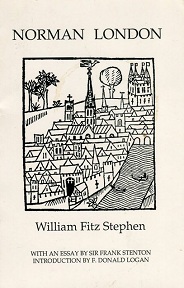
Norman London — William Fitz Stephen

Cover of Norman London


Norman London
William Fitz Stephen
109 pages including index
published in 1990

Now here’s an interesting little booklet. The meat of it consists on a treatise on Norman London, originally written by one William Fitz Stephen for his Life of Thomas Beckett, sometime before 1183. It’s therefore as close an eyewitness account of Norman London as we could ever get. Though interesting, this in itself is not enough to make a book of course. It is therefore partnered by another, more modern essay on the city, written in 1934 by Frank M. Stenton, a renowned historian of Anglo-Saxon England. These two pieces combined from the basis for what’s perhaps the most useful feature of the book, the maps of Norman London at the back of it.

There’s not really much more to say about Norman London. It’s an informative little booklet, but nothing more than that. What’s more, as the Stenton essay is more than seventy years old, it can’t help but be outdated, as new insights, more archaeological research and new theories will have altered our views of the period. I don’t think this would give a good picture of what we thought the Norman city looked like anymore. But this doesn’t make it worthless, if only because it still includes that eyewitness account of London, one of the few if not the only one we have of London at that particular point in time. The Stenton essay on the other hand is more of interest now for its own inherent historical value than for its accuracy.

Fitz Stephen’s depiction of London is that of the civic booster, the Londoner proud of his city, painting a rosy picture of the daily life of its inhabitants. It’s written with a naive enthusiasm, which is tempered by Stenton’s much more business-like summing up of what the city of London was like around 1100. His picture is based on not just Fitz Stephen’s account of course, but other sources as well, combined with archaeological research. So yeah, I bought this for a couple of euro on a book fair and read it in about an hour. An interesting curiosity, great to get a quick picture of Norman London, if not perhaps the most up to date picture.