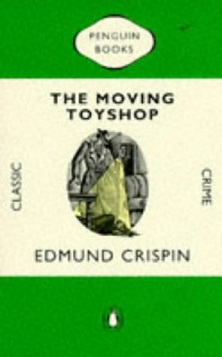
The Moving Toyshop — Edmund Crispin

Cover of The Moving Toyshop


The Moving Toyshop
Edmund Crispin
205 pages
published in 1946

Edmund Crispin, the pseudonym of Robert Bruce Montgomery, who under his own name wrote music scores for amongst others, the Carry On series of movies — something I only learned when I looked him up on Wikipedia just now — was yet another of those cult favourite English detective writer. Sometimes it seems there are hundreds of such writers published from the twenties to the sixties, intermittedly forgotten and rediscovered after their deaths. In Crispin’s case he’s on the upswing, his novels having been reissued in both American and British editions in recent years. This is less of an enterprise than with some detective writers, as he only wrote nine novels and two short story collections.

My copy of The Moving Toyshop isn’t a shiny new reissue though, but a green paperback Sandra bought years ago, when she first had discovered Crispin. She was always much more of a crime reader than I am, always keen to reread old favourites, of which this was one. You can easily tell as there was a cigarette burn (and even some ash still) near the front of the book; this having been one of the books she reread a lot in hospital. I can just picture her sitting in her wheelchair, cup of crappy tea or coffee nearby, out in the hospital garden smoking a fag, reading this book and perhaps dozing off and dropping her ciggie in it….

So when I came across this book and the traces of her presence I knew I had to read it and see why she liked it so much. That was easy. It doesn’t take long to figure out that perhaps Edmund Crispin didn’t quite take his novels as seriously as some crime writers. There were several places were I snorted out loud. Crispin had an eye both for the comic phrase and the comic scene.

The Moving Toyshop stars Oxford Professor of English Language and Literatur Gervase Fen as its detective hero. Fen is the archetypical eccentric Oxford don, driving his car, the Lily Christine III with reckless abandon through the streets of prewar Oxford, keener to involve his students in his criminal investigations than in lecturing them.

It starts out however with a poet friend of his, Richard Cadogan, who comes to Oxford for a short holiday. His train going no further than Didcot, he finds himself hitching a ride into Oxford, having to walk the last few miles. Which is how he finds himself in front of a toy shop, a toy shop whose door is open. Unable to resist and reminding himself he wanted some more adventure in his life, he walks in and stumbles over the corpse of a old woman, obviously strangled. Just as he starts to realise her murderer might still be around, he’s hit from behind and loses consciousness. When he gets round, he escapes the cupboard he finds himself, leaves the shop around the back and tells his story to the police. Imagine his surprise when on returning to the scene of the crime, there’s not only no longer a body, but no longer a toy shop either…

The solving of this mystery is done deftly, the plot moves with satisfying speed and the writing as said is witty. A very nice piece of entertainment indeed. I understand why Sandra liked it so much, it’s the kind of story that’s light and fluffy enough to read almost anywhere, while still being worth rereading.
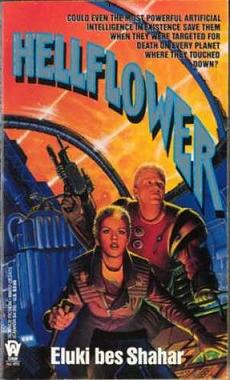
Hellflower — Eluki bes Shahar

Cover of Hellflower


Hellflower
Eluki bes Shahar
252 pages
published in 1991

Eluki bes Shahar is a science fiction and fantasy writer better known as Rosemary Edghill, the form of her name she now prefers. She’s been active since the late eighties, starting her career writing straight romance novels, then moving on to science fiction and fantasy, most recently in collaboration with Mercedes Lackey. I think it’s fair to say she’s only been middling succesfull as a writer, somebody largely forgotten as an science fiction writer. The question is, is she worth rediscovering?

At first glance Hellflower seems to be a bog standard space opera or adventure sf story. Hardbitten female independent trader/starship captain rescues a young nob from a mugging, due to his honour he’s now in her debt, the same honour leads him to be scheduled for execution, she rescues him again, they take off from the planet guns blazing, he turns out to be more than just a young, bored noble and she’s in over her head. What makes Hellflower different from the several dozen other space opera stories with the same plot is the atmosphere of elegiac foredooming it takes place in. This particular caper might have a happy ending after all, but sooner or later the odds will catch up with our protagonist.

Said protagonist is Butterflies-are-free Peace Sincere st-Cyr, who grew up on a low technology reservation planet and broke the embargo into a precarious life in the Phoenix Empire. Her only friend and confidant is Paladin, the last existing AI left in the empire, now installed in Butterfly’s ship, The Firecat. AIs are feared and loathed in the empire, with Paladin being a remnant from an earlier golden age. Together they’ve so far managed to survive in an increasingly hostile universe, but Paladin knows if Butterfly doesn’t, or pretends to, that it’s just a matter of time before something goes wrong.

And Butterfly’s impromptu rescue of Tigger Stardust, young teenager hellflower aristocrat with an overinflated sense of honour, first from a gang of thugs, then from police imprisonment, looks very much like the straw that’ll break the camel’s back, as they’re hunted from one world to another. It soon becomes apparent that the trouble Tigger found himself in was not entirely of his own making, but that he has made powerful enemies because of who he is.

Though a fairly standard sf plot, what makes Hellflower different is the melancholic atmosphere. There’s none of the romance of the usual science fiction smuggler/freetrader adventurer; Butterfly St Cyr is no Han Solo. She’s scrabbling for a living on the margins of galactic society and her odds for survival are low and getting lower. There’s a sense of realism there that you don’t see a lot in science fiction, that of knowing you’re winning if you can manage to keep your head above water.

What I also liked was the relationship between Butterfly and Tigger, who against all odds don’t become lovers or romantically engaged, something even rarer in genre fiction. Tigger admires and looks up to Butterfly, while she is equal measures annoyed and amused by him, but neither is attracted by the other.

Finally, what also sets Hellflower apart is the language, which has echoes of Delany and Zelazny in its richness.

Which all in all means that yes, if you like good, fun adventure science fiction, this is a good bet.

The British Character — Pont

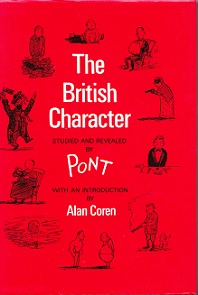
Cover of The British Character


The British Character
Pont
120 pages
published in 1938

It must’ve been a decade ago that Sandra found this book in a secondhand bookstore in Middelburg. She liked the cartoons, but since she had read it by the time I was done browsing, she didn’t think it worth buying. I disagreed and bought it for her as a present. She took it back to Plymouth with her, brought it back over when we started living together and today my eye fell on it when I was looking for something to read from among her books. It reminded me of how she liked several of the cartoons enough to make high quality copies of them, to hang on our walls. She recognised herself in them, some essential quirks of the British character she also possessed. Looking at these cartoons now I can’t help but seen Sandra in them.

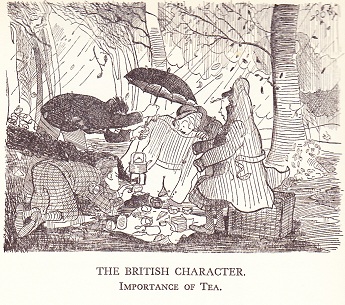
The importance of tea

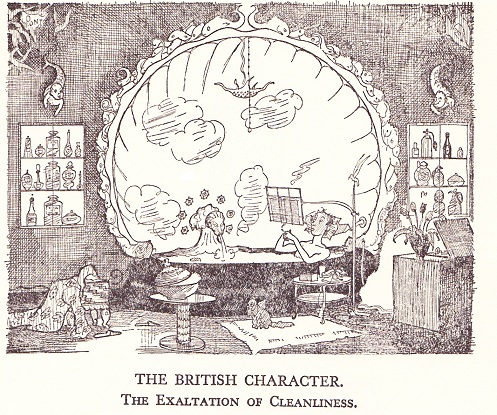
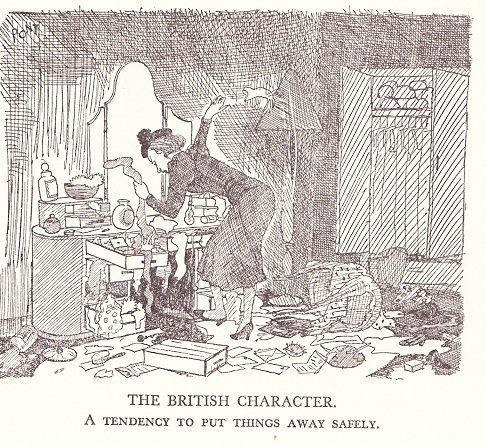
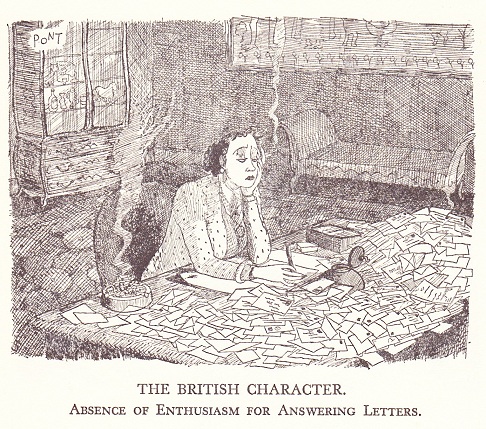
Pont is a pseudonym for Graham Laidler, a cartoonist who mainly worked for Punch, starting his “British Character” series there in 1936, with this collection first having been published two years later, and multiple times since. He himself had only a short time to enjoy his success, as he died in 1940 at age thirtytwo. He had been ill a long time, his sickness being the reason he turned to cartooning in the first place, rather than the architectorial drawing he had been trained for. Though his cartoons are very much of his time, they do touch on universal aspects of the British character.

The exhultation of cleanliness

But therein lies a paradox because, as Alan Coren indicates in his introduction to this edition, the people Pont depicts in his cartoons are stereotypes, hoary even at the time he first put them to paper. His character studies are largely limited to that of one class only, draw a caricature of the upper classes as existing in the English popular imagination, if not quite in reality. The people in them, in the midst of the great depression do not have jobs to worry about, or anything else really. Pont’s humour lies in gently mocking their pretensions, their idiosyncrasies and petty concerns. There is no anger or judgment in them.

A tendency to put things away safely

To be honest, many of the examples of this socalled British character are far more universal than that, familiar to culturally middle class people — like myself– all over the world. Yet, when looked at in total, there is a Britishness, a limited sort of Britishness perhaps, but a Britishness still, that speaks out of these cartoons. A very radio 4 sort of Britishness.

Absence of enthusiasm for answering letters

As you can see from the examples, they’re all done in pen ink, with a lot of fiddly dark lines and lots and lots of details, yet still with a certain looseness in the lines. The pictures all are a bit on the gloomy side, of course matching the stereotypical weather in the British isles. They’re quite lovely in their way. Almost every page in the book also has little side sketches, in a much looser style. So if you find a copy of this book, get it.

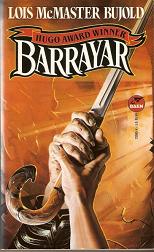
Barrayar — Lois Mc Master Bujold

Cover of Barrayar


Barrayar
Lois McMaster Bujold
386 pages
published in 1991

Barrayar was actually the first ever Bujold story I ever read and I hated it. That’s because it was the last part of its serialisation in Analog that I read and I had no idea of what was going. Coming back to it now, after having read all the Miles Vorkosigan books at least once, I enjoyed it much more. Like any prequel Barrayar depends for some of its impact on the reader’s knowledge of the main series. If you don’t know who Miles Vorkosigan is and why he is the incredibly determined little mutant runt that he is when we first met him in the Warrior’s Apprentice, the details of how he got to be that way won’t matter all that much.

Chronologically, Barrayar takes place almost immediately after Shards of Honor and is the second and so far last novel to star Cordelia Vorkosigan/Ransom. Cordelia and Aral are settling in to newly married live on Barrayar, with Cordelia pregnant with Miles. Then the old emperor dies and Aral becomes regent to his young grandson and he and Cordelia are soon plunged into the dangerous, still very medieval politics of the Barrayaran court and nobility. How dangerous Cordelia only realises when they’re the victims of an assasination attempt, with poison gas grenades thrown into their house.

They survive, but the antidote Cordelia has to take to counteract the poison gas has a very bad side effect, acting as a teratogenic agent on the fetus she is carrying, posing a real risk to its bone development. Normally there would be nothing for it but to abort the fetus or risk a stillbirth, but Cordelia is not the type of woman to just give up. On a more civilised planet, where medical science was more advanced, there would be chance for the baby, as it could be put into an uterine replicator and treated outside the womb. But Barrayar doesn’t have any of them, or does it?

There are after all still the uterine replicators which housed the children born of the rape of female prisoners of war taken in Barrayar’s last war, which had been forgotten about after they served their purposes. Cordelia manages to track them down, get Miles installed in one and get a bone strengthening programme going on. It takes all her strength but she gets her way and everything looks to be on the up and then the civil war breaks out.

And Miles is behind enemy lines, in the captial, trapped with the rebels. So Cordelia decides to go and get him to safety. Which is sort of where I came in the first time I read this, in the last third of the story. No wonder I was confused.

In retrospect, Barrayar is a turning point in the Vorkosigan series. The novels before it had been cleverly written, more intelligent than they need to be light science fiction adventure stories. With Barrayar the series took a leap in quality and became more serious and slightly darker, setting the tone for later entries like Mirror Dance and Memory.

Barrayar is also another reminder of how subtle Bujold can be in showing the effects of her science fictional technology. There isn’t any of the technogeekery or infodumping of some authors I could mention, but at the same time the plot is very much driven by a classic piece of science fiction kit, the artificial womb or uterine replicator. Here it is more of a macgufin of course, something for the protagonist to chase, but over the course of the series we slowly see the impact the introduction of uterine replicators has on Barrayaran society. And here is where it started.

Barrayar is not the best of the Vorkosigan series, but it is the best of the early part of the series. Don’t read it if you haven’t read the earlier published novels yet.

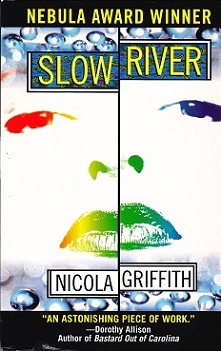
Slow River — Nicola Griffith

Cover of Slow River


Slow River
Nicola Griffith
343 pages
published in 1991

Everybody knows about the Bechdel test now, don’t they? Introduced in Dykes to Watch out For, it’s a test to see if a given story meets a minimum feminist standard: a) does it have at least two women, who b) talk to each other about c) something else than a man? It’s a good way to think differently about the movies you see or the books you read, to see how common it is for a story to have only male characters, or only a token female character, sometimes as prize for the hero. Having a story with only male characters is normal, having one with all or majority female characters is the outlier, can get you shoved into a women only ghetto like romance or feminist literature.

This is true in science fiction as well as mainstream literature, which made reading Nicola Griffith’s Slow River so interesting. It’s her second novel, also the second of her’s I’ve read and like the first, the cast is almost exlusively female. But where that one was set on a planet where men had died off due to some handwaved plague, this one takes place in near-future English city that for once isn’t London. I’m not sure whether Nicola Griffith made this choice of cast deliberately, or it just happened naturally because of the story she wanted to tell, but it works.

The story Griffiths wants to tell in Slow River is that of Lore, younger daughter of a wealthy Dutch family, who’ve made their fortune with building conservation and waste treatment plants. Lore has led a privileged and sheltered upbringing, up until the moment she’s kidnapped. That was three years ago, three years since Lore escaped from her kidnappers and found herself naked by the river that runs through the middle of the city and met the woman who called herself Spanner. Lore isn’t keen to go back to her family — why this is so is explained over the course of the story — and she moved in with Spanner, but now, three years after, she feels it’s time to stand on her own two feet and leave Spanner and her self destructive ways behind her.

Spanner you see is a small time criminal, somebody who steals information, can provide you with a trusthworthy fake identity and hacks reprogrammable slates in the best cyberpunk tradition, at the fringes of organised crime but a small fish in a big pound. She may have rescued Lore and Lore will always be grateful for that, but she herself isn’t a nice or particularly sane person and Lore could see that sooner or later it would catch up with her.

Lore herself is not quite healthy in her own skin either, otherwise she would’ve gone back to her family. But she neither wants to nor dares too, as too much has happened for her to go back. Instead she tries to build up a new life as a manual worker at a waste treatment plant in Hedon Road and gets involved with the day to day problems of being on the night shift of the conservation plant. The details of which, while the least dramatic, are also amongst the most interesting in the novel; Griffith has clearly done her homework and is good at dropping in convincing sounding details of the work.

The plant is also where we meet the third woman, Magyar in the “love” triangle between Lore, Spanner and Magyar. If it’s Spanner whose shadow Lore wants to get out under, than Magyar is who Lore wants to win the approval off. Tough, no-nonsense, she’s the shift leader at the waste treatment plant and almost from the start suspicious of Lore.

In between this main story, there are also the stories of Lore’s three years with Spanner, trading in the depence on her family to a sort of independence, as well as the story of her youth up until the kidnap. What I only noticed about a quarter of the way in is that these three interwoven stories are actually written in three different viewpoints. There’s the first person point of view for the present, tight second person focus for the years with Spanner, while the chapters focusing on her family are in a much looser second person focus. The difference is that in the first form of second person focus we’re still inside Lore’s head most of the time, with the text refering her as “she”, while the second form, we see her from the outside, as “Lore”. It is of course symbolic for her growing up, maturing, going from what others see her as, to what she sees herself as. A coming of age story that is not nearly as obvious as most such are in science fiction.

In other words, Slow River is quite strange for a science fiction novel: a largely female cast with the plot driven by their individual concerns rather than outside concern driven, which is quite sophistically written with three different viewpoint styles and where the science on display is ecological, environment enginering. It’s no wonder it won a Nebula. A great, satisfying novel by a writer who should be much more well known than she is.