We Who Are About To… — Joanna Russ

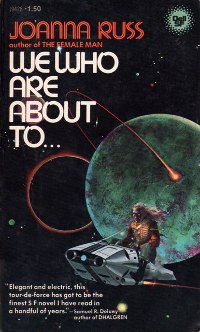
Cover of We Who Are About To...


We Who Are About To…
Joanna Russ
170 pages
published in 1975

We Who Are About To… is arguably Joanna Russ’ most famous and controversial novel after The Female Man. That novel became famous because of its outspoken feminism, still rare in science fiction at the time; if we’re honest, still somewhat rare today. We Who Are About To… comitted a greater sin however, by attacking the optimistic, can do attitude of classic science fiction, the belief that any adversity can be overcome by man’s unique fighting spirit. It’s not just that the protagonist doesn’t win in the end; even Asimov the arch-optimist had written “Founding Father” ten years earlier, a story in which four astronauts fight but fail to terraform a planet before it kills them. No, the real problem is that she rejects the choice out of hand and choses not to fight, not even to try.

That of course went against the grain, with plenty of science fiction fans being outraged about it, if I can believe the contemporary fan publications. But We Who Are About To… is about more than just rejecting science fiction’s traditional morality, it’s also a novel about how die. Slightly over half way through the story the central conflict of whether or not to fight has already been resolved, in favour of not to. The rest of the story is all about how you die. This part of the book has received less attention than the first half.

The plot is simple. A small, mixed group of interstellar travellers crashland on an unexplored planet barely liveable, far away from civilisation. Their hopes of being picked up are almost nil. They have shelter in form of the lifeboat that has set them down and enough supplies, water and tools for several months. They’ve no idea if there’s life on the planet and whether or not they can eat it, or it can eat them. The outlook is bleak, but they are all determined to make a go for it. All, but one, our protagonist, who is the only one to realise that rebuilding civilisation is not on the cards and wants nothing to do with it.

She argues as such, but is overruled. Civilisation is going to be restored, which means the women will need to start populating the world and make babies. Our hero obviously doesn’t agree with this and fight backs, eventually escaping the camp and moving away somewhere where she can die in peace. In the end she ends up killing everybody when they won’t leave her alone, then dies herself.

Russ does load the dice a bit. The narrator herself is an elderly, slightly embittered, cynical, “difficult” no-nonsense woman, not dissimilar to some of Russ’ heroines from The Female Man. We see events only from her point of view and she has little sympathy for any of her fellow passengers, who all come across as nasty stereotypes one way or another. The succesfull business man and woman and their bratty daughter, the strong but dim ex-football player, the smug, status aware but intellectually stagnant professor, the blonde floozy, the bitter young woman who hates everybody. Almost from the start they are all hostile against her, the men all determined to play pioneer, the women, apart from her, content to go along with this. The others are more than happy to force the narrator into going along with their agenda, tying her to a tree and raping her if need be. It’s not subtly done, which somewhat lessens the impact, but sometimes you need a sledgehammer to crack a walnut.

Once the narrator has escaped and killed her shipmates, not without some regrets, the story’s focus switches to how she deals with dying. She doesn’t commit suicide, just moves away from the lifeboat back to the cave where she hid before and stops eating. It takes time for her to die this way and she has long days to think about her life and to deal with any regrets she had about it, or about what she did to the other survivors. She hallucinates, but is never unaware that these are hallucinations, she gets weaker, slips away more and more and finally dies quietly: “well it’s time”.

This was the same way my wife died when she stopped treatment last year, well, without all the killing of course and how Russ described it was both familiar and emotional for me. She got the process right, the way in which it seems to drag out, then goes much more quickly than you expected, then suddenly the end is there. For me this was far more confrontational, far more powerful than the first half of the story.

I’m not sure in the end whether We Who Are About To… is actually a good novel, rather than a strident one. It was certainly a necessary one, a much needed kick in the pants to science fiction’s innate sense of human superiority.

The Empress Theodora — James Allan Evans

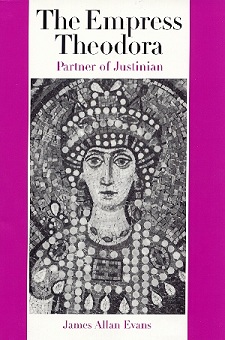
Cover of The Empress Theodora


The Empress Theodora
James Allan Evans
146 pages including index
published in 2002

Ken MacLeod once said that “history is the trade secret of science fiction”, but sometimes it’s abused and nowhere more so than in the cribbing from early Byzantine history that has been ongoing ever since Isaac Asimov first put in thinly disguised expys of emperor Justinian and general Belisarius in his Foundationtrilogy. Largely overlooked in these sort of appropriations is the empress Theodora, who as James Allan Evans shows in The Empress Theodora – Partner of Justinian was just as important as her husband in determining the course of the Byzantine empire.

There were quite a few strong woman emperors in Byzantine history, but most of them either ruled through their weak husbands, or as regents ruling in place of their still minor children. Theodora on the other hand ruled together with Justinian, a strong emperor himself. Their rule was a true partnership and it’s this relationship and Theodora’s role in it that Evans wants to examine here. At the same time The Empress Theodora is also a concise biography/history accessible to lay people like me.

The main problem with writing a biography of somebody who died in 548 CE is of course finding reliable sources. Archaeology won’t really help you much in pinning down the details of any given individual ruler’s life, though it can help with establishing the broad outlines of their reigns (e.g. through coins minted during their rule, or statues dedicated to their thriumps). Therefore the biographer needs to depend on the fortitious survival of primary sources dealing with their chosen subject. For Theodora luckily there are several such sources; contemporary histories, religious treatments and so on, but there’s one source that throws its shadow over the rest: the Secret History of Procopius.

Procopius was an official on the general staff (so to speak) of Belisarius and a gifted writer and historian. As such he wrote a history of Justinian’s wars, The History of the Wars in which he of course biggened up both the emperor and Belisarius, which is the most important reason why the latter is still so well known. As what you might call a court historian he was of course full of praise for the emperor and Theodora both, but in private his opinions were much less flattering. The Secret History is where all this saved up bile spewed out and Theodora does not come out looking well.

According to Procopius Theodora was born and raised in the theatre, a whore who used her sexual favours to become empress and kept using it to keep Justinian in her thrall and through him ruin the empire. Nonsense obviously, the rantings of a jealous man with the usual accusations against any woman who gains any sort of power in a patriarchal society like the Byzantine Empire, but not without a grain of truth, as Evans argues. That Theodora was of a humble background, even a theatrical background has been claimed in other sources as well, sources not as obviously hostile to her. Procopius therefore is likely to have been largely right about her background, just very slanted in how he presented it and biased in his interpretations, which has coloured later views of her.

James Allan Evans tries to look past the bias of Procopius and other sources to the real Theodora and the pictures he sketches of her is appealing. He argues that she was a true partner to Justinian as empress, also functioning as a sort of “loyal opposition” to him, the one person who could stand against him when necessary without fear of her life. This was especially important in the religious conflicts that dominated Justinian’s reign.

It’s hard to judge the importance of Christian dogma in the politics and daily life of the Byzantine Empire, but it’s fair to say these were more than academic debates. Once the Roman Empire had become an explicitely Christian one it was always going to become monoreligous, with only one kind of Christianity allowed. Which kind was decided by the ruling emperor and Justinian followed his immediate predecessor by supporting the Chalcedonian doctrine, against the Monophysites, who were now heretic. Theodora on the other hand was herself inclined towards Monophysitism and supported and protected them, to the point where she was later made a saint. Evans argues that she also functioned as a lightening rod, drawing dissenters towards her, with the end result being that Monophysite dissent could largely be channeled, rather than run wild. Theodora played the same roles in more down to earth political matters as well, as Evans e.g. shows how she influenced Justinian into putting more effort in his Italian campaigns to retake the old Western Empire.

At just under 120 pages, The Empress Theodora is more of a sketch than a full biography of course, but it’s a great way to start. Evans is a clear and careful writer, taking care to note the limits of his sources. Glad I took this out of the library.

Intrusion — Ken MacLeod

Cover of Intrusion


Intrusion
Ken MacLeod
387 pages
published in 2012

Over the past five years Ken Macleod has written a series of standalone novels that each in their own way have dealt with the post-9/11, post-War on Iraq 21st century and what it might evolve into. Intrusion is the latest in this series. Where MacLeod had always been a politically minded writer, his last few novels (The Execution Channel, The Night Sessions and The Restoration Game) were all directly rooted in current political realities, especially the socalled War on Terror. Intrusion continues this trend, but this time swapping the War on Terror with the nanny state.

And at first Intrusion feels like a novel from an alternate universe, one in which Labour didn’t lose the elections and had continued on its pre-9/11 social engineering course rather than by distracted by Blair’s foreign crusades. Britain’s nanny state has been turned up to eleven, driven by ubiquitous realtime surveillance and monitoring technology and increasingly finetuned social law. MacLeod has taken everything New Labour and the ConDem coalition have been guilty off in the past decade and a half regarding tackling socalled social problems: increasingly absurd health and safety laws, the liability adverse local bureaucracies, the enthusiasm to seek technofixes for ingrained social problems, the idea that you can force or nudge people into healthier lifestyles through banning or taxing their vices and extrapolated what it would look like a generation or so into the future. It’s a world in which most women wear monitor rings to make sure they’re not pregnant and if they are, are not smoking or drinking or going to places where toxins might be that could harm their unborn child, where ipso facto most women work at home as so many workplaces are not safe for their (potential) offspring due to e.g. trace remnants of cigarette smoke.

Such is the case for Hope Morrison, nee Abendorf, married with one child and one on its way, who for the most part accepts this as the way things are, neither bad nor good. What worries her far more is the Fix, a simple single dose pill that eradicates many common genetic defects and vulnerabilities. She doesn’t agree with it, hadn’t taken it for Nick, her first child nor does she wants to take it for this child. Worse however, she has decided against it not from any sort of religious dogma, but just because she’s uncomfortable with it. She had made this choice but doesn’t want to justify her choice to anybody, which is something the system has difficulties with. It is no wonder therefore that she’s increasingly pressured to either give in and take the Fix or to provide a proper, regulated reason for rejecting it.

Intrusion‘s plot is all about how Hope and her husband Hugh, a carpenter working with carbon fixing, self shaping New Tree wood, try and escape this pressure, trying to live their own lives within this system without either being grind up in it or compromise more than they have to. They’re not rebels set out to overthrow it, they’re just ordinary people who on one particular point want to make their own choice and want the freedom to make it without having to explain it in an approved, sanctified manner. But as an encounter with Hope’s local MP makes clear, when she tries to get him to help her, this is just what not only cannot be allowed to happen, but which the system as a whole is incapable of allowing: people cannot be free to make their own choices, as they might make the wrong choices:

“But it doesn’t feel very free,” Hope said, “having other people make your choices for you.”

“It feels a lot freer than making the wrong choices,” said Crow.

[And a few paragraphs later]

The government isn’t makeing choices for anyone. Like I said, it’s enabling people to make the choices they would make for themselves if they knew all the consequences of those choices.”

Which is something that could probably have been inserted in any Labiour manifesto of the past twenty years without raising too many eyebrows. On one level, as with the admonishment the MP bites off to Hope that if she’s that libertarian, why she doesn’t go and live in Russia, it’s incredibly funny; on another this image of the future is chilling as it’s so plausible, so clearly already starting to happen. The social free market ideology MacLeod has invented is something that could easily be reinvented by Labour (or perhaps the LibDems) for real.

If this isn’t chilling enough, Macleod doesn’t ignore the Labourite War on Terror and its security apparatus either. All through Intrusion there are hints that the powerful nudges the government can dish out often can turn into shoves, which is confirmed as one secondary character is picked up from the street, shoved in the back of a police van and chemically interrogated all without being arrested, but she is left with the number of a trauma helpline she could call. And all that because while she is Brazilian, she looks Indian and hence is suspicious in the climate of the Warm War, where the new Free World of America, Britain but also China and Iran confronts the new old villains of Russia and India as these refuse to confirm to post-Climate Change morals. This it seems is one of those things that are invisible to people who don’t fit a particular profile and ar therefore not hassled, but are common occurrences to those that do.

Intrusion is a bleak novel, a pessimistic novel, though not without a certain grim humour. It’s the most pessimistic I’ve seen MacLeod, even the sf macguffin driving much of the plot not offering much hope. It’s also a novel that calls back to his earliest novels, the Fall Revolution series and especially The Sky Road. You could read it as a dystopia, with the lazy comparisons being with 1984 or Brave New World, though it’s a much more realistic sort of dystopia than those two. In the end, unlike them, nobody is in charge but the system and the system has no consciousness, is unaware software rules and linked up databases driving surveillance and interference.

This is an awareness that slowly builds up through the novel, just as MacLeod only gradually reveals the world in which it is set and it makes a mockery of the grandiose speech one tertiary character gives to the woman who was assaulted by the police about how even the activists opposing the system actually serve it, how her assault was just a notification that it knew of her. It demands a consciousness of the system that it just doesn’t have.

Which is perhaps the most frightening idea in Intrusion.

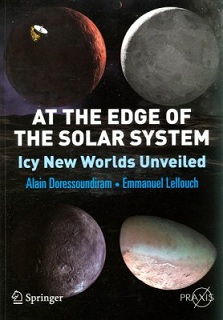
At the Edge of the Solar System — Doressoundiram & Lellouch

Cover of At the Edge of the Solar System


At the Edge of the Solar System
Alain Doressoundiram & Emmanuel Lellouch
205 pages including index
published in 2008

In 2006 the International Astronomical Union demoted Pluto, long the ninth and last planet in our Solar System from being a planet into a socalled dwarf planet, a new category not just meant for Pluto, but also a half dozen other planets that had been recently discovered at the edge of the Solar System. With the number of planets rapidly rising and estimates raging from a 200 to 2,000 more to be discovered as well as the general feeling that Pluto, only one fifth the mass of the Moon just did not fit in with the rest of the classical planets, this new categorisation was needed, halfway between true planets and asteroids or comets, now classified as small Solar System bodies.

Surprisingly for such a dry subject, the reclassification of Pluto led to a huge amount of media coverage and some controversy; many people, including myself, saw the argument as somewhat specious or had a sentimental attachment to the idea of the classical nine planets. They now were confronted with the reality of the Solar System being massively more complex than they had suspected, with our knowledge of the very edges of it having expanded massively since even the late seventies. Which is where At the Edge of the Solar System: Icy New Worlds Unveiled comes in: an introductionary text book about these discoveries and how they were made.

Though a relatively short book, the main text only being 178 pages long, it packs in a lot of material. It’s a good overview not just of what we know is in the trans-neptunian Solar System but also how we got to know this. Much of what oressoundiram and Lellouch talk about I knew at least a bit of already, but the way they have put it all together made me understand it better. It’s laid out as a text book, with frequent explanation boxes to go deeper into scientific concepts or astronomical techniques mentioned in the main text, without breaking up its flow.

The book starts with a very short history of how our ideas evolved from antiquity to the year that Pluto was discovered, 1930, focusing on how measured inaccurancies in the predicted orbit of each successive outer planet led to the discovery of Neptune, Uranus and ultimately Pluto. In the second chapter the focus lies on Pluto itself and what eighty years of observation taught us about it: not very much, due to the huge distance it’s from us. It was only in 1978 that somebody actually noticed that Pluto, which we thought had a mass greater than Mercury, was actually a double system with a moon almost as big as itself, Charon. As we slowly got to know more about both Neptune, especially its moon Triton and Pluto/Charon, the more something seemed off about calling Pluto a planet.

From there it’s a logical step to look back at how the Solar System might’ve started and what that may imply for trans-neptunian space, as well as where comets come from. Then it’s back to the outer rim and the Kuiper Belt, originally a theoretical concept for the origin of comets, a huge second asteroid/cometoid belt of icy worlds which Pluto is in the middle off. As more and more objects, comets, plutinos and other exotic worlds were being discovered, the belt moved more and more from theory into reality, the more so as more proper, Pluto like planets were being discovered in the nineties and early twentyfirst century.

In the fifth chapter the writers go deeper into those newly discovered worlds, what they look like (as far as we know) and what else we can tell about them from Earthbound observation. The sixth chapter meanwhile is all about the Pluto controversy. As the discoveries detailed in the previous chapters undermined Pluto’s uniqueness the need for a reclassification grew and ultimately ended as I described above. There is something to say for this, even if you can’t help but suspect part of the motive for it is to keep the number of proper planets down, as there indeed isn’t any good reason to keep Pluto one, but none of the other worlds, when some are barely smaller, some as big as and some even are maybe larger than Pluto itself.

Finally the book ends with a short chapter on the history of the outer Solar System as far as we know it and what we don’t quite have figured out yet about it, the biggest of which is why the Kuiper belt ends so abruptly. Is that just a question of more observation or could there be a true mechanism in the history of the early Solar System present that could explain this. The very last chapter then takes a quick look at the near future and the projects that are under development to give us a much better view of the outer Solar System and which might help us solve these problems.

I read At the Edge of the Solar System: Icy New Worlds Unveiled in just a few days, mainly while commuting to and from work. Reading any scientific book that way can be a recipe for disaster as you can’t get in the flow of it, but the way Doressoundiram and Lellouch have written it made it a breeze to get through, while still keeping a relatively large information density. If you’re interested in Pluto and the outer Solar System but not that familiar with it, this is a good introduction.

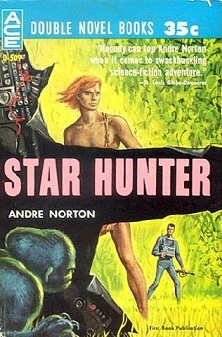
Star Hunter — Andre Norton

Cover of Star Hunter


Star Hunter
Andre Norton
96 pages
published in 1961

For a lot of American science fiction fans my age or older, Andre Norton was the first “real” sf writer they ever read, largely because she was hugely prolific and specialised in what we’d now call young adult novels. For some reason however she was never all that popular in the Netherlands so I’ve read little of her work so far. But that’s changing, thanks to Project Gutenberg, who have a fair few of her books available, those on which the original US copyrights had not been renewed. Star Hunter is one of them, originally published as an Ace Double. I read it during a couple of lunch breaks at work.

Ras Hume is a pilot for the Out-Hunters Guild who on a trip to the newly discovered planet of Jumala has made a discovery that could make him incredibly rich, but to exploit it he needs to make a deal with Wass, the biggest crime boss on Nahuatl. What he found was the lifeboat from the Largo Drift, a space ship which disappeared six years ago, taking with it the heir to the Kogan estate. He also has a plausible candidate to play the part of Rynch Brodie, the teenage heir. What he needs Wazz for is to condition this boy to actually believe he is this heir, then he will be let lose on Jumala for Hume to discover him when he brings over the safari party he’s scheduled to pilot there. It’s an almost foolproof plan, surely nothing can go wrong.

But there wouldn’t have been a story if something didn’t go wrong. The patsy Hume has chosen, Vye Lansor, an orphan plucked from the foulest bar in Nahuatl’s spaceport, was conditioned and dropped on Jumala, but the condition wasn’t good enough and he remembers flashes from his true life. Worse, while Jumala was deemed fit for human visiting and free of intelligent alien life, something has been woken up by the safari party and Hume and Lansor/Brodie find themselves as grudging allies against this alien menace as this attempts to herd them towards imprisonment in the hills of Jumala.

Since Andre Norton has only ninetysix pages in which to tell her story, it obviously has to be tight. Which means that while we do get a resolution to the central plot line, the mystery of the aliens and why they attacked the safari party is never followed through. Hume and Lansor bond, fight their way out of the alien traps and survive and that’s it. A bit unsatisfactory, but not the end of the world.

In the same way, there’s little room to develop the settings, Nahuatl and Jumala, very much. Both are solid pulp sf settings, feel more like small towns than whole planets, but are deftly sketched in by Norton with a few neatly chosen details, especially Jumala. There are the watercats for example, dangerous aquatic ambush predators lurking in creeks and rivers, and the scavengers that come out of the water to finish off their kills — or the watercat, if it’s unlucky. Clearly some thought has gone into setting up the planet, even if it’s only a stage for a pulp adventure.

As science fiction Star Hunter is of course incredibly dated, of the rockets and blasters school of adventure sf. The scheme that drives its plot, to substitute some lookalike for the heir of a vast estate, has long ago been made impossible by the development of cheap DNA testing, while most of the technology on display that isn’t part of the standard sf furniture doesn’t really look all that advanced either. But these are just quibbles. Taken on its own terms, this is a tight, fun, enjoyable little story. Ideal for reading in some stolen moments at work…