Rule 34 — Charlie Stross

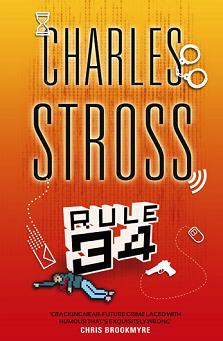
Cover of Rule 34


Rule 34
Charlie Stross
358 pages
published in 2011

It’s only thanks to Christopher Priest’s tirade about this year’s Clarke Award shortlist that you remember that you haven’t reviewed Charlie Stross latest novel, Rule 34 yet. You know that, like Halting State, which it is a sequel to, it’s written in the second person and you briefly toy with the idea to write your review the same way. But then you come to your senses and decide to write the rest of the review in a less irritating way.

Not that I minded the second person point of view in Rule 34, as Charlie Stross made it work and it fit the central metaphor of these books, reality as a massive multiplayer immersive game. At the same time I can see where Christopher Priest is coming from when he writes:

Stross writes like an internet puppy: energetically, egotistically, sometimes amusingly, sometimes affectingly, but always irritatingly, and goes on being energetic and egotistical and amusing for far too long. You wait nervously for the unattractive exhaustion which will lead to a piss-soaked carpet.

It’s funny because it’s true, if mean spirited. As a writer Charlie Stross does bring a kind of geeky enthusiasm to his novels that can be wearing if you don’t share his interests. Stross’ writing style is snarky rather than witty, more interested in conveying information than in a mellifluous turn of phrase and he can be prone to a bit of infodumping. As with using second person point of view, it is not to everybody’s tastes. And if that’s the case for you, as it seems to have been for Priest, it would be a slog to get through Rule 34.

Yet neither his writing style nor his choice of the second person viewpoint is a flaw in Rule 34; instead they’re deliberate choices made to enable Charlie Stross to tell the story he wanted to tell with this novel. Like its predecessor Halting State this novel is an attempt to create a plausible near future Scotland by looking at various contemporary trends and extrapolating them a couple of decades into the future. As fitting an “internet puppy”, most of these changes are technological, extensions of current computing trends a few years down the road, but Stross looks beyond what might technologically be possible and embeds these developments in a political and sociological context.

The central idea at the heart of Rule 34 is that of the panopticon singulary, the way in which technological developments, commercial pressures and the law come together to kill privacy. The second person viewpoint in which it is written drives this home, because it makes the reader complicit in the panopticon: the characters become the reader’s avatars, as if this is a videogame rather than a novel. At the same time, Stross’ writing style, detached & snarky distances you from the characters as well which again reinforces that sense of complicity, of voyeurism.

For the people caught in Rule 34‘s plot, Detective Inspector Liz Kavanaugh, banished to the Rule 34 Squad, the one dealing with all the pervy crimes, Anwar Hussein, a Scottish-Pakistani petty criminal turned honorary consul for a small, new Central-Asian state and “John Christie”, point man for The Organisation, having to negotiate their way through life with this sort of omnipresent surveillance is just part of their daily routines. So Liz spents her entire working life in CopSpace, through which she both has access to all data the Scottish police forces acquire and the system can keep taps on her. Hussein meanwhile is expected to keep his smartphone on and with him everyday so the polis can snitch on his location 24/7, while “Christie” has to take pains to avoid areas with too high a surveillance level, like airports.

Rule 34‘s story starts with Liz being called out to a crime scene, a suspicious death of an ex-criminal, who died while getting a colonic irrigation from an old Soviet machine that used to belong to Ceasescu… A true double wetsuit job, it at first just seems a regretable accident, but of course there’s more going on. Anwar Hussein meanwhile is beginning to wonder why exactly he has been made honorary consul for Issyk-Kulistan for. “John Christie” finally knows exactly what he’s in Edinburgh for, to recreate the Scottish branch of The Organisation. Each of these three protagonists thinks they’re at least somewhat in control of their own lifes, even if they’re now clearly been caught up into something bigger, but this turns out not to be the case.

Instead through the course of the novel it becomes clear that they are each being nudged in some way or another to perform certain actions, by somebody who knows how to do this for each of them individually and without their knowledge. Nudge theory is quite popular with the current British government, who see this as a cheap and easy way to get the hoi polloi to behave themselves and the more data you got on people the easier it becomes to find the right nudge. Current implementations are still primitive, in Rule 34 Stross imagines what it would be like if the people doing the nudging had perfect methods and all the data needed to use them, thanks to the panopticon. None of the protagonists ever quite catch up with the fact that they were being nudged or the overarching plot these nudges served, but the reader does get to know who is behind everything that happened and why.

As said Rule 34 sets out to create a plausible near future world which we could concievably get through from where we are now. Charlie Stross has done the most difficult job any sf writer can undertake, try and predict not just what new technology could do, but how it will be used and how the law, government and societies as a whole will handle it. As such then it is a worthy novel to be on the Clarke Awards shortlist.
Laurels Are Poison — Gladys Mitchell

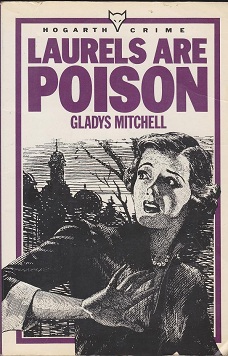
Cover of Laurels Are Poison


Laurels Are Poison
Gladys Mitchell
237 pages
published in 1942

Whereas my fiction reading mostly centers around science fiction and fantasy, Sandra was always more interested in other genres, especially that of the classical cozy detective story. Her alltime favourite was probably Margery Allingham, but Gladys Mitchell was a strong second. Now while Mitchell was as prolific as any of the big name writers, averaging one novel a year, she never was as popular as an Agatha Christie or Ngaoi Marsh and her books weren’t reprinted as often, which meant they’re much harder to find than those of her more famous counterparts. Which is why Sandra had only a small number of Gladys Mitchell novels, but she read and reread them at least once a year. Of that small number, I think Laurels Are Poison was the one she reread the most, certainly the one she had read the most recent before she died. Which is why I decided to read it as well.

Laurels Are Poison stars Mrs Bradley, Mitchell’s version of the noisy old biddy detective ala Miss Marple (Christie) or Miss Silver (Patricia Wentworth). Mrs Bradley has been hired as head warden of one of the houses of a women’s training college. That’s her cover, but she’s really here to investigate the disappearance of the previous year’s warden, Miss Murchan, who was last seen at the end of term dance and never came back. As soon as she arrives at the college, it’s clear somebody doesn’t want her to start her investigation, as amongst a flood of not very funny but innocent practical jokes some not so innocent traps are set for her…

From that description this may sound like a bog standard detective story and in some sense it is, but the mystery of Miss Murchan’s disappearance honestly isn’t the reason you keep reading. Instead it’s the setting and characters that make this book. Mrs Bradley is the usual, sensible, almost omniscient older woman detective, but for once she’s not a spinster, but instead a modern career woman, well known in her field and who has been married several times. Her physical appearance as described by Mitchell through the viewpoints of her other characters is not flattering, “the old crocodile” being the mildest.

Alongside Mrs Bradley, several other characters are followed: Deborah Cloud, the sub warden and three students Laura Menzies, Kitty Trevelyan, and Alice Boorman, the “three musketeers”, all four of which will wittingly or unwittingly help Mrs Bradley solve the mystery. Deborah Cloud, or “the Deb” as the students call her is mostly there as the innocent bystander there to ask the questions the readers might have, while the three musketeers, especially Laura, play a more active role in the resolution.

For long stretches of the book the mystery itself disappears to the background as we instead follow the daily lives of the three students and the sub-warden, all done in a jolly hockeysticks, slangy tone of voice which took me some time to get used to; some examples can be found at the Gladys Mitchell website. Overall the tone of the book is light, amusing, slightly tongue in cheek. What surprised me was the date of publication: 1942, which you wouldn’t have known from the story, with no mention of war whatsoever. Instead it reads as if it was written in the 1930ties.

On the whole I found the book a bit of a mess; entertaining but not very focused. I think I will read more Gladys Mitchell, if only because Sandra rated her so highly, but this wasn’t as good as I expected it to be.

Genius, Isolated — Dean Mullaney & Bruce Canwell

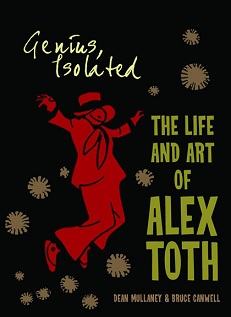
Cover of Genius, Isolated


Genius, Isolated: The Life and Art of Alex Toth
Dean Mullaney & Bruce Canwell
324 pages
published in 2011

If you’re not a hardcore comics nerd you’ve probably never heard of Alex Toth, one of the greatest cartooning geniuses American comics have ever seen. That’s because he never really had a comics series or character that he made his own, but instead had his art scattered over hundreds of seperate assignments for dozens of publishers, often wasted on formulaic, throwaway stories. His true genius lay in his approach to the art form, the way he stripped down cartooning to its essentials, never putting down one more line than was needed. Once you see his artwork you can understand why he’s so revered by his peers, a true “artists’ artist”, but first you needed to find his artwork, which has long been difficult to find other than by hunting through back issue bins.

This has changed in the last decade or so, fortunately, as the American comics field in general has become more aware and interested in its heritage, leading to a flood of high quality reprint projects as well as art books/biographies focusing on individual artists. Toth has had some attention paid to him before, but with Genius, Isolated: The Life and Art of Alex Toth, the first of a trilogy of books devoted to Toth’s life and career there finally is a book that does true justice to Toth’s genius.

It does so by being more than just a lavishly produced, gorgeous looking coffee table book and biography but also a showcase for Toth’s artwork. As many or more pages are devoted to reproducing Toth’s art, including a huge selection of complete stories as there are to talking about his art; there are only a few pages entirely devoid of his artwork. It’s this that makes Genius, Isolated such an important book, a demonstration of Toth’s artistic genius as well as an archive of stories that haven’t been seen since their first publication decades ago. Such showcases are important to establish an artist’s reputation, as they provide both a convenient sampler for people new to them, as well as a signal that yes, this artist is important enough to merit a fifty dollar art book.

There is a downside to publishing so many complete stories in this book, as I explained a few days ago at Wis[s]e Words, which is that you can’t help but notice how many of the stories Toth did his best work on were, to be honest, not nearly as well written as Toth illustrated them. If, like me, you tend to focus more on the story than the art when reading comics, it can be a handicap in appreciating Toth’s work.

Fortunately Toth’s art is strong enough to overcome this handicap; you can’t help but fall in love with it. What characterises it is his use of strong, angular lines to sketch his figures, the use of black shapes, silhouettes and shadow both to create mood and to compose his pages and panels, the economical way in which he conveys emotion with just a few lines and how he places his characters to guide your eye over the pages. Composition is the key word with Toth; at each level — panel, page, story — he excels in creating a holistic experience and make it look natural. Apart from that, his artwork at his best is drop dead gorgeous, the kind of art that leaves you staring at it open mouthed in sheer admiration.

The text that goes along with Toth’s artwork concentrates on the artist’s life and career, providing a decent biography, though not really much more than that. It’s good enough as it goes, but I would’ve liked to see more discussion of Toth’s art and how he created it. There is some of that, but not enough for my liking. Hopefully we’ll see more of that in the next two volumes in the series.

Keeping it Real — Justina Robson

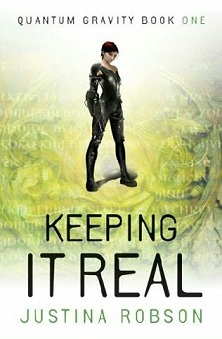
Cover of Keeping it Real


Keeping it Real
Justina Robson
279 pages
published in 2006

Justina Robson is one of those writers I’ve known about for years, but have never read anything by so far. One of the new breed of British science fiction writers who popped up around the turn of the millennium, her first couple of novels found critical acclaim, each being nominated for the Clarke or BSFA Award. Unfortunately popular success seemed to elude her however, until she started the Quantum Gravity series, of which Keeping it Real is the first novel.

It is also the first novel of hers I’ve read. A high concept description of it would be urban fantasy meets cyberpunk, a bit like the old Shadowrun role playing game but much less naff. Personally I’ve always thought cyberpunk was urban fantasy’s science fiction’s mirror counterpart anyway, so the combination seems logical. As Robson explains it in the prologue, an unknown “quantum catastrophe” in the Superconducting Superconductor in Texas in 2015 had torn reality into six realms: Earth, now called Otopia, Zoomenon, the realm of Elementals, Alfheim (elves country), Demonia, home of demons, Faery, home of fairies and finally Thanatopia, supposedly the realm of the dead though no human being has ever visited. The catastrophe was quickly dubbed the “Quantum Bomb” on Otopia, with the big question that keeps human philsophers and scientists awake at night being whether the Bomb really recreated reality or just made it visible to Otopia.

Such questions isn’t what keeps Lila Black (21) awake at night. Wounded, tortured and almost killed during a clandestine mission to Alfheim two years, she has been rebuild, better, stronger, faster but with added loss of humanity, as well as being cut off from her family, who thinks she died. Now she’s assigned to her first mission and for all her build-in weaponry and fusion powered systems, she’s less than confident in her own abilities. Especially because it involves playing bodyguard to an elf rock star called Zal, who has gotten death threats because elven don’t rock and if they do, loads of people, elven and humans both, don’t like it.

After her experiences in Alfheim Lila is understandably not too enamoured of elves, though she strives hard to hide her feelings, does her best not to be charmed by Zal’s charisma. There is the additional complication of being ensnared into an elven Game, a danger that’s always present when humans and elfs mix. And with the sexual tension between Zal and Lila soon thick enough to cut with a knife, it’s clear what a Game would be about if she entered it.

At first Keeping it Real‘s plot seems fairly predictable, until Robson gets it properly going, when we quickly learn that the reasons why Zal needs a bodyguard are a bit more complicated than just having recieved death threats. Instead he’s at the centre of an elaborate scheme dreamed up by some of the more conservative powers in Alfheim, who want nothing less than to sunder all access to the other five realms. Lila finds herself in the middle of all this, fighting to keep Zal and herself alive.

As a heroine, Lila Black is, depending on your perspective, cursed with awesomeness or blessed with suck. She has a fusion heart, lots of weaponry hidden in her body and titanium bones, but she feels she has lost her humanity. It’s not an unusual position for a heroine of a modern urban fantasy to find herself in of course, but Robson makes Lila’s internal turmoil and despair convincing, which is the greatest strength of Keeping it Real.

It is what makes me want to read the next book in the series.

Charlemagne — Rosamond McKitterick

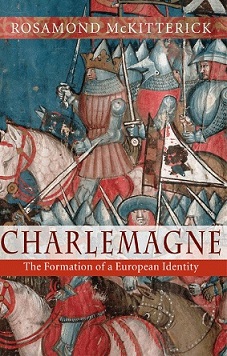
Cover of Charlemagne


Charlemagne: the Formation of a European Identity
Rosamond McKitterick
460 pages including index
published in 2008

I knew Rosamond McKitterick from the volume in the Short Oxford History of Europe series she edited, which is why I picked up Charlemagne: the Formation of a European Identity from the library. Charlemagne himself has only relatively recently picked my interest, mostly through having read Emperor of the West a few years back. Interest in Charlemagne in general has rather picked up in the past decade, as the search for a common pan-European identity has taken on obvious political significance, what with the EU and all.

Which is where this comes in, as Rosamond McKitterick attempts to get back to contemporary sources to re-evaluate Charlemagne and his reign, without the interpretations later historians have given them. Her goal is to in this way provide a new critical understanding of what these sources tell us about the development of the Carolingian empire, its political identity and how these changed during Charlemagne’s reign. It makes Charlemagne a heavily text orientated history, as McKitterick examines the narrative representations of Charlemagne produced during his lifetime and shortly after. To be honest, at times this made it heavy going, especially when I read most of it during the morning and afternoon commute.

Charlemagne is divided into five chapters. In the first McKitterick tackles the problem of how Charlemagne has been represented in late eight century and early ninth century sources, like the Annales regni francorum produced during his lifetime and revised shortly after, as well as purely posthumous sources like the Vita Karoli. The largest problem with these sources is of course the dating of them, which is far from easy; obviously it makes a difference if a source is truly contemporary or written several decades after his reign, with memories having become unreliable in the meantime and political useful interpretations of it having been developed…

The second chapter: Poppinids, Arnulfings and Agilolfings: the creation of a dynasty, is the closest this book comes to a narrative history as McKitterick gives a short overview of the rise of the Carolingian dynasty and Charlemagne’s own rise to the throne, first as ruler together with his brother Carloman, then on his own. The assumption underlying much of Carolingian history is that Charlemagne had fallen out with his brother at some point, but as McKitterick shows, this is actually not easy to prove using contemporary sources. From there on, she moves on to Charlemagne’s own succession as well as the growth of the empire during his lifetime.

The third chapter introduces another important aspect of Carolingian history where the orthodox interpretation might not quite be in synch with what can actually be deducted from the historical documents available: the royal court. She first looks at the representations of the court in various types of texts, then at what we might be able to conclude from these, in the context of whether the image of Charlemagne’s court as an itinerant one, travelling with the king between palaces, is actually correct. She also looks at Charlemagne’s own travels, the political and diplomatic space in which he operated and on a more meta level, at the survival and redaction of royal charters and what information these can give us.

The fourth chapter builds on this, examing the king’s own communications both within and outside the empire and what they reveal about the Carolingan political identity and programme, if there was such a thing. This and chapter five, looking at the religious aspects and ideology of Charlemagne, were the hardest chapters to finish, as McKitterick’s analys of the primary documents on these subjects is somewhat less than gripping, to be honest.

On the whole Charlemagne wasn’t quite the history book I was looking for, but it is obviously a valuable contribution to Carolingan studies.