The Better Part of Valor — Tanya Huff

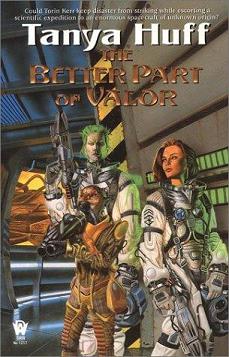
Cover of The Better Part of Valor


The Better Part of Valor
Tanya Huff
411 pages
published in 2002

Once I had finished Valor’s Choice, I knew I was going to have to go back to the bookstore I’d found it in and get the other two Tanya Huff books I’d saw there too. To be honest, I hadn’t even taken me as long as finishing the first two chapters to decide this. I’m always on the lookout for good, intelligent military science fiction and Valor’s Choice was just that, which meant I had to get the sequels too. What I especially liked was the absence of the sort of nasty rightwing politics souring me on so many other mil-sf writers.

The Better Part of Valor starts with staff sergeant Torin Kerr just back from her mission in Valor’s Choice. Having had words with general Morris, who was responsible for said mission, she is immediately sent out on another one by him, without her own platoon even. Whether this is punishment or reward she isn’t sure, but it turns out she will join a new marine platoon put together from scratch to protect a scientific expedition to an “unidentified alien vessel drifting dead in space”. She hopes it will be an uneventful recon mission, but after the last one she was sent on by general Morris, she isn’t hopeful.

And since we wouldn’t have a story if her pessimism was unjustified, she turns to be right. The reason why her new platoon was put together from individual specialists was to help avoid the media, but they turn up at the shipwreck anyway, the first of things that go wrong. Then, when Kerr, her platoon and the scientific specialists and journalists actually enter the alien ship, things go worse as an attempt to drill through part of a wall leads to an explosion, the loss of the airlock and attached shuttle, with the surviving members of the expedition having to find another way off the ship. The ship in the meanwhile isn’t as dead as it first seemed and starts to throw “tests” at Kerr and her people and turns out to be capable of influencing events outside itself as well, as it takes over the expedition’s own ship. Then, to top it all off, the enemy shows up, racing towards the same airlock Kerr and her people need to reach…

In the Valor series universe humans are one of three races that perform military services for the Confederacy, a loose gathering of intelligent species who never needed any military support until they ran into the Others, the first species that listen to reason but wanted to conquer the entire Confederacy. Which were humans and the two other “primitive” races, the Taykan and Krai, came in, offered membership in return for their military services. The way Huff writes these aliens there’s little difference between them and the human marines, all are more marine than alien. There are just a few stock traits each has: the Taykan are perpetually horny and their pheremones can inflame human passions too, while the Krai are true omnivores always talking about how good their teammates might taste, who are as flexible with their feet as with their arms, sometimes to the disgust of their team mates.

The news crew that shows up is more alien, being Katrien, small, furry, very cute, somewhat on the obnoxious side, either a racial trait or just a consequence of being a reporter. Unfortunately, Katrien being the Dutch name of Daisy Duck, I kept imagine them as just that, as aliens in pantless sailor outfits…

The plot reminded me of the those old Spacequest/Spacehulk boardgames, where you have to get a load of spacemarines out of a similar situation while coming up against various alien menaces. It’s not a novel story by any measure, but well told, even if it could’ve been a bit more claustrophobic for my liking. On the whole Tanya Huff turned out to be a writer who is very good at making you want to read on and on; I finished this in less than a day again.
Seventeenth-century Burma and the Dutch East India Company — Wil O. Dijk

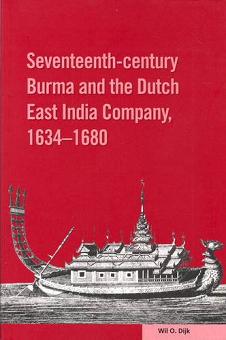
Cover of Seventeenth-century Burma and the Dutch East India Company


Seventeenth-century Burma and the Dutch East India Company 1634-1680
Wil O. Dijk
348 pages including index
published in 2006

I got this book out of the library soley on the strength of the author’s own story. Wil O. Dijk was born in Kobe, Japan in 1934, the daughter of a Dutch businessman and a Montenegrin-Burmese (!) mother. As a child she lived in Japan and Burma, with her brother got sent to Singapore when war broke out in 1941, became a prisoner of the Japanese there, like so many other children, while her mother fled to India and her father joined the British 14th army. They all survived war and after being reunited with their parents she and her brother spent some years at boarding school in Holland, before they returned east to Karachi when the Korean War broke out. There she stayed, met her husband, a Dutch foreign service employee, travelled with him from posting to posting all over the world, raising three daughters in the process, then came to stay in Holland permanently in the 1980ties. Wanting to reconnect with her Asian roots, she enrolled as a mature student at Leiden first to study Japanology, then to specialise in Burmese history, the end result of which is this book, written when she was well in her seventies!

Even without the author’s lifestory I would’ve gotten this book though. The focus in Dutch colonial history has understandably always been with Indonesia as well as with the colonies in the Americas, Surinam and the Dutch West Indies, as these were the most enduring, important and longest lived Dutch colonial ventures. With some exceptions (Nieuw Amsterdam obviously, South Africa), the rest of Dutch colonial history is mainly a concern for specialists. Which as Wil O. Dijk makes clear in her introduction, goes double for Dutch involvement with Burma, largely neglected even by specialists, yet no less important and interesting for it.

It’s not for lack of sources that this subject has been neglected for so long: the Dutch East India Company’s (VOC) archives are largely complete and extensive, recognised as long ago as 1939 by D. G. E. Hall of being a rich source of informaetion of the VOC’s trade with Burma. It’s this data that forms the basis for this book, painstakingly gathered by Wil O. Dijk for her dissertation. This is the sort of tedious, labour intensive research that’s sometimes dismissed as beancounting by more trendy historians, but which is essential as a foundation for further research. It does perhaps make Seventeenth-century Burma and the Dutch East India Company 1634-1680 somewhat dry at times therefore, but that can’t be helped.

The Dutch East India Company had been founded in 1602 as a monopoly for the Dutch trade with Asia. Its mission was to exploit the trade potential there to establish itself in the lucerative spices trade with Europe and to muscle out the enemy, Spain and Portugal. In this early stage it was not yet the colonising power it would become in later centuries, depending more on intra-Asian trade to finance the spice trade, which is where Burma came in. Burma was both a place where the VOC could sell (e.g. clothes and textiles from India) and buy (gold, long peppers, tin, rice, various kinds of wood) and make a profit at both ends. What’s more, getting into the Burmese trade would also win one over the Portuguese, who had been in the Gulf of Bengal for decades. In fact, one Portuguese adventurer had carved out its own kingdom in Burma, but came to a sharp end and was impaled, once this kingdom was reconquered by the Burmese.

The Burmese trade promised rich rewards to the VOC, but trade was never straightforward. The kingdom of Pegu, as the VOC knew it, was ruled by strong kings who kept trade restricted and who at all times were concerned about the stability of their own power, determined not to undermine e.g. the royal monopoly on rubies. They kept prices for import goods artificially low, prices for export products high, quantities of many goods restricted and on the whole the VOC was very much dependent on the sometimes arbitary decisions of the Burmese king.

Which is why it was hesitant at first to get into Burma, despite its rich potential, as it could not be certain of steady, year on profits. After the first few hesitant years though this worry was no longer a concern and while the trade did decline somewhat in later years, it wasn’t this that got the VOC to withdraw in 1680, but more the increased competition of other European (and other) trading companies and more importantly, its own internal restructuring. In the later part of the seventeenth century the VOC more and more focused on the direct trade with Europe, rather than the intra-Asian trade, starting to become a true colonial power with imperial holdings in Indonesia and the Spice Islands. While the Burma trade was very profitable, it no longer fitted its strategy, so it was abandoned. Some halfhearted attempts would be made a few decades later to reopen it, but this came to nothing.

When I normally think about the VOC and Dutch exploration in Asia, the picture I get is one of imperialism and colonalisation, with the native civilisations as the inferior, exploited party. But what Seventeenth-century Burma and the Dutch East India Company 1634-1680 shows is a situation in which the Burmese, far from inferior, are actually the superior power, with the VOC as just one of many trading parties, neither particularly welcome, nor particularly feared, quickly replaced by others once it upped sticks. The Burma trade for a few decades was very important to the VOC, but the VOC was never all that important to Burmese trading…

So all in all, Seventeenth-century Burma and the Dutch East India Company 1634-1680 does well both in sketching what these five-six decades of Dutch-Burmese trade looked like, its impact on VOC and Burma both and in presenting the data that support these conclusions.

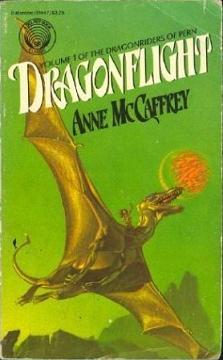
Dragonflight — Anne McCaffrey

Cover of Dragonflight


Dragonflight
Anne McCaffrey
303 pages
published in 1968

Because I’ve been running my booklog since 2001 I know it’s at least a decade or more since I’d last cracked open an Anne McCaffrey novel, yet once upon a time her The Dragonriders of Pern series was very important to me. Like so much science fiction and fantasy I discovered the Pern books through the local library, first reading them in Dutch, then continuing in English after I discovered the later books were only available that way. Over the years I devoured everything of McCaffrey I could lay my hands on, but I got less and less enjoyment out of her later novels, until I stopped reading them all together. Which is why I hadn’t read her in more than a decade and why it took her death to get me to reread the Pern novels. Which is a shame, as rereading them now makes clear how good McCaffrey at her best really was.

And Dragonflight was the best story she ever wrote. The two novellas that form the first twothirds of it, “Weyr Search” and “Dragonflight were rewarded with a Hugo and a Nebula Award respectively and are worth it. I had remembered Dragonflight as a fairly light novel, but it actually starts out quite dark, with Lessa, its heroine being the sole survivor of a coup against her family, plotting revenge as a kitchen drudge against the evil lord Fax who had taken over her hold. She’s not a nice person at all at the start of the story, completely focused on getting her own back and on making the hold as miserable as possible. But she also has a secret, a bond with the watch wher, a telepathic reptile like animal used as a watchdog. Little does she know that this is a hint to a much greater destiny for her…

Meanwhile F’Lar, a wingleader at Benden Weyr, where the last remaining dragonriders of Pern live. Once upon a time there were six Weyrs, to defend Pern from the dangers of Threadfall, spores drifting in from Pern’s sister planet the Red Star, but the last threadfall was hundreds of Turns ago, five of the Weyrs have been abandoned and the Holds, where the bulk of population lives have forgotten their obligations to the Weyrs, while the Weyr itself has forgotten its duty to Pern and nobody longer believes in Thread. Nobody but F’lar that is, and his brother F’Nor, who still keep the old traditions in honour. And now F’lar is visiting Ruantha Hold, Lessa’s Hold, looking for candidates for Impression, for young girls to bond with newly born dragons as the next generation of dragonriders. Three guesses who becomes one of the candidates…

But this is just the start of Lessa’s and F’lar’s adventures. There’s still the menace of Threadfall to overcome, the resistance of the Holds to the Weyr and the continuing problem of how one small Weyr of dragonriders can protect the entire planet when it needed six much bigger Weyrs in the past, with much more experienced and better prepared riders… Both Lessa and F’lar have their roles to play in resolving this, but Dragonflight is largely Lessa’s story.

Dragonflight was written in 1968/69, long before the fantasy boom of the seventies, when fantasy was still very much an offshoot of science fiction. A lot of the tropes and cliches of epic fantasy can be seen in embryonic form here and I suspect Ann McCaffrey’s dragons have had just as much influence on the shaping of genre fantasy as Tolkien’s hobbits have, even if it’s less recognised. But Dragonflight isn’t quite fantasy, even if it has firebreathing flying dragons, a medievaloid society and a fight against unreasoning evil at the heart of its story.

Because the dragons are genetically engineered from the fire lizard indigenous to Pern, the unreasoning evil is just an alien lifeform doing what it must do to survive and spread itself, while the medievaloid society is the descendant of colonists from Earth who had to abandon most of their high technology because Pern wasn’t suited for it combined with the pressures of Threadfall, which explains why there are Holds but no cities: Thread can’t burn stone so people live in caves and other rocky places. What’s more, these explanations for the dragons et all aren’t there just as handwaving: scientific curiosity plays a huge part in the plot of Dragonflight and its sequels as the Pernians rediscover the world they’re living on. That’s part of the appeal of The Dragonriders of Pern for me, that process of discovery, though it would get a bit silly in the later novels.

Another part of what made Dragonflight and the other dragon novels so popular and important for so many people for such a long time is Anne McCaffrey’s ability as a writer to suck you into the story, what Jo Walton called readability when discussing John Wyndham: “the ability to write a sentence that makes you want to keep reading the next sentence and so on and on”. McCaffrey had that in spades, where no sooner have you finished the first novel, you want to start the next one.

Which is just what I did.

Valor’s Choice — Tanya Huff

Cover of Valor's Choice


Valor’s Choice
Tanya Huff
409 pages
published in 2000

Tanya Huff is one of those science fiction writers I vaguely knew about but never had read anything from, nor to be honest, had heard much about. One of those authors that steadily plods along, has a decent following and career but never quite had a breakthrough novel. I never really had a reason to take a closer look at her work, until I found myself in the English Bookstore last Friday looking for something light to read and Valor’s Choice caught my eye. I’m always on the lookout for good, enjoyable military science fiction and continuously disappointed by what I find on the shelves, when even a cursory glance is enough to show me that yet again my expectations are set too high.

And yet my standards for mil-sf are set so low already; all any story has to be to get me to read it, is to beat the Weber minimum. If the politics are less annoying and rightwing than David Weber‘s, the writing can be just as awkward, as long as there’s something interesting the writer is doing with their story. Literary qualities be damned, just as long as you tell a good story. Tanya Huff, from what I saw in the bookstore seemed capable of delivering at least that much, so I took a gamble on her. You may guess from the fact that I’m reviewing this already that she more than succeeded: I started reading this on the way home from the bookstore and had finished it on Saturday evening.

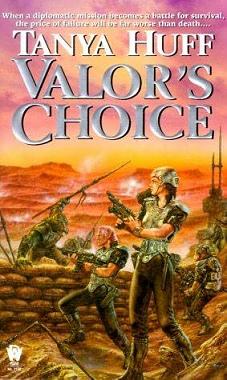
Valor’s Choice is not necessarily a good novel: Huff’s writing is servicable, slightly better than it needs to be to tell the story she wants to tell, while her characters for the most part are the usual stereotypes found in any military story, with the plot cleverly swiped from real life. For those who know their military history, the cover above gives a huge clue to which particular Victorian battle is re-imagined here, not for the first time in science fiction. None of this matters however, as the story that Huff creates out of these less than inspired ingredients was gripping enough that I had to keep reading to see how it all ended, even if I could guess the broad outlines of the story almost from the start and knew roughly what the payoff would be. That is in fact part of the payout of mil-sf for me, similar to the denouncement of the murderer in a classic detective story. What a good mil-sf story needs to do is give you a set of stock characters you can quickly bond with, follow them through the everyday routines of military life for a while with all its absurdities and annoyances, then give them a chance to win a victory against overwhelming odds, or at the very least a heroic death — craven betrayal by their civilian masters is optional though common.

What Tanya Huff gives us is staff sergeant Torin Kerr, a “battle-hardened professional”, who has just herded her mixed company of Human, Taykan — elf like aliens with an insatiable sex drive and few scrubles whom to share it with — and Kray — true omnivores who take a great pleasure in nausating their comrades in arms with what they eat, dead or alive, through a particularly nasty encounter when her and their well earned leave is cancelled for a sensitive, high profile engagement. They have been voluntered to serve as a honour guard for the Confederation diplomats visiting a newly discovered alien race, the lizardlike Silsviss, to get them to join the Confederation before the Others can do this. As the Silsviss are a typical warrior race, there needs to be an elite force of Confederation troops there to impress them and Torin and her people have been chosen for this role. Bad enough, but made worse for Torin when she discovers her new 2nd Lieutenant, the Taykan di’Ka Jarret, is the same Taykan she had just spent a very nice evening recuperating with…

The Confederation is a coalition of species that had amiably lived together in their corner of the Galaxy for a long time, long ago having become enlightened enough to realise space is big enough to share. That lasted until the Others came, who wanted it all for themselves. These elder species having long outgrown the need and ability to wage war, they needed more primitive species to fight for them, which is where first humans, then the other two warrior races came in, taken into the Confederation in return for their fighting skills. It’s a setting that’s been used both before and since, with the novelty here that for once these elder races do not seem to be corrupt and manipulative, at least so far.

So Torin, Jarret and the men and women of their company ship out to the Silsviss homeworld, to suffer through endless parades, visits and diplomatic gatherings, until one day, on their way to yet another city, their shuttle is shot down and they crashland into one of the nature reserves set out for the Silviss’ young adult males, who in the grip of their hormones, spent their years of puberty in huge gangs fighting each other, becoming the perfect warriors. Lost in the middle of the reserve, with no way out for the company and the civilians it has to protect and with several dead already and more wounded, Torin and co have to find shelther somewhere and wait for rescue from the Silsviss authorities, if they weren’t the ones that fired those missiles, that is. They find it in a small storage facility that’s normally used to feed the roaming hordes of hormone crazed, hyper aggressive teenage Silsviss males that has now surrounded the company, vastly outnumbered by the thousands of Silsviss coming for them…

And so the scene is set for a heroic defence, as this small band of marines is preparing to defend themselves against these vast hordes of Silsviss, their only consolation being their superiority in weaponry, if not numbers. Even so, if they can survive is anyone’s guess…

As I said, I’m a sucker for these sort of stories and Tanya Huff is as adept at tugging at the heartstrings, at bringing out the heroism of siege warfare as somebody like David Gemmell is. Valor’s Choice is a good entertainment, a story that in everything is slightly better, slightly smarter than it had needed to be to tell it’s story. As such it stands head and shoulders above the Weber Minimum, as well as the majority of mil-sf novels. I think I will read more of Huff.

City of the Chasch — Jack Vance

Cover of City of the Chasch


City of the Chasch
Jack Vance
172 pages
published in 1968

When I first started to discover science fiction (longer ago than I care to recall) Jack Vance was one of the more popular writers to be translated into Dutch and the local library therefore had a shitload of his books. I therefore read quite a lot of his work, including the whole Planet of Adventure/Tschai, the Mad Planet (as it was called in Dutch) tetralogy, in one of those big omnibuses Meulenhof specialised in. There’s little I remember off it, to be honest, other than that it was a typical Vancean planetary romance.

Jack Vance is of course the master of this subgenre, effortlessly creating new worlds and societies for his stories, always exotic and strange yet believable and with their own logic. Sometimes the stories he sets in these worlds disappoint, as was the case for me when I reread Big Planet two years ago. For City of the Chasch I had less expectations, just because I remembered less about it, but I was still a bit disappointed with it. Like Big Planet, the worldbuilding here is more sketched in than fleshed out, not as rich and interesting as I had hoped it would be. I had planned to read the next books in the series immediately (I’m still missing the fourth) after I’d finished this one, but now I’ll think I’ll pass.

As said, City of the Chasch is a classic example of a planetary romance, the science fiction equivalent of one of those fantasy grail quests that visits every place on the map in the front of the book. It all starts when a spaceship finds radio signals coming from a star system no humans are supposed to be, goes to investigate and is blown up just as it had launched a scout ship to the surface. This crash lands, one of the pilots is killed by one of the tribesmen who were drawn to the crash site, but the other, Adam Reith is luckier, caught with his parachute in a tree and not yet discovered, yet helpless to get himself down as well. And then an airsled arrives and sets down and out come Blue Chasch and Chaschmen to examine the crashed ship, but before they can do anything another ship arrives filled with Dirdir and Dirdirmen, who are immediately ambushed by the Blue Chasch, who kill them all and then take the spaceship away. Reith meanwhile is taken prisoner by that first tribe of humans and is taken to their camp.

That human tribe is an excellent example of Vance’s ingenuity in creating new cultures. They call themselves the Emblemmen and each male member of the tribe wears an emblem on their hat that defines their personality and character, with each emblem having a long history, being passed down from man to man whenever an emblem wearer dies or has his emblem taken from him. The women on the other hand are little more than slaves, emblemless and worthless. Reith himself is also little more than a slave. If he wants any chance of getting back to Earth, he needs to find his scoutship; luckily he still has his scanner so he knows where it is, he just has to get there.

Easier set than done, but he does manage to escape the tribe, setting out together with one renegade tribesman, Traz Onmale. Onmale is a sombre, serious young man, worried about life outside the tribe, but willing to go along with Reith. Some days later sheltering in the ruins of a Phung city, the Phung being the native sentients of Tschai, Reith rescues a Dirdirman, Ankhe at afram Anacho, Anacho for short, who despite a renegade, is proud of his Dirdir heritage. Reith himself meanwhile is getting more and more annoyed with how subservient men are to the various alien races on Tschai, but still thinks of nothing but wanting to go back home. But first he’ll have to get his ship back.

And that means trekking across an entire planet filled with almost half a dozen alien races and their human followers. Apart from the Dirdir and Chasch (Blue and Green) as well as the native Phung, there are also the Pnume and, most amusingly, the Wankh. So he and his companions set off to the city of the Chasch to go get his ship, with the usual sort of adventures on the way.

The story, though decent enough, never really held my attention; always a bad sign when I’d rather stare out of the train window than read a book on my commute to work. I’m not quite sure why this was, perhaps because it was all a bit formulaic or the characters were never more than cliches. There were some good bits; the Emblemmen, the various pieces of local colour, some of the setpieces later in the book, but it never gelled for me. A pity, because I would’ve liked to have liked this more.