The King’s Name — Jo Walton

Cover of The King's Name


The King’s Name
Jo Walton
320 pages
published in 2001

“The first I knew about the civil war was when my sister Aurien poisoned me.”

As opening sentences go, the one that opens The King’s Name is great, starting off the sequel to Jo Walton’s The King’s Peace with a bang. It’s been five years after the end of the previous book, the peace that Sulien and her lord king Urdo had fought for so hard has held all these years, but there have been some rumblings amongst the kings and rulers of the countries of Tir Tanagiri about the high king’s rule. But for Sulien there was no real indication for danger until her sister poisoned her. Luckily one of her companions was quick enough to recognise it as poison and not a sudden drunkness and manages to get her back to her own lands, which is the only reason she survived. And then she comes home and her own steward tries it too. Something more is going on than just a grudge her sister may have held against her. Clearly she needs to warn Urdo and rejoin him to fight for the peace again…

With The King’s Name Jo Walton’s histoire à clef becomes more explicitely Arthurian, with Urdo as king Arthur, his wife Elenn as Guinever and Sulien as a distaff Lancelot, with the traditional love affair not between the queen and Sulien/Lancelot, but implied between Urdo/Arthur and Sulien. It’s long been supposed that the night Sulien spent with Urdo in his command tent early in her career was one of passion rather than exhaustion, with Sulien’s son Darien as the result. The civil war, started through the manipulations of the Modred equivalent Morthu, is of course also an Arthurian theme, the war that ends the Golden Age, kills the hero-king and restarts history. Not quite what happens here and don’t think that if you know the Arthurian template you know what Jo Walton is doing here.

The Arthurian legends for a start are explicitely Christian legends and while religion plays an important role in this story, Sulien, our protagonist/narrotor herself is emphatically not a follower of the White God, as the Christ equivalent in this history is called. Sulien respects all the gods, but believes in the old gods of her own lands, having been raised in the Vincean traditions of worship. Urdo too, while a follower of the White God and having been raised by his monks, respects and venerates the other gods equally. He has to, as the high king of the entirety of Tir Tanagiri it’s his duty to consult all the gods that inhabit the land and keep their believers free to worship.

Many other followers of the White God are less tolerant and would have liked to have Urdo or one of the White God’s saints to force the other gods out of the island altogether, as has happened in other places. This intolerance is a large part of what seems to drive the rebels against Urdo, though again it’s been manipulated by Morthu. Part of the King’s Peace is tolerance of all gods and Morthu wants to pull it down like he wants all other aspects of the peace.

But this is not a simple story of evil Christians versus noble pagans. The White God is an attractive god to worship as Walton shows, most of his followers genuinely puzzled by the idea that someone would not want to worship him. As Sulien makes clear in her introduction and conclusion to her story, the White God has won, has become the most worshipped god in the land, with the worship of other gods slowly dying out.

Which brings me to the main theme of the story. This is not a story about glory and finding fame in battle, this is a story about loss and melancholy, about having lived a long, fullfilled life but looking back at when you were still young and your friends were still alive. That bittersweet sense of melancholy is present all through the book, even more so than in the first one. This is not a book a young person could’ve written.

As a novel The King’s Name is better structured, more of a proper story than The King’s Peace, which suffered from having its plot fulfilled about twothirds of the way through the book. I found it to be moving, a real tearjerker in places.
The King’s Peace — Jo Walton

Cover of The King's Peace


The King’s Peace
Jo Walton
416 pages
published in 2000

When I put together the list of science fiction and fantasy books I’d planned to read for my Year of Reading Women project last year, I’d knew I’d want something familiar and enjoyable to close out the year, as a reward. Looking over my bookshelves the choice was easily made: I hadn’t read The King’s Peace since it had first come out in 2000 so it was high time I reread it. Back then I had come to it cold, without any preconceptions other than Jo Walton’s reputation as one of the best posters on the rec.arts.sf newsgroups. Rereading it now, having read more of her novels and also knowing somewhat more about the setting she used or at least the historical inspirations for it, have changed The King’s Peace for me, in a positive sense.

To start with the setting, you could call The King’s Peace an Arthurian romance set in a fantasy Britain, but that’s not quite right. I prefer to call it a histoire à clef, where Walton has taken post-Roman Britain at the time of the Saxon invasions and changed it. So the Roman Empire here is called the Vincan Empire, the Saxony raiders are Jarns, Britain is called Tir Tanagiri and instead of a King Arthur there’s king Urdo whose Lancelot, Sulien ap Gwien is the first person narrator of the story. When I first got to grips with the story more than a decade ago this all seemed needlessly complicated and I wondered why she hadn’t just written a straight Arthurian story. But I think it makes sense.

Had Walton set The King’s Peace in anything recognisable as actually existing history, she would’ve had to deal with all the expectations that would’ve brought with it: she would’ve had to get both the history and the Arthurian mythology right. By creating her own version of Britain Walton could take the broad strokes of British post-Roman history and put her own interpretation on them, with the same for the Arthur legend, while still rooting her story in the “reality” of both history and legend, something she wouldn’t have had if she had set it in a completely made up fantasy world.

What you also need to understand going into The King’s Peace is that Jo Walton genuinely believes that the Roman abandonment of Britain in the late fourth/early fifth century CE was a tragedy, that in her version of this history the barbarians are at the gate and civilisation in Britain/Tir Tanagiri is slowly being extinguished by hordes of invaders. This attitude is reflected in her protagonist/narrator Sulien, who was brought up in the Vincan way by her mother Veniva, for whom the Vincan Empire still is civilisation. It’s hard not to see some of Walton’s own opinions being reflected there. Yet The King’s Peace as a story is not a tragedy, not about the disappearance of civilisation under a long dark night of barbarism, but about finding news ways of re-establishing civilisation, of making peace both for the civilised and the barbarian.

The story starts when Sulien is attacked, raped and left for dead under her brother’s corpse by Jarnish raiders who have also plundered her family’s land. She then is sent out on a conveniently escaped warhorse to the new king her family and its ruler have only recently sworn allegiance to, but she runs straight into another Jarnish raid, one fought by strange armoured soldiers on horseback, whom she immediately joins in attacking the Jarnsmen. That’s how she meets Urdo, a king with much bigger plans than just being yet another ruler of a small kingdom unable to beat off the Jarnsmen on its own.

Urdo wants to build peace over all of Tir Tanagiri for everybody who lives in the land and is willing to abide by his peace, including Jarnsmen. But to do this, he first needs to make war, which is why he has build up his alas, regiments of armigers, mounted warriors armed with lances and swords, fighting as disciplined heavy cavalry, almost unstoppable when properly used. Sulien becomes one of his armigers, impressed by Urdo and his dream. In his quest Urdo is also supported by the priests of the White God, a new god in the islands, this world’s equivalent of Jesus, who was stoned rather than crucified and whose priests are about as intolerant as Christian priests in real life were of other gods, if much less nasty about it. Sulien herself is a proper pagan, willing to respect all gods and praying to her old, familiar gods of her family, practising practical magic in their names.

Magic, though much much less flashy than in most fantasy, is real in Tir Tanagiri, playing a role in everyday lives as well as warfare. We first see it in action when Sulien is forced to heal the leg of her rapist, while in one of the big battles Urdo uses his privileges as king of the land to contact the gods for help when he and his troops are surrounded by the enemy. The only ones not given much to using magic are the White God’s followers, either unable or unwilling to do so, though there are incidents in which it’s clear the White God can assist his believers if needed.

The King’s Peace is told through the memory of Sulien, reflecting back on the events of her youth after a long life and is somewhat choppy in its narrative. She tells both the story of how the King’s Peace was achieved, but also her own personal story, from her rape to her rise as one of Urdo’s most trusted lieutenants, his Lancelot, but fortunately without the love triangle. Though that doesn’t stop her comrades gossiping about her and Urdo…

I was a bit annoyed with the rape at first, largely because it’s such an overused conciet to give a heroine her motivation, as if women cannot become heroes unless they have a nice juicy trauma in their past. Luckily, this was not how Sulien’s rape was used. It is an important plot point, both for Sulien’s personal life as she meets her rapist again, as well in the wider scheme of things; it has consequences for her, not the least of which is that she feels she could never have sex or be married, but it’s not an overwhelming melodramatic trauma that keeps driving her. She becomes an armiger because she believes in Urdo’s dream, not because she wanted revenge on the people that hurt her. Sulien is also relentlessly practical, something what reminded me of the narrator/protagonist of Walton’s latest novel, Among Others.

As anybody who has actually been reading my booklog over the past few years knows, I’ve been reading a lot about the fall of the Roman Empire and the transformation of Late antiquity into the Early Middle Ages and about whether the Roman world really fell or was just transformed and how that would’ve looked like to the people living through it. The King’s Peace may be set in a disguised, fantasy version of this part of history, but I think it got it as well as anybody could’ve gotten it. The world changes, but change does not have to be bad and although what was lost could not be recaptured, what was built in its stead is good in its own right. A very complex, bittersweet and mature attitude for a fantasy novel to take.

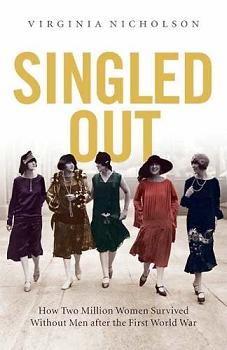
Singled Out — Virginia Nicholson

Singled Out


Singled Out
Virginia Nicholson
312 pages including index
published in 2007

I found Singled Out in the Middelburg library and picked it up because it looked like the sort of book Sandra would’ve enjoyed reading. She had always been interested in social history, especially of Britain between the wars and of the role women played in these years. Sandra had actually been the one who first pointed out to me why there were so many spinsters in twenties and thirties detective stories, all those women living alone in bedsit rooms or sharing a cottage together. That was something I had noticed but assumed just to have been some sort of convention of the genre, rather than something real reflected in fiction.

But that was exactly what it was, as the interwar period was the period of the “Surplus Women”, two million women for whom there was no and would be no husbands, with the “flower of British manhood” cut down in the mud of Flanders. The First World War had left hundreds of thousands British men dead and many more crippled for life and a whole generation of women without enough husbands to go around. Granted, as the raw statistics prove this was not a new situation, as in Victorian times too this had been the case, but this was the first time this gender imbalance was both large and out in the open. This time it had hit the middle and upper classes disproportionally and therefore was widely commented on in the media and felt by those women themselves. What’s more, it came at a time of huge societal changes and anxiety and, as Nicholson shows, these socalled “surplus women” played a huge role in making British society more equal to women in general.

In Singled Out Virginia Nicholson attempts to tell the stories of this generation of women, who had all been brought up with the belief that the highest possible duty and happiness for a woman lay in marriage and motherhood, having to cope with a reality in which for them this was no longer possible and for some (many?) of them it was no longer as desirable either. The realities of the First World War, in which the absence of men had forced women into roles earlier denied them had given a great many young women a taste of greater freedom already. Now that two million of them were completely unable to fullfill their traditional roles, they had to find new meaning in their life, nor were they content to be pushed in the role of the traditional spinster as free caretaker for her sibling’s children or her aged parents. Instead they became business women, college students, artists, socialists or activists, forged new roles for themselves and the women coming after them.

Virginia Nicholson has taken great care to let these women talk for themselves as much as they can at this late stage. As Singled Out was published in 2007, a lot of the women of this generation were already dead, but she has managed to find quite a lot of first hand accounts nonetheless, by interviewing those women still alive, through tracking down memoirs and dairies, as well as contemporary documents: novels, essays and newspaper articles, even poetry. The stories that she tells this way are touching, often moving.

Especially the stories of those women who did leave a husband to be on the battlefield and had to deal with that grief for the rest of their lives. I’ve after all just lost Sandra myself and can understand what they were going through, even if my grief is different from theirs.

But these stories are also inspiring, as Nicholson shows how these women, had to deal not just with the loss of their men, but also with the expectations and disapproval of much of British society and the realities of being a single woman in a world where opportunities for single women were still few and far between and there was little help for them. Yet many of them still managed to find fullfilment in life through work, through political activism or even through taking care of other people’s babies. We’re all in their debt, because their efforts helped shape our modern world.

Air Power and Maneuver Warfare — Martin van Creveld et all

Air Power and Maneuver Warfare


Air Power and Maneuver Warfare
Martin van Creveld, Steve Canby & Ken Brower
268 pages including index
published in 1994

Air Power and Maneuver Warfare is a strange book. At first it seems to be just a theoretical and historical overview of how air power and maneuver warfare fit together, but something seemed off from the start. This book was commissioned by the US Airforce’s Air War College just after the Cold War had ended and more importantly, the US military establishment finally started to be convinced of this. It’s a political document as much as a theoretical one, written for an audience that’s supposed to be familiar with the theory of “maneuver warfare” (sic) but who do needed to be convinced of the argument Creveld and his co-authors are putting forward.

Said argument seems to be that the US Army needs to move away from its historical attrition warfare, linear orientation towards a more flexible maneuver orientated attitude, to be better able to deal with the challenges a post-Cold War world will throw at it. Meanwhile the airforces also need to shift towards a more tactical support role for the army rather than being obsessed with strategic air warfae and air defence suppression. This latter is not a new criticism of course, as ever since the USAF became a seperate arm of the armed forces it has been accused of neglecting tactical air support. The irony of it all is that while van Creveld and his co-authors (politely) argue that the then current strategic orientation of the US Armed Forces is outdated and inadequate to deal with the complexities of a post-Cold War world, their own recommendations are just as much a product of Cold War thinking, assuming that potential opponents will need to be and can be defeated by conventional military operations.

The reality of the last two decades has for the most part put the lie to this assumption, with the sole exception of the opening phase of the War on Iraq. Most conflicts the US has involved itself in have been limited conflict, fighting guerilla forces rather than conventional armies and where the sort of strategic air support van Creveld et all were denouncing has been rather important for the success of these operations. Some lip service is given in the introduction to this sort of warfare, but on the whole the book only talks about traditional warfare.

Which is probably not that surprising, written as it has been between the succesful conclusion of the First Gulf War and the US marine landings in Somalia, before things went sour there. The Gulf War was the final hurrah of the Cold War US Army, a vindication of their training, equipment and tactics; it was not quite the war it was taught to fight, but it was the type of war it was taught to fight. It’s in that context that Air Power and Maneuver Warfare was written, which explains its emphasis on conventional warfare rather than the kind of operations the US army would fight in reality. It’s also written without the benefit of access to Soviet archives that later historians/military theorists would’ve have, so misestimates a lot of the Soviet experiences in World War Two, as well as during the Cold War, still holding the conventional view that in a conventional war in Germany NATO would’ve been toast against the Warsaw Pact.

Air Power and Maneuver Warfare starts with a short overview of the theory of maneuver warfare in the first chapter, from its inception in the campaigns of Napoleon through the refinements theorists like von Clausewitz put it thorugh. The next three chapters then looks at the historical examples of the German Blitzkrieg campaigns in WWII and the Soviet response later in the war, together with the Israeli experiences in 1967 and 1973 to see how air power has been used and should be used in maneuver warfare. The concluding chapter than takes the conclusions reached and applies them to the US Army in the nineties and how it should re-organise itself, before looking in an appendix at how the just concluded Gulf War measured up. Finally, in a seperate part of the book, the Air War College responds to van Creveld and his co-authors, criticising their critique. This part is not fully integrated in the rest of the book and though it has its points (frex, in how van Creveld ignores the political context in which the Gulf War took place and how this impacts strategy) but is too short and sketchy to convince.

In short, this was a propaganda attempt that didn’t quite convince, largely due to van Creveld’s own blindspots. Hindsight is 20/20, but even at the time it should’ve been clear that the military context the book was written for no longer existed.

Medieval Warfare — Helen Nicholson

Cover of Medieval Warfare


Medieval Warfare
Helen Nicholson
232 pages including index
published in 2004

Helen Nicholson’s Medieval Warfare is, as she puts it in her introduction, “intended to provide a point of entry tpo the subject of medieval warfare for students and others with an interest in the subject who are perplexed by the rapidly expanding body of scholarship in this area”. Which is just what I needed, as this is indeed a subject I’ve become interested in following on from my earlier readings in Late Antiquity and the Early Middle Ages. Medieval Warfare is an ambitious book for trying to cover this whole period (300 to 1500 CE) even in overview in just 166 pages, excluding index. But Nicholson is a reader in history at Cardiff University who has written extensively on Medieval military matters and therefore is well suited to the task.

As any good historian should, she sets out how she will go about it in her preface. What she attempts to do is to look at the development of the main aspects of medieval warfare from just after the end of the (western) Roman Empire to the end of the Middle Ages, using concrete examples to illustrate these developments. She chose the period 300 to 1500 CE to emphasise the continuity between the military practises of the Late Roman Empire and the Middle Ages, with the latter date providing a convenient cutting off point between them and the Renaissance. The fourth century was chosen as a starting point because it was in the late fourth century that the Roman bureaucrat Vegetius wrote his manual on military strategy, a book that was hugely influential in European warfare until at least the sixteenth century. Geographically, Nicholson limits herself mostly to Europe, particularly France, Italy, England and Germany for her examples, though she does look to Eastern/Byzantine examples as well when appropriate.

After the introduction, Medieval Warfare starts with a chapter on the theory of warfare, followed by chapters on military personnel, buildings and equipment and finally one on the practise of warfare, with a smallish chapter on naval warfare tacked on at the very end. Each chapter is organised in a roughly chronological order, though several start with enumerations, as e.g. in the military buildings chapter first the various kinds of military buildings are briefly examined. Where necessary, Nicholson has also taken care to present the various parts of a given subject in a logical order, where e.g. the chapter on the practise of warfare has her first looking at the training of soldiers, troop manoeuvring, the actual battle, sieges and finally the aftermath of war.

The overall impression that you get from the development of the art of warfare in the Middle Ages was that it was largely evolutionary rather than revolutionary. After the collapse of the Roman political order war was effectively privatised, with professional warriors recruited for service by a warlord rather than trained by the government. As new states became stronger warfare became more centralised and professionalised again, but there wasn’t a real watershed moment. As Nicholson argues it is tempting to think about a warfare revolution in the last few centuries of the period, what with the development of larger standing professional armies, the switch from largely cavalry based armies to infantry based ones, not to mention guns and gunpowder, but in fact most of the fundamentals of warfare remained the same throughout the period.

As a primer to a huge subject Medieval Warfare was quite good, with one minor caveat, as there were no illustrations at all, which would’ve helped with some of the more technical bits.