Foreigner – C. J. Cherryh

Cover of Foreigner


Foreigner
C. J. Cherryh
423 pages
published in 1994

Foreigner is the fifth book in my Year of Reading Women project. It is the first novel in one of C. J. Cherryh’s more popular series, yet until now I had never read any of them. She is such a prolific writer that it’s easy to miss a series or two. She also has such a wide range, writing anything from fantasy to space opera, that not everything she writes appeals to every one of her fans. The number of people I’ve known who hated her breakthrough novel Downbelow Station for example…

Yet, once you’ve read a few of her novels, you discover that there is one narrative trick all her stories have in common, no matter what the setting or the plot is. What she likes to do is to take her protagonists out of their comfort zone, get them at their most vulnerable and then put the pressure on. Every one of her novels I’ve read has the same structure. The protagonist is a young man (rarely a young woman) put in a position of responsibility but without power. Usually he’s an outsider in an alien culture, cut off from his own people, in the middle of some sort of political crisis he barely understands let alone can influence. She then let’s this crisis heats up, makes sure her hero gets little to eat and less sleep and is as far removed from the centre of the crisis as possible, yet still has a vital role to play in resolving it, even if he not necessarily knows it. To make sure the reader is as much in the dark as the hero, she usually makes sure they’re only looking at the story through his eyes.

Read More

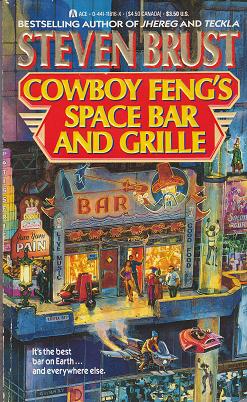
Cowboy Feng’s Space Bar and Grille — Steven Brust

Cover of Cowboy Fengs Space Bar and Grill


Cowboy Feng’s Space Bar and Grille
Steven Brust
223 pages
published in 1990

Sometimes when I’m depressed I go on a book reading binge — I managed to read every Wheel of Time book up to Lord of Chaos in a week when I was at a low point during my time at college. Pure escapism, fleeing into a story to temporarily ignore the world around me. A few weeks ago I fled back in that habit when my wife was having a very bad night, the day before she had to go back to hospital again. I was sleeping on the couch to try and give her an easier night’s sleep but then couldn’t sleep myself, so I grabbed the nearest book at hand. This turned out to be Cowboy Feng’s Space Bar and Grille.

Which perhaps wasn’t the best book to keep the night terrors at bay. Cowboy Feng’s Space Bar and Grille is a strange book, if only because it’s one of Steven Brust’s rare science fiction novels, but also because it’s a light adventure story about a Strange Bar, set amongst a series of nuclear holocausts. Amongst Brust fans it’s apparently a bit of a controversial book with some hating it, but for me it was the right book at the right time. It may be strange to think of a book that has a succession of nuclear wars at its heart as comforting, but that’s what it was.

Read More

China Mountain Zhang — Maureen F. McHugh

Cover of China Mountain Zhang


China Mountain Zhang
Maureen F. McHugh
313 pages
published in 1992

China Mountain Zhang is the fourth novel I’ve read in my Year of Reading Women project. It had been on my shelves unread for over a decade before that, silently accusing me every time I walked past. Some novels are like that, shoved aside each time for a more interesting looking book. Which is one of the reasons I put it on my list of twelve science fiction novels written by women to read this year: to force me to finally read it.

Because I should’ve read this long ago. China Mountain Zhang was Maureen McHugh’s debut novel and was nominated for both the Hugo and Nebula awards in 1992, winning the Lambda Literary Award (best science fiction with LGBT themes), the Locus Award for best first novel, and the James Tiptree, Jr. Award (feminist themed science fiction). It also has always been a highly regarded novel in the fan circles I hang around in. Yet until now I never had even tried to read it, largely because everytime I looked through my bookshelves the cover repelled me. And of course you should never judge a book by its cover, but in this case the cover did seem to promise something worthy but dull I never was quite in the mood for. A bit dumb, because of course China Mountain Zhang turned out to be just as good as its hype had made it out to be.

Read More

Early Medieval Settlements — Helena Hamerow

Cover of Early Medieval Settlements


Early Medieval Settlements
Helena Hamerow
225 pages including index
published in 2002

I wasn’t quite sure whether I should get this book — complete title: Early Medieval Settlements – The Archaeology of Rural Communities in North-West Europe 400-900 from the library. It looked as if much of what it covered I had already read about in Chris Wickham’s books Framing the Early Middle Ages and The Inheritance of Rome, only concentrating on the archaeological side of things rather than the history, which I’m more interested in. I also worried about whether it wouldn’t be too dry or technical, something I had problems with occasionally in the Wickham books. On the other hand, it was short, a quick scan didn’t make it look too boring and reading the introduction showed me it was meant as a general introduction to this subject, rather than an indepth analysis, all of which persuaded me into getting this.

The fact that I finished it means I made the right choice. Helena Hamerow writes well, knows her subject and also knows when to go into detail and when not to, making good use of footnotes. The end result is a good overview of the archaeology of everyday rural life around the North Sea coasts of the modern Netherlands, Germany and Denmark during the transition from Late Antiquity into the early Middle Ages and its relationship to the archaeology of Anglo-Saxon England in the same period. Hamerow, as she explains in the first chapter, meant this book both as a general introduction to this period and area and as a pointer for her (monolingual) UK colleagues working on Anglo-Saxon England to the work done on the continent in the same period. Each chapter therefore ends with a quick overview of the relevant English archaeology.

As Hamerow argues, such a book was necessary because English archaeology lags behind the continent when it comes to this period, in general lacking the kind of large scale settlement excavations that have been done succesfully in Denmark, Holland and Germany for several decades now, giving archaeology on the continent a much larger evidence base to work with. Because of that larger evidence base it has been possible to make some generalisations about the way rural settlements evolved and developed in this period, though of course always with the necessary caveats and with no guarantee that new discoveries won’t upend some splendid theory. According to Hamerow this means that the work done on the continental side of the North Sea can be related to Anglo-Saxon discoveries in England, also because it is possible to –cautiously– speak of a similar cultural context in all these regions.

She sets this all up in the first chapter, introducing the differing archaeological approaches and frameworks used for this period, to provide the context for the more specialised chapters to follow, each of which treat one aspect of settlement archaeology. She starts with the most concrete and physical archaeological evidence, steadily opening out in scope. So we go from “Houses and Households: the Archaeology of Buildings” via “Settlement Structure and Social Space” to “Land and Power: Settlements in their Terrirorial Context”, ending with two chapters on “The Forces of Production: Crop and Animal Husbandry” and “Rural Centres, Trade and Non-Agrarian Production”. The final chapter is barely worth that name, just a couple of pages of summing up and generalising what we just read.

Each of these chapters is in itself an overview of a much bigger subject, of necessity barely scratching the surface. Each chapter therefore needs to build a balance between the general and the specific, providing specific examples of the subjects treated in it while also putting them in context, where possible. A difficult job, but one that Hamerow manages quite well. Throughout the book she tries to use the same excavations as examples where possible, each time treating a different aspect, which helps a lot in keeping things clear as there’s enough information to take in already in this slender book. Interesting enough for me as a Dutchman are the large number of Dutch examples she uses, especially from the province of Drenthe, where as it turns out much pionering settlement archaeology has been done.

Early Medieval Settlements was published in 2002 and as Hamerow admits, uses little information from after 1999, so no doubt some of the information and theories in here are outdated, but this does not diminish its achievements in providing a good, general overview of a difficult subject. I need to keep an eye out for more of Helena Hamerow’s work.
The Inheritance of Rome — Chris Wickham

The Inheritance of Rome


The Inheritance of Rome 400-1000
Chris Wickham
651 pages including index
published in 2009

The way you learn about history as a kid, both in school and through pop culture is as discrete chunks. You got your prehistory, your Bronze Age, your Greeks and Romans, your Biblical Times if you’re in an Christian school, your Middle Ages and so on and so weiter. It’s comprehensible, makes history all very neat and tidy and of course completely wrong. This is not a new truth of course, but it was driven home for me once again by Chris Wickham in The Inheritance of Rome, which is all about showing the continuity the Early Middle Ages had with the Late Roman Empire, without being blind to the ways in which Europe evolved away from its Roman era roots during this period. There is no bright line you can draw that divides these two eras.

Nor is there a Dark Age. As Wickham puts it in his introduction, the centuries between the Fall of Rome and the Central Middle Ages, between 400 CE and 1000 CE, tend to fit it awkwardly with the traditionally whiggish view of history as one of inevitable progress leading from antiquity to modern times, where Classic Antiquity can be seen as a vanished Golden Age, with the Renaissance or Late Middle Ages as the starting point for that story of inevitable progress, the centuries inbetween banished to the awkward limbo of the Dark Ages. When these centuries were treated in traditional history it was because that’s when modern European nations like France or England got their first start. Neither view sits well with Wickham, who argues that these essentially teleogical views of this transitional period, judging them in the context of what came after them, give the wrong image. You have to look at this time on its own terms rather than trying to glean the beginnings of future developments in it.

Read More