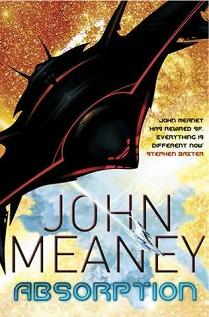
Absorption — John Meaney

Cover of Absorption


Absorption
John Meaney
407 pages
published in 2010

Absorption is the first volume in John Meaney’s new Ragnarok trilogy. It seems to be set in the same future as most of his novels, from his first book To Hold Infinity onwards, have been set. You don’t need to have read those to understand this book, but if you have you’ll know roughly what to expect and will get certain references quicker than a new reader would. In general however it is enough to know that John Meaney is of the same generation of British writers like Richard Morgan, Alastair Reynolds and Neal Asher and writes the same sort of widescreen “hard space opera”, though a bit more cyberpunky.

But Absorption is more than just another space opera novel. You could in fact say that this is not science fiction at all, but fantasy dressed up as space opera. Because while one of the three main storylines is set in Meaney’s standard future of Mu-space pilots with jet black eyes and the computer upgraded Luculenti upperclasses of Fulgor around 2603 AD, the two other storylines are set in 777 AD and 1926 AD and both feature things that look a lot like magic… And with flashes of an even father future in which the main characters of all three storylines meet, as well as hints of magic in the main future storyline as well, who knows what’s really going on?
Read More

Sidewise in Links — sci-fi Sundaze

You know you’re not enjoying an SF novel when you keep stopping to read a really badly written academic text on international relations.
— Jonathan McCalmont.

A year of reading women:

More science fiction links:

Not science fiction:

Earth is Room Enough — Isaac Asimov

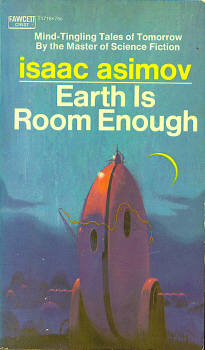
Cover of Earth is Room Enough


Earth is Room Enough
Isaac Asimov
208 pages
published in 1957

As the backcover blurb has it, “ANYTHING CAN HAPPEN and probably will RIGHT HERE ON EARTH” — which is why Earth is Room Enough for Asimov to set his stories on. This, with another Asimov collection, Buy Jupiter, is one of the books that made me into a science fiction reader and fan. It’s not so much that this is an outstanding collection — a good few of the stories here are amusing at best — but that Asimov is at any rate such an easy and pleasant writer to meet when you’re young. A clever ten year old can follow his stories but since they were originally written for adults, there’s no talking down here. Asimov might not be the best writer now to introduce you to science fiction, but he was for me.

Earth is Room Enough, originally published in 1957 and which stayed in print for at least twenty years is is a collection of stories written between 1951 and 1957 and somewhat of a grab bag, jokes and shaggy dog stories intermixed with more serious ones. As said, all stories were set on Earth and deliberately picked by Asimove for the collection, to prove he could do more than write galactic space opera. Mind, he cheats a bit by including two pieces of comic verse… It doesn’t make for a first rate collection, but it certainly wasn’t a chore reading this either.

Read More

Killing for England — Iain McDowall

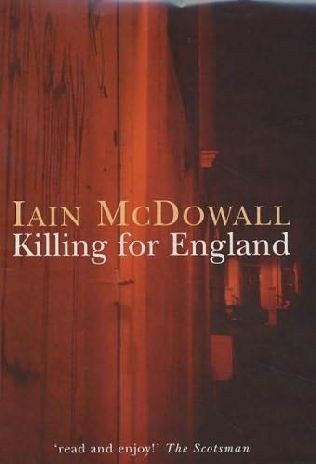
Cover of Killing for England


Killing for England
Iain McDowall
305 pages
published in 2005

I picked up this book because I thought it was by a writer I sort of knew, then kept looking when it became clear McDowall wasn’t the writer I was thinking of, because the back cover blurbs compared him favourably to Ian Rankin. That intrigued me enough to read the first few pages and those few pages in turn hooked me and got me to take the book out of the library. For once, the blurb writers had done their work well, though the comparison to Rankin turned out to be only superficial.

Like Rankin, McDowall has a gritty, older detective as his hero, Chief Inspector Jacobson, somebody, again like Rankin’s Rebus, who does not sit well with his police force’s hierarchy. Like Rankin, McDowall has a good eye for the politics of policing as well. Where they differ is in the setting: Rebus polices gritty, urban Edinburgh, while Jacobson patrols fictional, small town English Crowby. Jacobson is also less cynical, less worldweary than Rebus, more idealistic perhaps. McDowall, on the strength of Killing for England at least, is no Rankin clone, but won’t be a disappointment for those looking for a similar sort of writer.

Read More

Golden the Links were – Oh! Oh! Oh! — Sci-Fi Sundazes