The Ruin of the Roman Empire – James J. O’Donnell

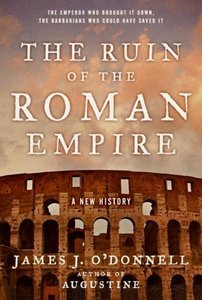
Cover of The Ruin of the Roman Empire


The Ruin of the Roman Empire
James J. O’Donnell
436 pages including index and notes
published in 2008

A few years ago I became interested in Roman history, especially with the later Roman Empire, what historians now call Late Antiquity, the period during which Rome supposedly fell. Supposedly fell, as the simple history we’ve been taught in school of barbarian invasions from the fringes of the Empire finally overrunning its heartlands, looting Rome and deposing the last true Roman Emperor in 476 CE, is of course wrong. That story is an invention, largely created by, as James J. O’Donnell put it, “a short, fat man”, Edward Gibbon, in his famous Decline and Fall of the Roman Empire, which codified this standard history of the fall of the Roman Empire. It was challenged in the early seventies, most famously by Peter Brown’s The World of Late Antiquity, as new research and new generations of historians started to question this old story. They found a Roman Empire and world that was severely challenged in the fifth century CE, but much more continuity between the old classical world and the new dark ages than there had been room for in the standard model.

Fast forward a few decades and the revisionists themselves are being corrected by later generations of scholars, e.g. in the books of Peter Heather and Bryan Ward-Perkins I’ve reviewed before. James O’Donnell’s entry on the subject, The Ruin of the Roman Empire is the most idiosyncratic so far I’ve read, aptly summed up by its subtitle: “The emperor who brought it down. The Barbarians who could’ve saved it.” The emperor is Justinian I, who wanted to make the empire whole again, the barbarians the supposed invaders who had taken over its western provinces. O’Donnell argues that if Justinian I had not tried to reconquer Italy and North Africa, but had concentrated his energies on his Eastern provinces and the border with Persia, something like the Roman Empire could’ve survived for longer than it did, if not an united Roman Empire. The fall of Rome in 476 CE was not the end of the Roman Empire.
Read More

The Pride of Chanur – C. J. Cherryh (reread)

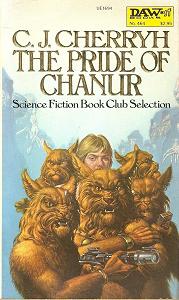
Cover of The Pride of Chanur


The Pride of Chanur
C. J. Cherryh
224 pages
published in 1981

I’ve read and reviewed The Pride of Chanur before, way back in 2001. That’s only three sentences long though, so high time for a reread and a proper review, especially as I’m trying to read more women sf writers this year, having discovered how unbalanced my reading was. Rereading old favourites like this one seemed a good way to start. Even if it did make me dream of kissing a Kif at Kefh.

The Pride of Chanur is a trade ship run by Hani –a race of bipedal intelligent lions– of the Chanur house/clan, captained by Pyanfar Chanur. She’s doing the rounds of her ship, currently docked at Meetpoint, the big interspecies trading station run by the stsho, when something speeds past her into the ship. At first thinking it some kind of animal escaped from another ship, it turns out to be sapient, but “naked-hided, blunth-toothed and blunt-fingered” unlike any species she knows, something that after careful questioning calls itself human and turns out to have escaped Kif custody, the Kif being a particularly nasty race of black robed, grey skinned, long snouted pirates and thiefs. She refuses to hand it –him– over to them and the result is she and her ship have to flee Meetpoint, one step ahead of the murderous Kif, who in the process blow up and murder another Hani ship…

Read More

Shards of Honor – Lois Mc Master Bujold (reread)

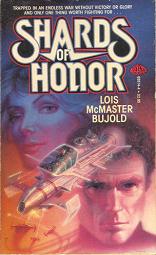
Cover of Shards of Honor


Shards of Honor
Lois McMaster Bujold
313 pages
published in 1986

I’ve reviewed Shards of Honor before, way back in 2001. Chronologically it’s the earliest story in the Vorkosigan series, with the exception of Falling Free. It is also the earliest published novel in the series and was based on an idea Bujold had for a Star Trek story. In the original story, the roles of Aral and Cordelia would’ve been played by a Klingon warrior and a Vulcan scientist; you can still sort of see the traces of this in the published book.

Cordelia Naismith is the captain of a Betan Planetary Survey Mission investigating a newly discovered planet, when her expedition is attacked by a Barrayaran force. She’s stunned and when she comes to she’s alone with the leader of that force, Aral Vorkosigan, left behind for death by his own internal enemies. They negotiate an uneasy truce to try and survive on a hostile planet to reach a survial cache left behind by the Barrayarans. After a long and ardeous trek they reach the cache, but something unexpected has happened in the meantime: they’ve fallen in love.

Read More

Diplomatic Immunity – Lois McMaster Bujold

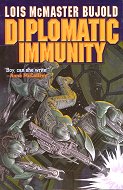
Cover of the Diplomatic Immunity


Diplomatic Immunity
Lois McMaster Bujold
367 pages
published in 2002

Rereading Diplomatic Immunity on the heels of Komarr and A Civil Campaign drove home how conventional and slight it was compared to those two novels. It’s as if Bujold, having lost her nerve after having written two somewhat unusual novels, decided to go back to a tried and true formula of getting Miles into trouble and letting him dig his way out of it. Of course, she had also started her fantasy series at this point, so a more charitable explenation is that she had simply lost interest in Miles Vorkosigan and only wrote this to please her fans.

In any case Diplomatic Immunity is a bit disappointing. Nothing wrong with it as a story, but it misses the sociological insights and character depth of the previous two novels. What’s more, we only see things from Miles’ point of view, again unlike Komarr and A Civil Campaign. Which means that Ekaterin is demoted from co-protagonist to supporting character and worse, barely present. It’s Miles’ show all the way and Ekaterin is only there to lend moral support. Which is a criminal waste: she is what made Komarr and A Civil Campaign so good, as intriguing and strong a character as Miles himself. This novel would’ve been so much better if Bujold had let Ekaterin play an equal important part in the plot as Miles.

The plot itself is discussed in my original review. Sufficient to say that I’d largely forgotten it in the six years since. It’s compelling enough while reading, but ultimately on the slight side. I think I was right to describe it then as an exercise in nostalgia, a last look at Miles before Bujold went on to greener pastures, even though a new novel, Cryoburn has been published since.

Omaha Beach: a Flawed Victory – Adrian R. Lewis

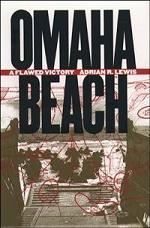
Omaha Beach: a Flawed Victory


Omaha Beach: a Flawed Victory
Adrian R. Lewis
381 pages including index and notes
published in 2001

Omaha Beach: A Flawed Victory was not quite the book I expected it to be or wanted to read. What I thought I was getting out of the library was a book describing the landings itself, looking in detail at how the battle for Omaha Beach evolved, similar to a book on Kursk I got at the same time. What I got instead was an analysis of the strategic choices made for the landings and how that led to near-disaster at Omaha. The actual battle is dealt with in the first chapter, the rest of the book deals with the reasons why the battle happened as it did.

Any disappointment I felt was shortlived. The book I got was easily as interesting as the book I wanted to get. What it managed to do was to make me question the “official” reasons why the Americans at Omaha Beach did so much worse than their colleagues at Utah or the British/Commonwealth forces at their landings. What I’ve always read was that the American commanders at Omaha had both underestimated the German resistance and the German fortification and had rejected the use of all the various special enginering tanks the British had developed to tackle these fortifications, the socalled “Hobart’s Funnies“. What Adrian R. Lewis argues instead was that the real problem was that the Normandy Landings were planned according to the wrong doctrine, that the experience build up in earlier landings in the Pacific and the Mediterranean was ignored in favour of finding new solutions to the same problems because the commanders in charge of Operation Overlord overestimated the uniqueness of the operation.

Read More