R.E.S.P.E.C.T — Martin’s increasingly petty translation rules

Who’d want to be an anime translator? No matter what you do, some monolingual schlub on Reddit or Twitter will accuse you of DoInG iT wRoNg, or worse injected politics in your subtitles, insisting that Japanese should be translated literally and that machine translation is good enough. You’re expected to work quickly enough that a new episode is translated and subtitled on the day it is released in Japan and most streaming services will not only not credit you, they’ll pay you not enough to live on:

Yes, you heard it right: Crunchyroll pays translators eighty bucks per episode, according to the Canipa Effect’s video above. That’s from two years ago and I’ve heard scuttlebutt that conditions for translators are slowly improving, but the reality of the business is still that it’s hard work for little pay and even less respect. Especially under the sort of time pressure same day streaming services put translators. You may have the script the week before the episode is released but even if there are no differences between it and the episode, you still need to do the actual subtitling. And often there are differences, or things that only become clear once they’re heard in the context of the episode. Do keep in mind that the subtitling itself isn’t that easy either; it needs to be timed properly with the audio and fit properly on the screen too, not to mention that it needs to be clear who’s speaking. All of which also can impact the translation as frex the chosen text doesn’t fit or cannot be timed correctly and needs to be adjusted.
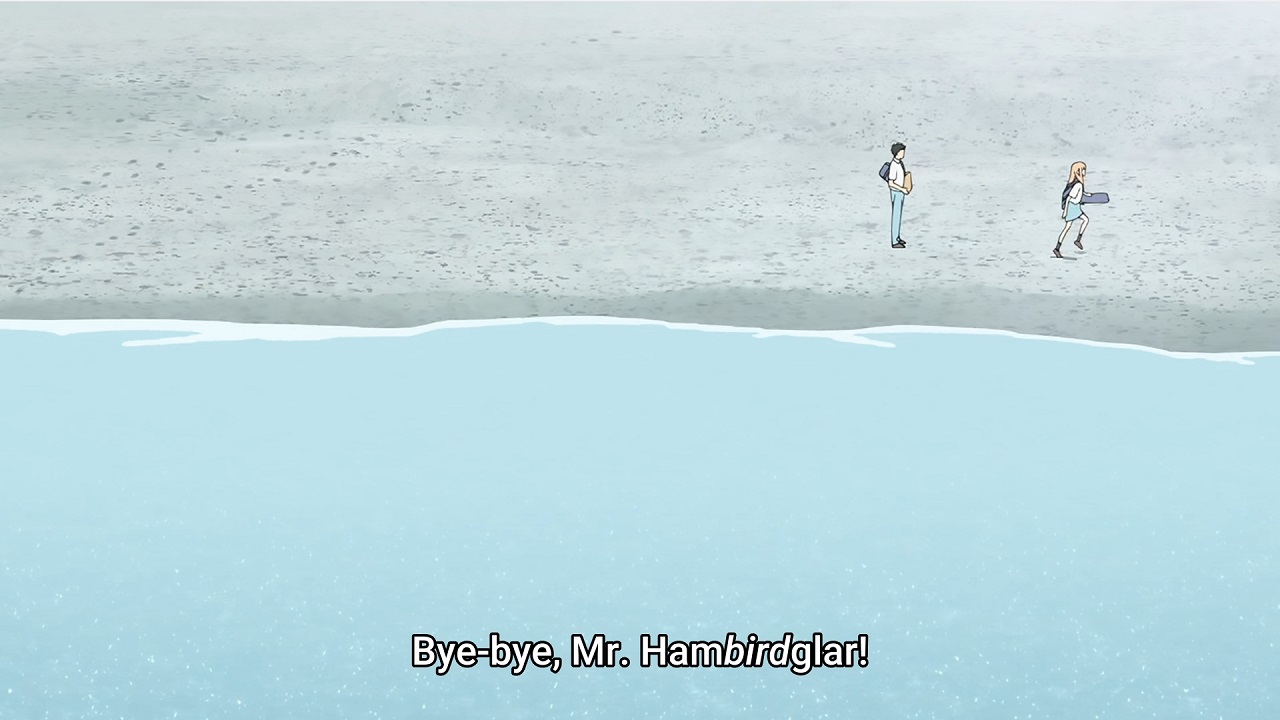
Bye-bye, Mr. Hambirdglar!

It’s frustrating all this hard work is not rewarded properly and almost as frustrating must be that it’s usually uncredited as well. I don’t know which genius came up with this particular pun in episode 8 of Sono Bisque Doll Wa Koi Wo Suru because Funimation refuses to credit any of its staff working on their releases. So does Funimation and even Netflix. The only streaming service consistently giving credit is Hidive/Sentai Filmworks, who have a separate credit section listing both the Japanese and their own staff tacked on to each episode. It’s thanks to that I know that Jake Jung was responsible for the excellent translation on this seasons Paripi Koumei for example. Really this should be the standard at all streaming services, a little bit of credit for the people doing the work.

These then are the first two of Martin’s increasingly petty rules for translating anime: 1) pay your translators (all staff really) a living wage and 2) give them proper credit. Not too controversial yet I think, but this is only the first in a series of posts I want to do on what I think is good translation. The focus here will be mostly on subtitled animation as I don’t care about dubs, but I’ll also talk about manga and even *gasp* other forms of translation than from Japanese to English.

Seireitsukai no Blade Dance Specials — Anime 2022 #014

If you bought the Seireitsukai no Blade Dance series on DVD or Bluray — but why would you — you would’ve gotten these thrown in for free: six three minute mini-OVAs showing hilarious interludes from the series.

The crossdressing protagonist is always prettier than his harem

Not much to say about them to be honest. If you’re a fan of the series you’ll enjoy those occassionally funny slice of life episodes, but otherwise there’s no reason to seek them out. It’s all literally fanservice, like in the third episode shown here, where protag-kun and his harem have to help out a cake shop and he turns out to look better in a maid uniform than most of the haremettes. All harmless fun, not going too heavy on the sexy times like certain titles.

Mermaids and sexy sea slug doctors — Tropical-Rouge! Precure — Anime 2022 #013

Tropical-Rouge! Precure is the 2021 installment of the long running Precure series. This times the villains are driven by procrastination and attempt to steal people’s motivation power. The Cures’ gimmick on the other hand is make-up, with the transformation sequence being based on applying make-up.

our Precure: Asuka, Laura, Manatsu, Minori, Sango and Kururun

It all starts with Laura the mermaid being send to the human world to find “the legendary Precure” who are the only ones who can stop the Procrastination Witch from stealing everybody’s motivation powers, something she will get up to doing tomorrow. She ends up in Aozora City, coincidently the place Manatsu also ends up in after she moves from the small tropical island she lived with her father, to go to school in the city, living with her mother the aquarium director. She meets up with Laura just as the first monster attacks the city and it turns out that of course, Manatsu is one of the legendary Precure, Cure Summer. They’re joined in short order by the cosmetics loving Sango, Cure Coral, mermaid obssesed bookworm Minori who becomes Cure Papaya and finally Asuka, Cure Flamingo, a sporty third year at Manantsu’s school. Sango and Minori are fairly typical blue and yellow Cures respectively, but the tomboyish and somewhat hot tempered Asuka is more interesting. She turns out to have a bit of a hidden past with the school student president, going from best friends to enemies over a tennis match, though it’s clear both are still upset about their falling out. Of course it all gets resolved in the end.

The villains: hermit crab Chogire, sexy sea slug Numeri, the sea horse Butler and Elda the child maid prawn.

As per usual with Precure, each week one of the Procrastionation Witch’s underlings comes to town, drains a convenient crowd of people of their motivation power, then uses it to create the monster of the week. The first is Chongire, a hermit crab who normally works as the chef in the Witch’s castle. Then there’s Numeri, the sexy sea slug doctor (Precure does like its sexy older woman villains) and Elda, a literal child (and also a prawn). None of those three is actually all that bothered about their jobs, prefering doing anything else, but their loyalty to the Witch compels them to follow through with it. There’s also the Butler, sort of the head underling who is the only one who really seems a villain. When in the best Precure tradition the series turns serious in its final part, the villains get their redemption and help the Precure fight the real evil. For Precure villains they’re very relatable in their bad attitudes to their jobs.

Close-up of Laura lookign bored

Best character in the show is Laura though, vain and egocentric gremlin that she is. She wants to become queen of Grand Ocean and if it takes becoming a Precure and defeating the Procrastination Witch to do so, she will. Though she learns to genuinely care about her friends, she’s still not above using them to get her way. She also brings out the best in the other Cures, especially Asuka, who just can’t with Laura’s general attitude to life. They also become pseudo rivals for Manatsu, though that never really leads anywhere. Laura’s so great she got her own Twitter meme account. Second best character is Kururun, the seal fairy mascot whose role in the series is to show up and go ‘kururun’ every episode. A very important role indeed.

Your Happening World (clean out your tabs! clean out your tabs!)

Some of these tabs have been open for months.

  • We’ve Made a Rare Animation Artbook Free to All — The author of Cartoon Modern, Amid Amidi, owns the book’s copyright and digital rights — and has written that he wants to see it reborn. “Would be delighted if someone scanned in and made available a high-quality PDF of Cartoon Modern,” he tweeted in 2019. “Book has been out of print for a long time and should be readily available to all.”
  • Download Cartoon Modern: compressed .PDF — 319 MB or uncompressed .CBZ — 4.6 GB.
  • Out of Touch/Out of Time — We remember the ghost of Lucky Star, so representative of what it meant to be an anime fan at that time. What was contemporary fan service is now a time capsule. Before legal streaming and simulcasts, before anime was something Netflix would spend millions remaking into live-action, when anime was kind of, well, cringeworthy. Maybe that’s why more problematic elements stand out these days. At the time, you had to take the embarrassment as par for the course, even a badge of honour that you could take it, unlike the normies. Lucky Star is a bit cringe.
  • Iraq, The Last Pre-War Polls — The final polls to be published before the war in Iraq started, conducted last weekend, all found a shift in public opinion in favour of British involvement in the war but still found a majority disapproving, both of military action and of Tony Blair’s handling of the Iraq crisis. Still relevant twenty years on as evidence that no, not “everybody” was in favour of the War on Iraq.
  • Dub Influence Vol 3: Snoopy — Yes! For our third installment of ‘Dub Influence’ we are very lucky to have a chart from the legend that is Snoopy. What Snoopy doesn’t know about reggae, dub and music in general… ain’t worth knowing. This got me on a dub/reggea kick a few months ago when I read this.
  • Transformers UK — the comic that (nearly) cheated death — This is the story of the comic that never was. Or, more accurately, the comic that nearly was.
  • bfi.org.uk/sight-and-sound/lists/50-key-anime-films — From the breakthrough of Akira in 1988, through the exquisite films of Miyazaki Hayao and others, Japanese animation has captivated audiences around the world. But anime’s history runs deeper still. Here we select 50 titles that celebrate its full, fascinating riches.
  • We’ve Got A File On You: Insane Clown Posse — VIOLENT J: And the amount of gay Juggalos out there is really surprising. I think about them doing their research and getting the old records, getting excited about it, and getting their hearts broke or something, you know? I tell my daughter, “For the rest of your life, when your friends ask why your dad said that, say it’s because your dad was a fool. Don’t defend me. Say I was a fool then, but I’m not now.” There’s no excuse. I was going with the flow, and that’s the very thing we preach against — being a sheep. And that’s what I was doing.

Food & Geisha — Maiko-San Chi No Makanai-San — Anime 2022 #012

Kiyo and Sumire wanted to become maiko, apprentice geisha, and came to Kyoto from snouwbound Aomori in the north of Japan. Sumire succeeded, Kiyo ..didn’t. Instead she became the live-in cook of the Maiko house Sumire is attached to. To be honest, it suits her much better than attempting to become a maiko ever did.

Sumire in maiko outfit and makeup shares an ice lolly with Kiyo

Maiko-San Chi No Makanai-San then is a slice of moe series that focuses on Kiyo’s daily life at the maiko house she shares with Sumire. A look behind the scenes of Kyoto’s geisha industry, if you will. It’s based on a manga series by Koyama Aiko. Unusually it was released as a monthly rather than a weekly anime, with the first episode released in February 2021 and the last in January 2022. That slower tempo of release suits the series well, with each episode taking place in the same month it’s released. In this way the series offers an insight in the rhythms of a maiko’s life.

Squid mince: squid and vegetables mixed together, battered and deep fried, eaten with brown sauce or ketchup or soy sause

Each episode is divided into three short, bite sized parts with each part separated by a short segment that discusses the food showcased in the previous part. Because this is a heavily food based show, not to be watched if you’ve skipped lunch. The cooking scenes have the best animation in the show, with close ups of food sizzling in a frying pan or Kiyo kneeding dough. Quite often the food on display is also much more obscure than the onigiri or takoyaki you get in other shows, the squid mince shown in the first episode, obscure even in Japan outside of Aomori prefecture. The connecting segments bracketing each chapter therefore have the useful function of explaining these foods and their history. They’re also done in a much simpler style; more illustrated than animated.

Kiyo hugs Sumire against the background of the kitchen

When talking about the quality of animation, we tend to concentrate on character design and the fluidity something is animated. Where Maiko-San Chi No Makanai-San‘s strengths lie is in something different: the ways in which it depicts its setting. The character designs are a bit simplified from the manga, but the backgrounds they act against are drop dead gorgeous even when completely mundane. It of course helps that it’s set in Kyoto, gorgeous in its own right, but what really struck me where the interiors of the maiko house, especially the kitchen. It is exactly the sort of somewhat old fashioned working kitchen that you’d expect yet it looks almost lush the way it has been drawn.

One minor criticism on the subtitles. Because the translation refuses to use honorifics, the varying levels of respect and familiarity the maiko have with each other and Kiyo is not reflected in the subtitles. Kiyo for example consistently calls Sumire Su-chan, even after the latter’s debut as a maiko with a new maiko name, while the rest of the cast do address her with her new name. In a series on such a quintessential Japanese subject like geishas, you’d expect the subtitles to be a litte bit more daring rather than flattening everything to basic English.