The Dark Colony — Richard Penn

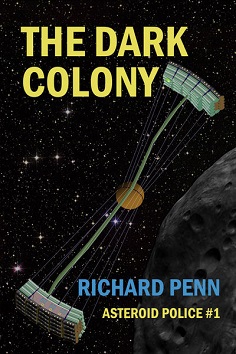
Cover of The Dark Colony


The Dark Colony
Richard Penn
327 pages
published in 2014

James Nicoll is a longtime science fan active on Usenet and Livejournal, who has been working as an internal reviewer for various publishers. As that work started to dry up earlier this year, he started doing sponsored reviews, where people (but not authors) can buy reviews of books they’re interested in, suspect James would like, or at least would have an enjoyable reaction to. I’ve known James for a long time and he’s one of the people I absolutely trust their taste in books of, so I pay attention when he says something he’s worth reading. Which is exactly what he did with Richard Penn’s The Dark Colony and since it was cheap on *m*z*n, I bought it.

Now there was a risk with this. At times James’ fondness for exactly the kind of setting The Dark Colony provides — near future, the real Solar System, no magical rocket propulsion to let people pootle around it in hours or even days, no cheating — can blind him to some of the other qualities (or lack thereof) of a book. Fortunately however, in this case, the book’s appeal exists beyond its setting. Basically, this is a police procedural: it starts with the discovery of a body floating around in the the giant free fall hangar of Terpsichore Station. What’s remarkable is that it’s the body of a stranger to the Terpsichore colony, which only has a few hundred people living in the station and the asteroid itself. It’s up to constable Lisa Johansen to find out where the stranger comes from and in the process she finds herself unravelling a huge conspiracy in the heart of her community and beyond. Yes, this is not just a police procedural, it’s a gloomy Scandinavian one…

Read more…

Blind book dates at ABC

window dressing for the ABC blind book date

So yesterday I went to the Blind Book Date at the American Book Center. This was an idea that their sf book buyer Tiemen Zwaan had come up with, an extension of his own experiments in selling books wrapped in brown paper with only crypic clues to reveal their identity. Now it was our turn to both baffle our fellow readers and crack their own codes. It made me realise one thing: I’m woefully under read.

I’d expected only sf or fantasy books would be represented, but in fact there was a wide spread of books, both fiction and non-fiction being offered by the 17-18 or so participants. Some of the clues were obvious, some obvious with hindsight, some had me racking my brains trying to remember what book this had to be, while some were brilliant but impossible to guess, like the book shown above. The woman who brought the book on the left had actually hidden her clues in the wrapping paper itself. Clever but perhaps too clever and it was only because somebody else brought the same book with more conventional clues, that people were able to guess which book it was…

As for my book, the clues I brought were:

  • Secret History
  • Kim Philby
  • Cold War Magic
  • Mount Ararat

Can you tell what book it is?

Incidently, the smartypants at Making Light have been hosting their own blind book date party, not just writing cryptic clues, but writing them in the style of a different author, which is far too clever by half.

Broken Homes — Ben Aaronovitch

Cover of Broken Homes


Broken Homes
Ben Aaronovitch
357 pages
published in 2013

Peter Grant was a normal copper until he noticed he could talk to dead people in Rivers of London/Midnight Riot. Now he’s part of the Folly, the Metropolitian Police’s special unit for magic, which apart from him consists of one elderly but backwards aging survivor of the glory days of British wizardry before the war, as well as his colleague Lesley May, Toby the dog and Molly, the folly’s housekeeper of indefinitive species, currently experimenting with cooking from one of Jamie Oliver’s recipe books, to mixed results.

Broken Homes is the fourth novel in the Rivers of London series. There has been a mini boom in London based fantasy these past few years and Aaronovitch isn’t the only one either who has his protagonist working for the Met. There’s a sort of inevitability about the idea. London with its long history and dominant presence in the psyche of not just Britain, but arguably the world, just fits as a nexus of magic in a way that say Amsterdam wouldn’t. Of course the Met would have its own magical police force, some hangover from Victorian times, staffed with aging public schoolboys, into which the thoroughly modern London figure of police constable Peter Grant fits awkwardly. That tension between the gentlemanly tradition of magic and modern policing is part of the charm of the series.

Read more…

A History of the Vandals — Torsten Cumberland Jacobsen

Cover of A History of the Vandals


A History of the Vandals
Torsten Cumberland Jacobsen
360 pages, including index
published in 2012

Of all the Germanic tribes invading the Roman Empire, the Vandals have the worst reputation for reasons that have little to do with what they actually did. Mostly this is of course due to the simple fact that they lent their name to vandalism, coined in the wake of the French Revolution to describe the destruction of religious artworks by revolutionairies by equating it to the infamous sack of Rome in 455 CE, which in itself had already been exagerrated by pro-Roman historians for various political reasons. The Vandals then have never had an even break, always been the bogeyman to an Europe much more inclined to identify itself with the grandeur of Rome than with the ‘barbarians’ that ended its reign.

This attitude perhaps explains why books about the Vandals are rare in English, with A History of the Vandals being the first general history of them in English. Then again it could also be because unlike the Franks or Lombards or Goths, the Vandals had their largest impact outside of Europe, in the empire they created in North Africa and hence can’t be used as semi-mythical ancestor tribe for a modern European nation. This, as well as the fact that for a century they were the most successfull of the ‘barbarian’ successor states to the Roman Empire could also explain why they and not those Goths or Huns were used and abused as the villains in the Fall of the Roman Empire.

Read more…

James Nicoll’s Great Heinlein Juveniles Plus The Other Two Reread

With Podkaybe of Mars, does not end well:

Unlike Elsie, Jackie, or Peewee, poor Podkayne is cut off at the knees before her adventure begins. Podkayne can dream of commanding a space ship but she can never see that dream realized because her narrative purpose is to serve as a doleful lesson to readers. This is where misplaced female ambition can lead! Well, if not Podkayne’s misplaced ambition, then her mother’s. Where the classic Heinlein juveniles are about boys reaching for the stars, Podkayne of Mars is a hectoring lecture, telling women to stay in their place.

To be fair, it’s not just Podkayne of Mars James has problems with, as shown by the list of the other reviews, below. It’s abundantly clear that many of the problematic opinions Heinlein had in his later books towards the proper role of women, sex, incest and consent were not a product of his medical troubles nor a new development, but present already in his juveniles. For somebody lauded for being so forward looking, he sure is wedded to gender models already becoming obsolete at time of writing. With rare exceptions, women are there to be mothers or wives and while his heroes may often be overshadowed by their female companions, they still need to be satisfied with these roles once the story is over.

  • Rocket Ship Galileo (1947):
    “Depraved indifference” and “the uncle who used his relatives as living meat shields” are going to be book-ends for this series of reviews.
  • Space Cadet (1948):
    It’s entirely possible that Matt is part of a terrible machine and too naïve to realize but at least, unlike my memory of Starship Troopers, the Patrol has ambitions of being lawful good.
  • Red Planet (1949):
    By this point in his career, Heinlein was still sticking with the “girls are ick and moms are a drag” model; there’s a genially patronizing treatment of the female inability to handle math in a discussion of the air plants that made me idly wonder what that character’s throat would sound like if his wife stuck a knife in it in mid-sneer.
  • Farmer in the Sky (1950):
    It’s pretty clear to me that George’s Plan A was to ditch Bill on Earth so George could secretly marry Molly and emigrate to Ganymede; given the difficulty of communicating with Earth, it’s possible Bill might not have found out about George’s new family for years, if ever.
  • Between Planets (1951):
    I’ve never particularly noticed it before but there are parallels between the plot of this and the plot of Lord of Rings; Don is stuck with a ring of great importance and what he needs to do to save the day is get rid of it under the right circumstances.
  • The Rolling Stones (1952):
    Heinlein paid lip service to the idea that women could be professionals but all that had to stop as soon as he married one of them, even if it meant poverty for the Heinlein family.
  • Starman Jones (1953):
    This book stands out as possibly the first young adult novel I ever encountered that featured pretty transparent references to johns being rolled by prostitutes.
  • The Star Beast: (1954)
    Of all the Heinlein Girls in Charge, The Star Beast’s Betty Sorenson is the girl most in charge and in Mr. Kiku we find an extremely uncommon figure for SF, a sympathetic career bureaucrat.
  • Tunnel in the Sky (1955):
    Since the majority of Americans didn’t come to see mixed race marriages as acceptable until the mid-1990s, forty years after this book was written, that minor bit of business was pretty daring on Heinlein’s part.
  • Time for the Stars (1956):
    Given that telepathy completely breaks relativity, I don’t know that it makes any sense to discuss whether the way he telepathic communication is affected by relativistic star-flight is realistic.
  • Citizen of the Galaxy (1957):
    Purchased on an apparent whim by the beggar Baslim the Cripple, Thorby is rescued from a life of exploitation and abuse for one as the acolyte and adopted son of a man who is far more than he appears.
  • Have Spacesuit, Will Travel (1958):
    For me, the highlight of the book is young Peewee Reisfeld, twelve years old — almost — and willing to take on an alien invasion single-handed if she has to. Peewee might be the finest example of Heinlein’s girls in charge. Peewee is smarter than Kip, she is just as brave, she manages to escape (temporarily) from the wormfaces before she ever meets Kip, something she keeps up through the book, and she saves Kip on a number of occasions.
  • Starship Troopers (1959):
    The book opens as Juan Rico nerves himself to murder alien civilians, “Skinnies”, as he calls them. Heavily armed and armoured, Rico and his human confederates rampage through the Skinny city, destroying infrastructure and leaving a trail of bodies behind him (including what may be a substantial fraction of the congregation of a church).

Does this mean these books aren’t worth reading? Not entirely; certainly the best of the bunch like Citizen of the Galaxy have charms that make their flaws easier to overlook, but the overwhelming sexism does sour a lot of the fun in these.

If you like these reviews, you can commission your own review from James.