Books read October

October was a fruitful month for me, with twelve books read in total.

The Zero Stone — Andre Norton
A great, fast paced space opera adventure story made somewhat weird by the conspicuous lack of female characters.

Ordeal in Otherwhere — Andre Norton
This instead had an actual female protagonist and was a good coming of age/first contact story.

Exiles of the Stars — Andre Norton
Sequel to a novel I haven’t read, but readable enough on its own.

Between Giants — Prit Buttar
The story of the Baltic states (Estonia, Lithuania and Latvia) in World War II caught between Nazi Germany and the Soviet Union. Not a happy story.

Storm over Warlock — Andre Norton
What turned out to be the novel I should’ve read before Ordeal in Otherwhere. When the Throg attack the survey camp on Warlock, the sole survivor, Shann Lantee, has to keep himself alive as well as find some way to take revenge…

Judgement on Janus — Andre Norton
A young man sells himself as indentured labourer on a forest world, then catches a mysterious illness that transforms him into one of the planet’s long died out natives. From there his troubles begin…

Victory on Janus — Andre Norton
Andre Norton goes Lovecraftian in the sequel

Ancillary Sword — Ann Leckie
Highly anticipated sequel to Ancillary Justice which didn’t disappoint.

The Stone Boatmen — Sarah Tolmie
I think I found my number one pick for the Hugo Awards.

The Lost Steersman — Rosemary Kirstein
The third volume in the Steerswoman is as brilliant if not better than the first two novels.

Orlando — Virginia Woolf
Orlando starts out a young noble man at the time of Elizabeth I, becomes a young noble woman while an ambassador from Charless II in Constantinople and merrily lives through the 18th, 19th and early 20th centuries as such.

A Night in the Lonesome October — Roger Zelazny
There’s an ancient tradition in sf fandom (where ancient tradition equals something done twice) to read A Night in the Lonesome October in October, one day at a time. So I did. Perhaps Zelazny’s last great novel.

The Defiant Agents — Andre Norton

Cover of The Defiant Agents


The Defiant Agents
Andre Norton
222 pages
published in 1962

The danger with relying on Project Gutenberg for your reading is that you end up missing things, like in this case, where the first novel in a series, The Time Traders was available, but the sequel wasn’t and I only noticed once I had started to read this, the third in the series. Luckily the first chapter is all setup and infodumping, explaining how in Galactic Derelict time travel led to the discovery of a fully functioning alien spaceship, from the same aliens as see in the first novel and that in turn led to a warehouse full of navigation tapes. Those tapes were divided by lot ver various countries, including Soviet Russia and of course with the Cold War raging between the West and the USSR, spying is rife. As The Defiant Agents opens, one Soviet plant has manages to get his hands on the navigation tape for one of the most promising planets the west has in its possession, which means a crash expedition has to be launched to colonise it before the Russians do.

That crash expedition becomes literal when it turns out the Soviets are already there and have hunter/killer satellites in orbit, shooting down the expedition’s spaceship. Thanks to a bit of luck and a bit of skill the ship, though damaged, still manages to crash land on Topaz in such a way that their enemies think they’re dead. With the crew dead, the colonists, now less than forty, all volunteers from an Apache tribe, have to build a new home on a world with not just hostile nature to contend with, but also hostile humans as the Soviets who have poached the planet are still there. And it’s up to Travis Fox, once Time Travel Agent, to guide his people.

Read more…

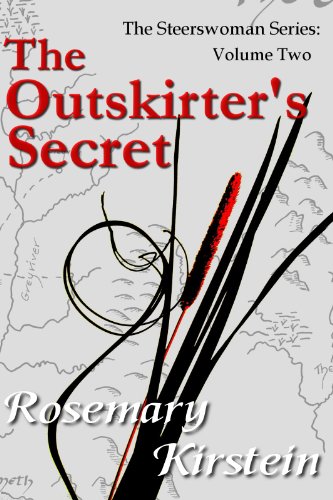
The Outskirter’s Secret — Rosemary Kirstein

Cover of The Outskirter's Secret


The Outskirter’s Secret
Rosemary Kirstein
342 pages
published in 1992

The Outskirter’s Secret is the sequel to The Steerswoman, the second in what’s so far a four book, projected to be seven book series. Kirstein is one of those authors who’ve fallen between the cracks of the science fiction/fantasy field: incredibly loved by those who’ve read her books, but barely known outside that circle of aficionados. The trouble is, for all sort of reasons, she isn’t a fast writer; the first two books in the series were written in 1989 and 1992, the second two in 2003 and 2004, with the fifth scheduled for publishing next year. Perhaps. Which means that, because she’s never been the runaway bestseller kind of author, that her books slip out of print faster than they’re written and you have to luck into finding her books secondhand to be initiated into her cult once you’ve heard people like Jo Walton rave about her. Luckily these days there are ebooks.

The Steerswoman series is science fiction in what looks like a fantasy setting, complete with wizards, dragons and goblins, in which Rowan, the titular steerswoman through her curiosity and intelligence is driven to investigate the nature of her world. Steerswomen (as well as the occasional steerman) are members of what you may call a semi religious order bound to answer any question truthfully as long as in return their own questions are also answered in the same manner. In the first book, Rowan’s curiosity into a peculiar kind of worked blue stone she found made her into a target for a wizard conspiracy. She escaped and in The Outskirter’s Secret, together with her faithful companion Bel, an Outskirter herself, a member of one of the nomadic tribes living in the wildernesses beyond the civilised inner lands, sets out to track down the source of the blue stones, deep in the Outskirts.

Books read…

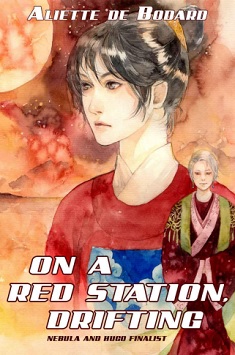
On a Red Station, Drifting — Aliette de Bodard

Cover of On a Red Station, Drifting


On a Red Station, Drifting
Aliette de Bodard
116 pages
published in 2013

I wasn’t too impressed with the first story of Aliette de Bodard I read, when it was linked from Metafilter. I found the story, set in a Vietnamese or Vietnam inspired far future “too laboured, too trying to be interesting, but in the end it’s just another Orientalist allegory”. Which is somewhat ironic, as De Bodard is actually of Vietnamese descent… Can a writer be Orientalist if she’s actually writing from her own cultural background? That’s a question we’re going to come back to in discussing On a Red Station, Drifting as it’s at the heart of the problems I’ve had reading this book.

The reason I bought On a Red Station, Drifting, after that rough start I had with de Bodard was because she was nominated for the novelette Hugo and I discovered that her nominated story, The Waiting Stars, was “an excellent slice of Banksian space opera, a story of love, family and two incompatible views of the world”. On a Red Station, Drifting promised to be more of the same. It’s set in the same universe as The Waiting Stars, where the Dai Viet Empire ruling the stars makes a welcome retrieve from the usual Roman Empire model. At the time of this novel however it’s in trouble, with a weak emperor on the throne and rebel warlords springing up and taking over star systems.

Read more…

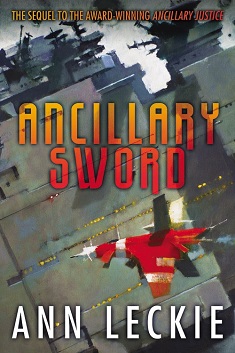
Ancillary Sword — Ann Leckie

Cover of Ancillary Sword


Ancillary Sword
Ann Leckie
356 pages
published in 2014

Ann Leckie’s debut novel, Ancillary Justice, won about every major science fiction award going: the BSFA, the Clarke, The Nebula and the Hugo, the first time any author won the four most important awards in the field with the same book, let alone with their debut novel. Anticipation has therefore been high for the sequel, not least on my part. Would Leckie been able to keep up the high standard of her debut? Would Ancillary Sword build up on it or be more of the same? Is Ann Leckie really the major new sf talent she seems to be or just a flash in the pan?

The main reason for Ancillary Justice‘s impact was Leckie’s use of gender. The Radchaai culture she created uses female pronouns exclusively, making no distinction between male and female in their language. but it goes further than just mere language. Leckie’s protagonist, Breq, struggles with establishing gender, has to consciously evaluate gender clues even when she does speak a gendered language. Possibly this is because she’s an ancillary — one of the meat puppet extensions of a ship AI — because from what we saw in the first novel other Radchaai had no such difficulties. Breq is also the last surviving part of her ship AI because her ship, The Justice of Toren was killed by the immortal ruler of the Radch, Anaander Mianaai, at war with herself.

Read more…