Judgement on Janus — Andre Norton

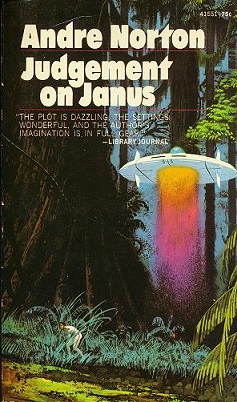
Cover of Judgement on Janus


Judgement on Janus
Andre Norton
188 pages
published in 1963

It’s a miracle: I actually managed to start an Andre Norton series in the right order: Judgement on Janus is the first of a duology, together with Victory on Janus. Another minor miracle is the fact that my copy lasted long enough for me to read it as the cover was flaking off something fierce. Normally Ace paperbacks hold up better. This is actually one of the first Norton novels I’d bought, years ago, but had never read so far.

Naill Renfro is a young man who, caught up in the slums of the Dipple, sells himself as indentured labour (just like Charis Nordholm) in order to have enough money to give his mother a dignified death. He ends up on the planet Janus, where dour religious fanatics fight a never ending battle against the primeval forests covering the planet. These forests they consider a source of evil, as they do many things, especially the alien relics or treasures occassionally found. These are supposed to be reported and destroyed immediately. Those who don’t report it and try to keep them for themselves are punished by god with the green sick and left in the forest to die. Three guesses what happens to Naill.
Read more…

Exiles of the Stars — Andre Norton

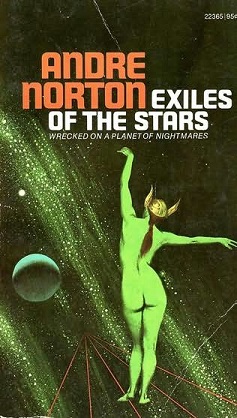
Cover of Exiles of the Stars


Exiles of the Stars
Andre Norton
249 pages
published in 1971

It was clear from the first page that Exiles to the Stars was a sequel and a quick trip to Librarything confirmed that this was a sequel to Moon of Three Rings, which I’ve never read. It’s neither the first nor likely the last time I’ll read a sequel before the original novel and in Norts on’s case, since she wrote before the rise of the epic fantasy series, her novels always tell complete stories, with anything you need to know from earlier books neatly explained. In Exiles of the Stars the things that need explaining are the protagonists, Krip Vorlund and his companion Maelen. Both are not what they seem. Krip outwardly looks like a Thassa, a humanoid alien race, but his midn is human, having taken over the thassa body when his original was destroyed. The same thing happened to Maelen, now inhabiting the form of a glasssa, a small four footed hunting animal where she once had been a woman and priestess on a planet where the priesthood was adept at body switching. All this of course the result of the action from the previous novel.

Their prediciment shows up the important role psi powers and mind control play in Norton’s space opera, as it does here. Many of her heroes either encounter ESP or discover their own talents during their adventures. It can feel a bit old fashioned, on a par with the navigation tapes used to steer the spaceships. But in this case it also shows how large and strange Norton’s universe is, where her heroes are lucky to survive, let alone thriumph. Occasionally in the wrong body.

Read more…

Books read September

Guess what? I actually read some non-fiction this month, in the shape of a history of the 1953 Iranian coup. Apart from that, I’ve also dipped my toes in the troubled waters of Dutch science fiction and fantasy, thoroughly enjoyed Kameron Hurley’s new novel but was slightly dissappointed to still have only read six books in total this month. UPDATE: seven actually, as I completely forgot I’d read The Secret Feminist Cabal this month too.

Zwarte Sterren — Roelof Goudriaan (Ed.)
An anthology of Dutch science fiction I got from the library to find Dutch authors worth reading.

The Mirror Empire — Kameron Hurley
One of the biggest sf&f books of 2014 and it lived up to its hype.

Otherbound — Corinne Duyvis
A Dutch author writing in English, this is Duyvis’ first novel, a well written YA fantasy with one of the more original ideas I’ve seen in fantasy behind it.

The Secret Feminist Cabal — Helen Merrick
A cultural history of feminism in science fiction, science fiction fandom and academic research into science fiction. This is essential reading for anybody interested in the history of science fiction and women in science fiction.

All the Shah’s Men — Stephen Kinzer
An overview of the 1953 coup that ended democracy in Iran and the role the British and Americans played in it. Comes close to victim blaming at points.

The Outskirter’s Secret — Rosemary Kirstein
The second novel in the Steerswoman series of science fiction disguised as fantasy.

Roadside Picnic — Boris & Arkady Strugatsky
A classic of Russian science fiction and the inspiration for the 1979 movie Stalker as well as the more recent S.T.A.L.K.E.R. video horror games.

The Zero Stone — Andre Norton

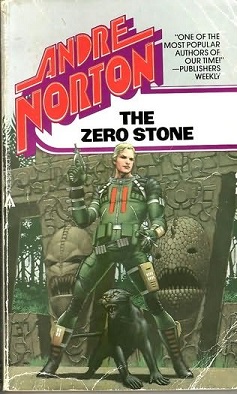
Cover of The Zero Stone


The Zero Stone
Andre Norton
221 pages
published in 1968

You can’t accuse Andre Norton from starting her stories slowly. When The Zero Stone opens, its protagonist, Murdoc Jern is fleeing through a primitive town on an alien planet, barely one step ahead of a mob of religious fanatics wanting to kill him. They already killed his boss when the priests of a local cult indicated the both of them for their next ritual victims, but Murdoc managed to escape. He finally manages to reach the dubious safety of a free trader ship, where his only friend is the ship’s cat, but when it falls pregnant after ingesting a strange stone on the traders’ first stopover and he himself falls ill of a strange plague once the cat gives birth, he learns not only that the trader’s crew plan to abandon him on an airless moon, but also that they had been hired to kidnap him. Luckily for him, the cat’s mutant offspring turns out to be a mysterious and powerful alien intelligence who calls himself Eet and who sets out to save Murdoc from his predicament.

The reason for Murdoc’s continuing bad luck turns out to be the old memento that was the only thing he’d taken from his adopted father’s home, who had been not just a gem trader but also a retired crime Guild boss. This memento is a ring too large to be worn and containing a dull, lifeless stone; it was found on a corpse drifting in space but Murdoc’s father could never find out anything more about it, which is why he called it the zero stone. As you’d expect in a story like this, his son has more success in finding out at least some of the story behind the stone, if only by being dragged behind it in a series of increasingly desparate escapes from danger, aided and abetted by his alien companion.

Read more…

All the Shah’s Men — Stephen Kinzer

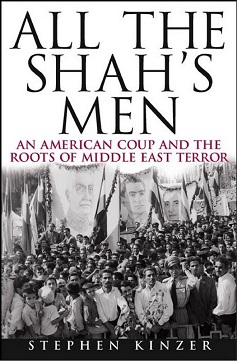
All the Shah's Men


All the Shah’s Men
Stephen Kinzer
258 pages including index
published in 2003

If you read the name Roosevelt, you probably think of the American president during World War II, or perhaps his predecesor Theodore Roosevelt, who gave his name to the teddy bear. But there’s another Roosevelt who has been of some influence in world history, a grandson of Theodore, Kermit Roosevelt, Jr., the man behind the coup against the democratically elected government of Iran in 1953. That was the coup that overthrew a government nominally an ally of the United States, on the behest of a British oil company to install a dictator whose father had had nazi sympathies, who himself would be overthrown a quarter century later in the Islamic revolution of 1979, when Americans were baffled to realise most of Iran hated them, a ahtred that had its roots in 1953.

That 1953 coup is one of those monumental changes in history that are far less well known than they should be. Though not exactly a secret, the American involvement and leadership of the coup is even less known, or at least that was the case when this book was published, in the year the US would invade another former client state, Iraq. These days the sad and sordid story of American meddling in the Middle East is well known, at least to those who paid attention to what happened after 9/11. I’m not sure how much Stephen Kinzer’s book contributed to this though.

Read more…