The Lives of Tao — Wesley Chu

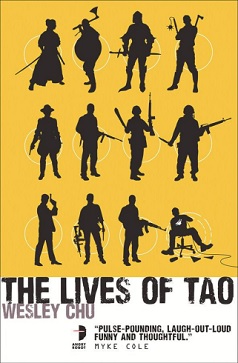
Cover of The Lives of Tao


The Lives of Tao
Wesley Chu
393 pages
published in 2013

I read this because Wesley Chu was nominated for the 2014 John W. Campbell Award for best new writer and it was available in the Hugos Voters Package. I’d also seen it recommended at the local science fiction bookstore and had picked it up once or twice to sample it, though was never convinced enough to buy it. Because I was visiting my hometown for a couple of birthdays this weekend I took the opportunity of two long train journeys to read this, which worked out well.

From Myke Cole’s cover blurb — pulse-pounding, laughout-loud funny and thoughtful — you might guess that this was meant to be an action comedy story, which it was, but without the humour. This just wasn’t funny, I’m not sure it was actually ever meant to be funny and if you read this, set your expectations accordingly. The Lives of Tao actually is a geek wish fulfilment sf thriller, where the fat, underachieving, nerdy slop is taken out of his comfort zone and thrust into a worldwide conspiracy and finally gets the girl he’s been silently lusting after but was afraid to ask out. There may be a bit of pandering in this, you may have guessed.
Read more…

Fugue for a Darkening Island — Christopher Priest

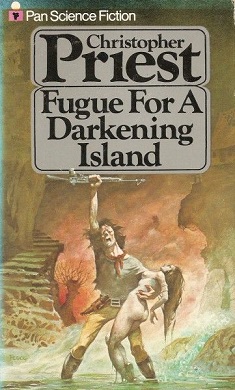
Cover of Fugue for a Darkening Island


Fugue for a Darkening Island
Christopher Priest
125 pages
published in 1972

There are certain protocols you have to take into account as a reviewer when discussing the books of a new, young writer. Protocols that are still in effect when the author has aged more than forty years since the first publication of his novel and has become a grand old man in the meantime, prone to gently correcting younger writers. Anything that can be said about Fugue for a Darkening Island has to be tempered by the realisation that it is a fortytwo year old novel, not necessarily indicative of the writer Priest now is.

But the truth remains that Fugue for a Darkening Island is a problematic work, a novel with its heart I think in the right place, but which features certain unfortunate themes in Priest’s work that will return in later novels, somewhat muted. I’m thinking of last year’s The Adjacent, featuring a near future Islamic Republic of Great Britain as well as the much earlier A Dream of Wessex which had parts of Britain as a caliphate, but also of The Separation and its naive story of a better world created by a separate peace between nazi Germany and Britain. In short, Priest sometimes goes for settings you’d sooner expect to see in the stories of the more reactionary Baen writers and A Fugue for a Darkening Island is one of those novels, a near future Britain ripped straight from the front pages of National Front propaganda, as the country is flooded by a never ending stream of African refugees destroying the British way of life, its hero a decent middleclass Englishman trying to find a new home for him and his family.

Read more…

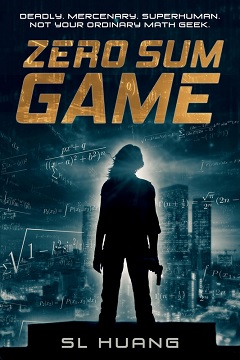
Zero Sum Game — SL Huang

Cover of Zero Sum Game


Zero Sum Game
SL Huang
305 pages
published in 2014

If it wasn’t for her blogging about the renewed SFWA controversies back in January, I would never have heard of SL Huang or Zero Sum Game, her first novel. She’s not the first author I bought books from on the strength of their online writing. I knew Jo Walton and Charlie Stross as Usenet posters before I’d read their fiction and Ian Sales as a blogger before I read his Apollo Quartet books. It’s of course not guaranteed that somebody who’s a good blogger or poster is also a good fiction writer, but so far I haven’t been disappointed.

Zero Sum Game opens with its heroine tied down to a chair watching the fist of Rio, the one man in the whole world she trust coming at her face hard and fast enough to break her jaw. As she watches, lines of force, numbers and probabilities dance before her eyes, giving her a way to take the blow without getting more damage than a split lip. Barely a minute later she sees a way in which she can free herself, kill the four Columbian mobsters in the room and knockout Rio, all while evading the thugs’ gunfire, and takes it, escaping just as more thugs come barreling in. Jumping through the only outside window calculated in such a way as to not get herself torn to pieces, shen then doubles back to get the woman she needed to rescue from the gang, knocks out the guards outside with perfectly aimed rocks thrown to their foreheads and escapes in a hotwired jeep. All in a day’s work for Cas Russell, math savant extraordinaire.

Read more…

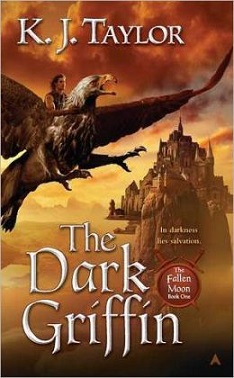
The Dark Griffin — K. J. Taylor

Cover of The Dark Griffin


The Dark Griffin
K. J. Taylor
369 pages
published in 2009

One of the things I’ve been trying to do more of these past five years or so has been to try out more new to me authors. K. J. Taylor is one of these authors, an Australian fantasy writer whose Black Griffin looked interesting when I was browsing the Amsterdam library shelves. I had no choice but to like a writer who said of herself: “a lot of fantasy authors take their inspiration from Tolkien. I take mine from G. R. R. Martin and Finnish metal”. A bit of research online discovered that she isn’t even thirty years old, published her first book at twenty in 2006 and has had seven books published since. Which makes her on a par with Elizabeth Bear with regards to productivity (and here I have trouble writing a blogpost sometimes…)

The Dark Griffin is the first in a fantasy trilogy, which in turn was followed by another trilogy. You may suspect therefore that this is pretty much a setup book and you may be right. What this is, is an origin story, both of the titular dark griffin (literally, as the book starts with his birth) and his ride, Arren Cardockson. As the story starts Arren is the only Northerner griffin rider in the city of Eagleholm, of far humbler origins than his fellow griffineers. His parents are freedmen, ex-slaves, while all other griffin riders are aristocrats. Nevertheless and despite the occassional tension, he feels well supported by the city’s elite. Even more so when lord Rannagon, one of the leaders of the griffiners and master of law, suggest a way for Arren to get out of his money problems.

Read more…

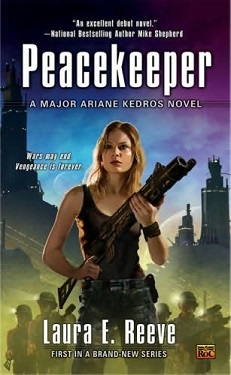
Peacekeeper — Laura E. Reeves

Cover of Peacekeeper


Peacekeeper
Laura E. Reeves
324 pages
published in 2008

Peacekeeper is the sort of novel you pick up knowing full well it’s probably not going to be very good, but hopefully will be entertaining. It helps, if like me, you have a bit of a weakness for military science fiction and are willing to lower your standards. Once you’ve voluntarily read David Weber’s Honor Harrington series the chances are you’ll read most anything. And, to be honest, Peacekeeper wasn’t that bad. Very much the first novel in a trilogy, but decently paced and competently written. I’m not sure I’ll go out of my way to read the sequels, but wouldn’t pass them up either If I came across them.

Ariane Kedros is the pilot of the scout ship Aether’s Touch, which she runs together with her employer Matt Journey. She’s also a reserve major int he military of the Consortium of Autonomous Worlds, which has just fought a brutal war with the Terran Expansion League, until strong hints from the Minoans — the aliens who had uplifted humanity into space and faster than light travel — put both parties at the negotiating table. Though nobody but Ariane’s superior, colonel Owen Edonus of the Directorate of intelligence, knows, in the eyes of the Terrans she’s also a war criminal, having piloted the ship that destroyed an entire solar system using temporal distortian weapons. As part of the peace treaty both sides will have to stand down and destroy said weapons and colonel Edonus has tapped Ariane to be part of the team that will escort a Terran inspection team at one of the CAW’s facilities. He of course has a hidden motive for this: somebody is killing off the people involved in the mission that made Ariane a war criminal and she’s put out as bait…

read more…