Books read January

With the first month of 2014 done, I’m reasonably satisfied in what and how much I’ve read. Eight books, five science fiction, one fantasy, two non-fiction. Could be better, could be worse. Five female writers, three male; I’m still trying to keep a rough gender equality in what I read.

Key out of Time –Andre Norton
Another novel in the series that started with Time Traders finds Ross and friends stranded in the prehistory of an alien planet. More decent young adult adventure science fiction.

Rocannon’s World — Ursula K. LeGuin
An early LeGuin science fiction novel, not nearly as good or interesting as the novels she made her reputation with, but still of interest for fans.

Women in Medieval Europe 1200-1500 — Jennifer Ward
A thorough introduction to the roles women could and did play in the late middle ages.

Soviet Operational and Tactical Combat in Manchuria, 1945 — David Glantz
An examination of the Soviet campaign against the Japanese late in World War II, in which they basically crushed the Japanese forces in Manchuria in barely a week.

Pushing Ice — Alastair Reynolds
When Janus, one of Saturn’s moons, turns out not to be and leaves it orbit, only the Rockhopper is in place to follow it. Just another gritty Reynolds hard science fiction bravoura.

The Killing Moon — N. K. Jemisin
First in a duology (so far) of fantasy novels inspired by certain aspects of Egyptian history and mythology.

Zoe’s Tale — John Scalzi
The fourth in Scalzi’s Old Man’s War series, a retelling of the third one, now told through the eyes of the seventeen year old daughter of that novel’s protagonists.

Ascension — Jacqueline Koyanagi
Alana Quick is a starship engineer in a galactic wide depression when nobody needs starship engineers anymore. She stows away on the Tangled Axon and falls in love with its captain, Tev, — “blond hair, boots and confidence”.
Ascension — Jacqueline Koyanagi

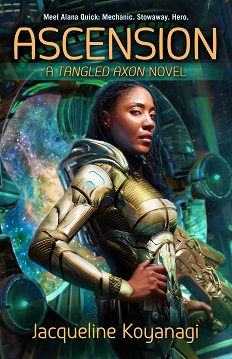
Cover of Ascension


Ascension: A Tangled Axon Novel
Jacqueline Koyanagi
331 pages
published in 2013

It was the woman on the cover which drew me to this novel and the subtitle which almost scared me off again. The woman attracted me because it’s not often you actually do see a woman of colour on the cover of a science fiction novel, sometimes not even when the heroine is indeed a black woman. Seeing that got me to pull Ascension off the shelves, but reading the subtitle A Tangled Axon Novel almost made me put it back because it made it sound as if this was a novel in an established series, rather than a first novel. Luckily the inside cover blurb mentioned that this was Jacqueline Koyanagi’s first novel, so I took a punt. Not having heard of her or her novel before, in the end the cover as well as reading the first few pages were enough to make me want to read this.

And I’m so glad I did, because this was a glorious, wonderful mess of a book. Reading it, especially in the first couple of chapters, you get the idea that the author is only showing you glimpses of a much larger universe she’s been carrying around in her head for a long time, therefore occasionally making oblique references to things she knows and which are completely clear to her, but doesn’t quite explain to the reader. That’s the messy part of the book. The glorious and wonderful parts are its characters, its protagonist especially. Alana Quick is a sky surgeon, a starship engineer in the midst of a depression when nobody needs starship engineers because starships are obsolete. Her ex-wife left her for a career with Transliminal Solutions, the company that made them obsolete, her sister Nova has a flourishing career as a spirit guide, relieving rich clients from their anxieties, while her own obsession with space, with the Big Quiet, makes her unsuitable for anything but repairing spaceships even if the hard physical labour does her chronic nerve disease no favours. Having to deal with a debilitating disease while barely making ends meet, is it any wonder she stows away when the Tangled Axon comes looking for her sister? Or that she falls in love with the ship’s glamorous captain Tev — “all blond hair, boots and confidence”?

Read more…

Zoe’s Tale — John Scalzi

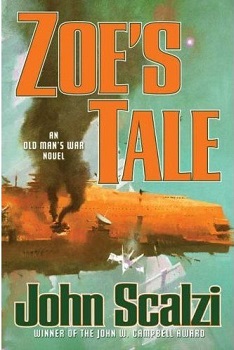
Cover of Zoe's Tale


Zoe’s Tale
John Scalzi
406 pages
published in 2008

John Scalzi’s Old Man’s War was popular enough to spawn four sequels so far, of which Zoe’s Tale is the third. Military science fiction set in a Heinleinian dog eat dog universe, with hundred of alien races competing for new colonies and humanity only a middling power, the first three novels in the series followed new recruit John Perry and Special Forces specialist Jane Sagan through increasingly high stakes adventures, in the process learning that the Colonial Defence Forces they’re fighting for might not be entirely trustworthy. Things came to a head in the third novel, The Last Colony in which John and Jane, as leaders of the latest colony founded by the CDF had to fight off the Conclave, a four hundred members strong alien alliance as well as the CDF’s own plans to turn the colonists into martyrs. Amongst those colonists? Their own, adopted, daughter Zoë.

As you may have guessed from the title, Zoe’s Tale retells and extends the story of The Last Colony from Zoë’s point of view. On its own it’s therefore slightly less than a whole novel and can only be properly understood if you’ve read the previous novel. Things happen for reasons that are only partially explained, with major plot developments happening off screen, “as you know bobbed” later; at the same time Zoe’s Tale was partially written to explain some of the plot holes from The Last Colony. For me, it had been more than two years since I’d read it, so some of its plot was a bit hazy while reading this; not entirely dissimilar to Zoë’s experiences.

Read more…

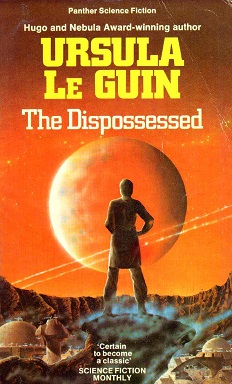
The Dispossessed — Ursula K. LeGuin

Cover of The Dispossessed


The Dispossessed
Ursula K. LeGuin
319 pages
published in 1974

After the Earthsea trilogy and of course The Left Hand of Darkness, The Dispossessed is arguably Ursula LeGuin’s most famous novel. It was one of a small group of novels in the early seventies –including e.g. Joanna Russ’ The Female Man that took the American New Wave and science fiction as a whole into a much more explicit political direction. It’s a novel that’s still controversial today, or at the very least can still lead to heated debates. The Dispossessed has been hugely influential in radicalising whole generations of fans, while there are plenty of conservative science fiction fans for whom its is a symbol of everything that went wrong with science fiction in the seventies.

The Dispossessed, firmly in the utopian tradition of Herland and looking Backward is a travelogue, set on the double planets of Urras, stand-in for seventies America and Anarres, the “ambiguous utopia” of the subtitle. The protagonist Shevek is a brilliant young physicist whose passion for science leads him to travel from his anarcho-syndicalist home planet to Urras because there he hopes to find the support he needs to finish his thesis. In alternating chapters we get to see his journeys to and on Urras as well as his upbringing and life on Anarres.

Read more…

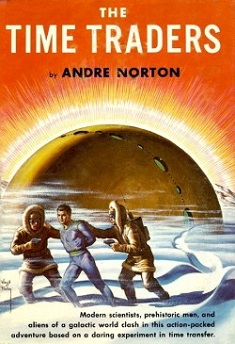
The Time Traders — Andre Norton

Cover of The Time Traders


The Time Traders
Andre Norton
191 pages
published in 1958

If it wasn’t for Project Gutenberg I might’ve never read this novel. Though Andre Norton was one of the most prolific US science fiction writer, mostly writing what we’d now call young adult novels, she never was translated into Dutch much so was missing when I went through my personal Golden Age. It’s only in the last couple of years that I’ve started to catch up with her, in no small part thanks to Gutenberg’s collection of her works. Because until roughly the seventies, American copyright was only valid for a limited time and had to be explicitly renewed, a lot of science fiction pulp and early paperback stories entered the public domain. In this case, the copyright on the original 1958 hardcover publication of The Time Traders was never renewed, making it fair game for Gutenberg.

I picked this out of the available Nortons for two reasons: it was the first book in a series and more importantly, it was a time travel story. It had been a while since I’d last read a good, old fashioned time travel story and this seemed to fit the bill perfectly. After all, it has time agents who have to travel undercover through prehistoric times to find the ancient civilisation from which the Soviets are getting sophisticated weaponry and technology they couldn’t have possibly produced themselves.

Read more…