Moar book loot

slightly too many books bought

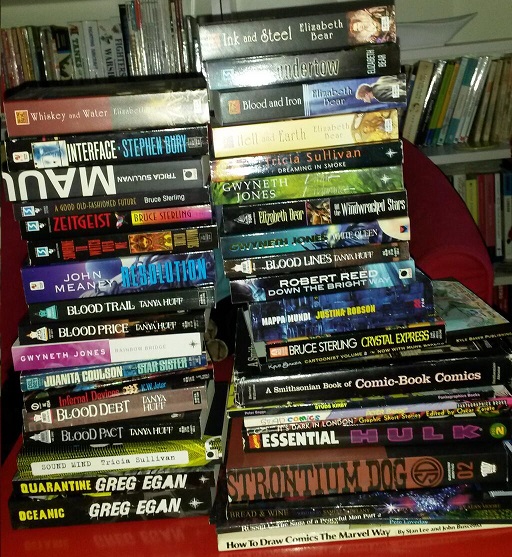
So on a whim I decided to go to my favourite secondhand bookstore in Amsterdam, only to find they’d just gotten a shedload of science fiction/fantasy in as well as added a new comics section. This led me to getting slightly more books than I’d counted on.

But at least I got a lot of books I’d been looking for for donkeys. Tricia Sullivan’s Maul for one, as well as Dreaming in Smoke, sound Mind and Someone to Watch over Me. There’s Justina Robson’s Mappa Mundi and Robert Reed’s Down the Bright Way, as recommended by Jo Walton, several Bruce Sterling books (Crystal Express, Zeitgeist and A Good Old-Fashioned Future), the last in a John Meaney trilogy (Resolution) I needed, two Greg Egan books: Quarantine, Oceanic and one of K. W. Jeter’s steampunk novels (Infernal Devices).

I also got Tanya Huff’s complete Blood … series, a lot of Elizabeth Bear’s Promothean Age novels (as well as her science fiction novel Undertow) not to mention some more Gwyneth Jones books: Rainbow Bridge, White Queen and Divine Endurance as well as a Juanita Coulson novel, Star Sister to try out and perhaps review for SF Mistressworks.

Comics wise it was a mixed bag: two Pete Bagge collections of early, Neat Stuff work, an Marvel Essential Hulk collection, How to Draw Comics the Marvel Way, two volumes of Russell: the Saga of a Peaceful Man, A Smithonian Book of Comic-Book Comics, a thick slab of Strontium Dog, Oscar Zarate’s It’s Dark in London, a Samuel Delany adaptation, Bread and Wine and finally, Kyle Baker Cartoonist Volume 2.

And then I got home and the latest volume in Kevin O’Neill and Alan Moore’s League of Extraordinary Gentlemen was waiting for me…

Books read February

February was dominated by one book and one book only: Samuel R. Delany’s Dhalgren, which I started at the beginning of the month and only finished in the last week of February. Very unlike me, I couldn’t read anything else beside it, because this was a book that demanded and got my full attention. I needed to concentrate to read it and when not reading it, I had no desire left for other books.

Fortunately Dhalgren is a masterpiece, one of the greatest novels ever produced as science fiction, so I didn’t begrudge its monopoly claim on my reading.

However, I did manage to squeeze one other book into my reading at the end of the month, K. W. Jeter’s Morlock Night which, as both Jeter and afterword writer Adam Roberts take great pains to tell you, is one of the books that created the steampunk genre back in the late eighties. I’m not actually sure I agree with that: there were steampunk books published before it that actually have more in common with the genre as it exists now than this book does. It’s also not as good a book as it thinks it is, glorified pulp ultimately.

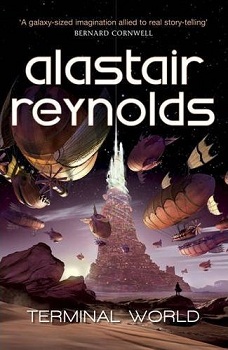
Terminal World — Alastair Reynolds

Cover of Terminal World


Terminal World
Alastair Reynolds
487 pages
published in 2010

I find Alastair Reynolds hard to review. I like his work well enough to keep reading his novels, but I find it hard to say anything useful about them. As a writer, he has his feet planted firmly in the hard science fiction camp, where “hard” means no FTL ships or time travel and only the right sort of technobabble and jargon. He is however, unlike far too many American hard sf writers, not blind to literary virtues and not half bad at creating plausible, lived in futures either. All in all, most of his novels are solid, core science fiction, where if you like that sort of thing you’ll like them, but perhaps with not much to talk about other than the plot or the setting. They’re evolutionary, rather than revolutionary novels.

Terminal World is a case in point. This is a standalone adventure story set in the far future, where the world as we know it has changed considerably. It’s slowly dying, with what remains of humanity clustered on and around a gigantic artificial spire called Spearpoint, which from top to bottom is divided into zones of ever decreasing technology: Circuit City, Neon Heights, Steamtown, etc. Transfering from one zone to another is not easy: people who do it suffer from zone sickness, while higher technology stops working in a lower tech zone. Away from Spearpoint the world is largely wilderness, with the various zones becoming much larger as they spread out from the spire. What we have here in fact, is the planetary equivalent of Vernor Vinge’s Zones of Thoughts he divided the galaxy in, in A Fire Upon the Deep and sequels. It’s a great setting, with a never quite revealed secret at the heart of it observant readers might puzzle out for themselves.

Read more…

Ancillary Justice — Ann Leckie

Cover of Ancillary Justice


Ancillary Justice
Ann Leckie
385 pages
published in 2013

It’s funny how you don’t notice how ingrained gender is until you get your nose rubbed in it. In Ancillary Justice, Ann Leckie makes it clear by the third page that when her protagonist Breq uses “she” and “her” she uses it as a neutral pronoun, yet unless I paid close attention or Leckie explicitly outed a character as male, I kept thinking of every character she meets as female. That’s I think a response more readers will have, as we’re just not used to thinking of the female form as universal; traditonally it has always been “he” or “him”, or something like singular “they” for those of us aware that the male isn’t actually universal. It may seem like a too clever writing trick, a clumpsy attempt at showing the reader the gender assumptions build into the very language we use, but I don’t think this is actually what Leckie had in mind. What it does instead is establishing the fundamental strangeness of Breq herself even before we learn she’s the last remaining component of a thousands years old warship’s AI.

That consistent use of “she” and “her” foregrounds the difference of the Radchaai culture Breq comes from. It’s a bit of unexplained strangeness that tells a lot about their society, culture and history, most importantly that the Radchaai are inherently matriarchal in the same way most if not all actually existing human societies are patriarchal. But there’s more going on with Breq’s gender blindness, as other Radchaai seem to have far less trouble differiating between men and women, even if they use the same pronouns for both. Meanwhile Breq not only has pronoun troubles, she also has trouble remembering which secondary sexual characteristics are male and which are female. It’s this that singles her out as not quite human.

Read more…

Plague Ship — Andre Norton

Cover of Plague Ship


Plague Ship
Andre Norton
192 pages
published in 1956

Hold on to your tail fins, space fans. This retro rocket boosted tale is sure to knock you out of your orbit. Oy, did this very fifties future slang get old fast in Plague Ship. This is another of Norton’s books at Project Gutenberg and mildly irritating as its language occasionally was, it was also the perfect kind of light adventure science fiction to be read in small snatches on my phone, while getting coffee at work.

Plague Ship is the second in Norton’s Solar Queen series, about the adventures of the crew of the ship the series is named after, free traders trying to eke out a living making the kind of trading deals the big companies can’t. The Solar Queen is literally a huge rocket ship, complete with humongous fifties tail fins to land on. Amongst its crew is Dane Thorson, Cargo-master-apprentice and our hero, prone to saying things like “rest easy on your fins” and “right up the rockets” and all other sorts of horrid expressions you have to read around.

Read more…