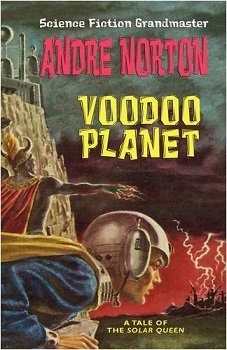
Voodoo Planet — Andre Norton

Cover of Voodoo Planet


Voodoo Planet
Andre Norton
192 pages
published in 1956

Genre science fiction got its start in the pulp magazines of the twenties and thirties and many of its early writers were just pulp authors writing the same old stories they’d always written, just with some sf flavourings. So instead of the brave sheriff depending on his horse and trusty six gun to fight off the bandits out in the Oklahoma badlands, you got the brave space marshall depending on his trusty rocket and raygun to take out the bandits hiding out in the Martian badlands. It’s this what fans meant when they talked about space opera, before that got co-opted for something more respectable, crappy fake science fiction stories that might just as well have been westerns. As the field matured and new writers moved in actually interested in science fiction as a genre, these stories quickly disappeared.

Or did they?

“It’s possible I have bitten off more than I can chew”

I’m more than slightly in awe of Olivia Waite. For the blogging from A to Z in April challenge she decided to do a series of posts on intersectional feminism in Romance, leading to such gems as this review of Sandra Hill’s Frankly My Dear:

This is the petty tyranny of inconvenience — just as the heroine believes that her individual comfort somehow justifies the enslavement of roughly a hundred other human beings, romance readers feel it’s inconvenient and uncomfortable to reflect on the ways the genre not only has marginalized but continues to marginalize not only characters, but also readers and authors of color. This book was not written by an obscure self-published writer with a small niche audience. Sandra Hill is a New York Times bestselling author, a genre mainstay for the past two decades; she is still writing books set in the contemporary South, though I am certainly not going to read them.

In her introduction post she sets out how she will do this:

Every day in April, Sundays excepted, I will post about an author or a book that features something other than the straight white wealthy cis able-bodied mold romance is so wedded to (see what I did there?). These will not be reviews in the usual sense, though I will usually mention whether or not I find a book compelling as a romance. Instead, these posts will be literary or structural analyses with a feminist lens, using as much privilege-checking as I know how to bring. Many of the books are no longer new, so if you can think of more recent releases that grapple with the same issues, please mention them.

Every day in April, Sundays excepted, I will post about an author or a book that features something other than the straight white wealthy cis able-bodied mold romance is so wedded to (see what I did there?). These will not be reviews in the usual sense, though I will usually mention whether or not I find a book compelling as a romance. Instead, these posts will be literary or structural analyses with a feminist lens, using as much privilege-checking as I know how to bring. Many of the books are no longer new, so if you can think of more recent releases that grapple with the same issues, please mention them.

Sometimes, as with Sandra Hill’s novel, this means looking at a problematic work to see what it’s doing wrong and what this means for romance as a genre, sometimes, as with Jacqueline Koyanagi’s Ascension, it means looking at a book that gets it right and show how it does it:

It’s easy to say that Jacqueline Koyanagi’s luscious debut Ascension ticks just about every box on the anti-kyriarchy bingo card: our heroine is a queer disabled woman of color (in space!). She falls in love with a disabled starship captain who’s in a polyamorous relationship with another queer woman: a medic who plans on having children with a man-slash-engineer-slash-sometime-wolf. But like we saw with Her Love, Her Land, this book was written from deeply within the perspective of the identities it represents. The characters’ disability is a plot point, but it’s not The Plot Point — the same goes for queerness and race: they’re baked in, functions of character rather than Moving Moments. Polyamory gets a bit more of the Very Special Episode treatment, but this aspect is presented as bridging a gap between two different planetary cultures, one more sexually conservative than the other.

And all the characters are compelling, and several scenes made me gasp out loud (Adul!), but what I can’t wait to talk about is how this book treats the problem of humans having bodies.

And I’m so glad that finally not only has somebody else heard of Ascenscion, but she seems to like it as much as I liked it. It’s a novel I found only by accident, in the for sale section of a local bookstore and which nobody else online seems to have read, unlike say Ann Leckie’s Ancillary Justice, which is somewhat similar.

I’m not much of a romance reader myself, but it is interesting to read these reviews and certainly some of them make me curious about the books reviewed, like e.g. Jeannie Lin’s Jade Temptress or Zora Neale Hurston’s Their Eyes Were Watching God. It’s impressive not so much to write a post each day — I’ve managed to do that for long periods of time myself — but rather to write such substantial and insightful posts on such a difficult subject day after day.

(Found via Natalie Luhrs, who has a knack of finding interesting, chewy sort of links.)
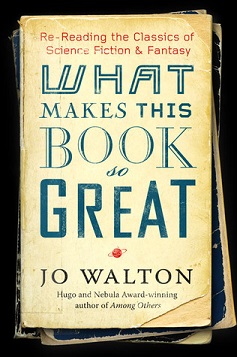
What Makes this Book So Great — Jo Walton

Cover of What Makes this Book So Great


What Makes this Book So Great
Jo Walton
446 pages
published in 2014

What Makes this Book So Great is that it’s written by Jo Walton, who has a real talent for making you both reconsider books you know well or long for books you’ve never heard of before. I’ve known Jo for almost twenty years now, from when we both independently discovered internet, usenet and rec.arts.sf.written, where it didn’t take long for her to become one of the most interesting posters there. It was no great surprise that she became a professional writer, or that Tor would ask her to do the same thing she did on usenet on their website, the end result of which is this book. You could call it the non-fiction counterpart of Jo’s Hugo and Nebula award winning Among Others

What this is than is a collection of some 130 columns written for tor.com in 2008-2010, mostly discussing a single book, sometimes going into more general topics about reading books. As Jo makes clear from the start, she isn’t a critic and she’s not reviewing these books, she’s just writing about the books she’s reading and why she likes them. Because she’s been reading for a long time, because she’s a writer herself, because she’s been thinking and talking about books, about science fiction in the ways only an intelligent lifelong reader can, these columns are interesting whether or not you’ve read the books in question.

Read more…

Books read March

I struggled with my reading this month, starting but not yet finishing several novels (The Creative Fire, Deathless), “Wasting” a lot of reading time. Two fantasy novels, one science fiction, two non-fiction books this week. The Shadowed Sun — N. K. Jemisin
Second in a duology of Egyptian inspired fantasy set on a world orbiting a gas giant, this one deals with the consequences of the end of the last one.

Dark Eden — Chris Beckett
This won last year’s Arthur C. Clarke Award. It’s a decent enough sf heartland adventure story, but fell somewhat flat for me.

The European Colonial Empires 1815 – 1919 — H. L. Wesseling
An overview of the height of the European colonial system.

What Makes this Book So Great — Jo Walton
What makes this book so great is Jo Walton, who gets you passionate and interested in books you may never have considered otherwise.

Blood Price — Tanya Huff
First in an urban fantasy series. Not normally my cup of tea, but everything I’ve read of Huff I liked, so I bought more or less the entire series in one go.

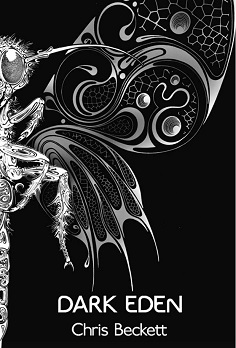
Dark Eden — Chris Beckett

Cover of Dark Eden


Dark Eden
Chris Beckett
404 pages
published in 2012

Dark Eden won the 2013 Arthur C. Clarke Award and was also a finalist for the BSFA Award, which is why I got it from the library when I saw it there. It won against fairly stiff competition like Ken MacLeod’s Intrusion as well, so I was curious to see if it was worthy of the win. To be honest, I was slightly disappointed. This isn’t a bad novel, but it’s a bit on the slight side for my liking.

To start with the positives, the world Beckett depicts in Dark Eden, a planet far out in interstellar space, a rogue wanderer without a sun, with life only possible through the presence of geothermal energy, which the local lifeforms have evolved to make use off one way or another. Trees grow out of the heat channels running from the planet’s core, the basis for a complex ecology that luckily for the people that crashed into Eden, turns out to be compatible with human life. Five people landed on Eden, three people decided to try and leave again, two remained behind and started a family. Twohundred years later their descendants number roughly fivehundred, still living in the same valley their ancestors landed in, having degenerated into hunter gatherers, losing most skills and knowledge of their ancestors in the process.

Read more…