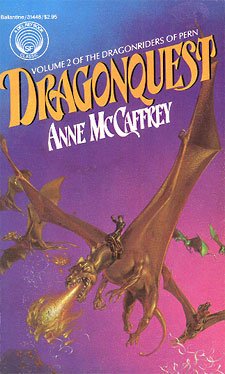
Dragonquest — Anne McCaffrey

Cover of Dragonquest


Dragonquest
Anne McCaffrey
303 pages
published in 1968

Rereading Dragonflight/Dragonquest I realised something: Anne McCaffrey’s influence on modern fantasy is highly underrated. The Dragonriders of Pern after all was a bestselling series long before a Robert Jordan, J. K. Rowling or Stephenie Meyer had even started writing, functioning as a gateway drug into fantasy and science fiction for a lot of young teenagers the way e.g. the Potter books do now. Yet she is rarely mentioned when we’re talking about the evolution of fantasy, with the potted histories of the genre usually starting with Tolkien, lightly touching on an Eddings or Brooks before getting to the fantasy boom of the nineties and beyond with Jordan, Goodkind, Rowling, Martin et all. Is it just because when the Pern books were first published fantasy was still science fiction’s poor cousin and they were therefore sold as sf?

Certainly the streamlining of genre history often has the side effect of erasing all the awkward, not quite fitting parts of it, in favour of a more teleological approach and too often these awkward fits are female pioneers like McCaffrey. More so than Tolkien she helped shape what modern epic fantasy looks like. The loner, young adult hero or heroine, in telepathic contact with his or her dragon, saviour of the world though looking extremely unlikely to be so at first, all taking place in a largely medivaloid world, that’s all McCaffrey. But there are differences with modern fantasy as well: her dragons were made by science, not magic.
Read more…

So how many female writers do you review?

Over at Lady Business, they’ve looked at the coverage of female writers on science fiction and fantasy blogs:

Project thesis: when looking at a sample of bloggers reviewing SF/F, a majority of men will skew toward reviewing more men. A majority of women will skew toward a more equal gender parity, or the opposite in which they review a majority of women. There will be a handful of outliers.

Which meant it was time to check my own reviewing, to see whether or not I’m an outlier or not. A few years ago I re-examined my reading habits, coming to the conclusion I read too few female writers, then set out to correct this. However, though I strive to review each book I read, the reality is that I largely don’t succeed in doing so. Last year I read 91 books, but reviewed only forty.

Luckily I keep track of which books I review each year, so it was easy to do the math. I reviewed forty books, of which twentyfour were written by men, sixteen by women, for a very clean division of sixty to forty percent male vs female writers reviewed. That’s better than how the average male reviewer is doing in the Lady Business study (74 to 25 %), worse than the average female reviewer (42 to 58, slightly more skewed towards female writers) and still not gender balanced.

The numbers are somewhat skewed by my Pratchett rereading project, which accounts for eight of those twentyfour, or a third of my male writers. Without those, the ratio switches to sixteen male to sixteen women, or a perfect fifty/fifty split. All done by accident though.

Books read February

Seven books read, four Terry Pratchett Discworld novels as part of my ongoing quest to reread them all.

Feet of Clay — Terry Pratchett
The third Discworld city watch novel and the first in which the focus is less on the doings of the Watch itself, and more on the broader politics of Ankh-Morpork.

Holy Disorders — Edmund Crispin
Another dry humouristic detective novel by Crispin

Head Hunters — Steven F. Pond
An excellent look at how the classic Herbie Hancock jazz fusion album was created and the context in which it was recorded.

The Secret State — Peter Hennessy
The evolution of the UK’s nuclear policy over the decades and how this influenced the shape of the secret state.

Hogfather, Jingo, The Last Continent — Terry Pratchett
Three more Discworld novels, including the last Rincewind novl.

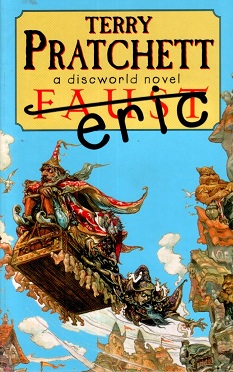
Faust Eric — Terry Pratchett

Cover of Eric


Faust Eric
Terry Pratchett
155 pages
published in 1990

Eric is a bit of an odd duck in the Discworld, out of place amongst the increasing sophistication of the last couple of novels coming before it, almost a throwback to the very first few books. It’s a lot shorter, a lot less serious and a lot more written for comedic effect than its immediate predecessors were. All of which can be explained by the simple fact that it was first published as an illustrated book, written around a series of Josh Kirby illustrations, which was later adapted into standard Discworld paperback format, losing most of its charm in the process.

A word about Josh Kirby is needed at this place. Kirby was of course the cover artist for all the Discworld novels up until his death, Thief of Time being his last novel. His work was incredibly caricatural in nature, with very exaggerated figures and bright colours, not really to everybody’s tastes. Some might have found it a bit childish even, but I always liked it. To me his covers were Discworld, especially the early novels when it wasn’t all taken that seriously yet even by Pratchett himself. Therefore it made perfect sense to do an illustrated Discworld story with his drawings, just like his replacement as cover artist, Paul Kidby, would do with The Last Hero.

Read more…

Books read January

So we start the sixth year of doing these monthly Wot I Done Read Last Month reports. Back in 2008 I started doing them to at least record something about the books I’d read, as I felt guilty about falling behind with my booklog; something which hasn’t been solved yet. Oh well.

In the meantime, I’ve read five books this month, somewhat below par.

Soul Music, Interesting Times — Terry Pratchett
Two Pratchett novels, of which the latter shows the return of Rincewind and the former stars Susan the first time. Decent but not the best of the Discworld series.

Exit Music — Ian Rankin
The last Rebus novel, as he’s finally retiring. Some loose ends are cleaned up, some aren’t. Even more melancholy and sombre than usual.

The Dark Reign of Gothic Rock — Dave Thompson
A decent chronological history of a sometimes deservedly, much maligned genre, that is smart enough to limit itself to a specific period and grouping of bands, the original English gothic bands like Bauhaus, the Cure and the Cult.

Maskerade — Terry Pratchett
Another Discworld novel, starring the Lancre witches. Doing opera this time.