Saga — Brian K. Vaughan and Fiona Staples

So a couple of months ago I talked about Prophet and how much it seemed influenced by European comics. Well, Saga is another Image series that could’ve just as well been published in Metal Hurlant or A Suivre. It’s written by Brian K. Vaughan, known to me from Y: The Last Man and Ex Machina, but whom I haven’t yet read anything from and drawn by Fiona Staples, who I know nothing about but who is seriously good here. Especially her facial expressions:
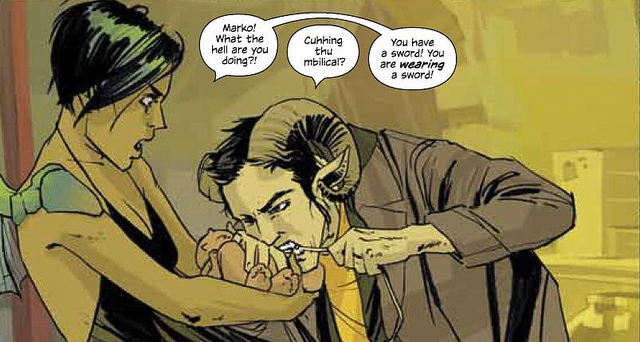
Saga - cutting the umbilical cord

Saga is the story of Alana, the woman on the left and Marko, the horned dude, starcrossed lovers in a galaxy at war. Alana is from Landfall while Marko is from Wreath, its moon and these two have been at war for seemingly forever, having outsourced it to the rest of the galaxy. Alana and Marko met on Cleave, the latest planet to become a battlefield when he was a POW and she his guard, fell in love and deserted. Now they have to get off planet while taking care of their newborn baby. Hijinks ensue.
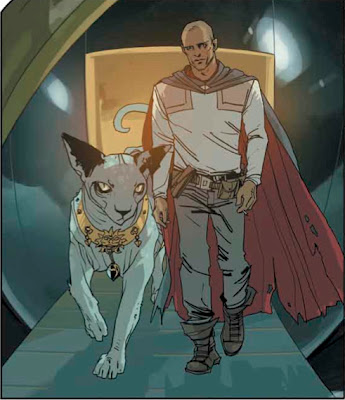
Saga - The Will and the Lying Cat

Both sides meanwhile want them dead. From Planetfall Prince Robot IV is sent to Cleave to hunt them down, while Marko’s people have hired freelancers to do the same. That’s one of them above, The Will, with his partner Lying Cat, who can tell if you’re lying to her. The other freelancer is The Stalk, below, whom The Will has history with.
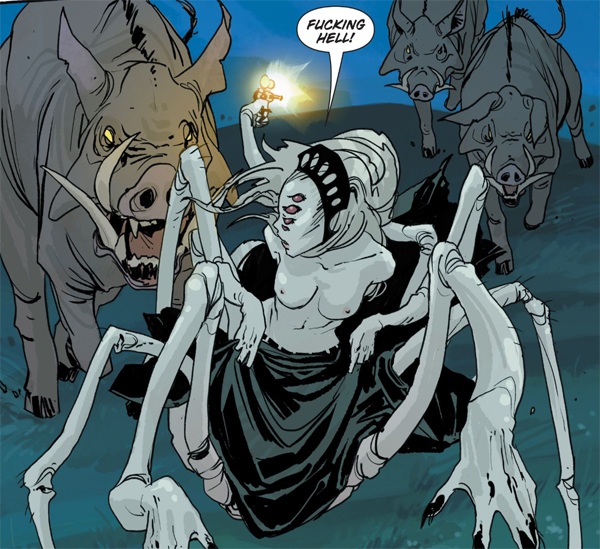
Saga - The Stalk

The story moves slowly over the course of the six issues represented in the first trade paperback, with Marko and Alana trying to get to the Rocketship Woods on the other side of Cleave, while The Will, The Stalk and Prince Robot IV all attempt to catch up to them, one way or another.
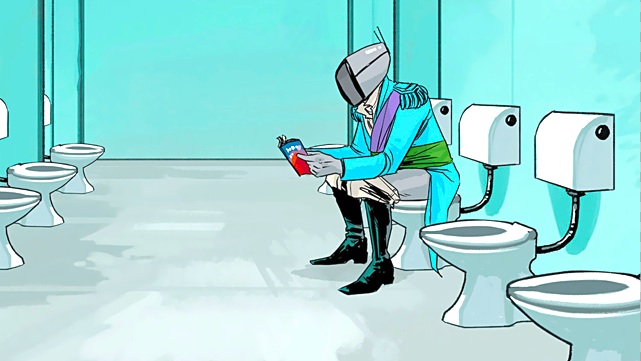
Saga - Prince Robot IV

What makes Saga more than just a pretty sci-fi adventure is the simple fact that none of the main characters are true villains or heroes. Alana and Marko just want to live in peace with their daughter, to be left alone, while Prince Robot IV just want to get things over with so he can go home to his pregnant wife. Even the two freelancers are anything but Boba Fett like bounty hunters, with The Will frex having confliced feelings about his former partner, The Stalk.
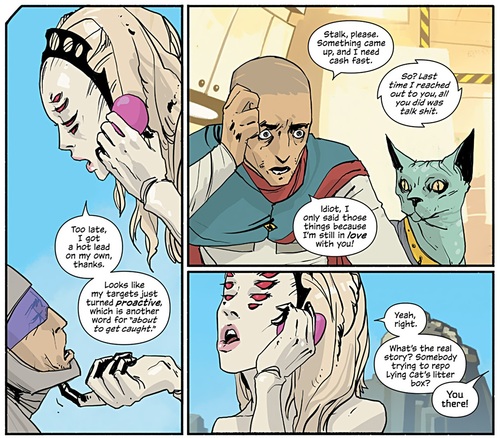
Saga - The Will and the Stalk

But what really makes the series is the artwork; as said Staples is seriously good at facial expressions, slightly exaggerated at key moments, but also has a good eye for character design and layout in general. In general, like Prophet, this is a series that actually makes me enthusiastic about American comics again, something that shows there are still pleasant surprises to be had.
Books read December

And so we’ve reached December and the year’s total: ninetyone books read in total, the first time since 2006 that I’ve read less than a hundred books — and even this number is somewhat inflated by my reread of the entire Discworld series. I blame my obsession with Football Manager — as well as other videogames — this past year for this, for keeping sitting behind the pc for much longer and hence reading less. I also seemed to have less energy for reading and in general 2012 was somewhat of a year of recuperation for me, for obvious reasons.

Terminal World — Alastair Reynolds
Alastair Reynolds does steampunk in a far future world where Vingean zones make high technology possible in some parts of the planet, but limits technology in others.

Outies — J. R. Pournelle
A sequel to a sequel which itself had not been half as good as the original novel, written by the daughter of one of the original writers, decades after the first sequel had come out. Nine out of ten of the books you can describe this way are godawful crap (ten out of ten if Kevin J. Anderson is the cowriter), but this is the exception. It helps that J. R. (Jennifer) Pournelle is an archaeologist and anthropologist and takes her experience into the novel. As a writer, she’s at least as good a craft person as her father, if not better.

Imperial Women in Byzantium 1025 — 1204 — Barbara Hill
An interesting look at a period of Byzantine history that saw a remarkable number of powerful women entering imperial politics. This book not just tells their story, but examines their limits and powers and the ways in which they could and could not exercise their power and how this was represented in contemporary sources.

Moving Pictures, Reaper Man, Witches Abroad, — Terry Pratchett
The first batch of Pratchett Discworld novels read in December in my ongoing reread of the entire series.

As They Were — M. F. K. Fisher
Sandra always loved M. F. K. Fisher’s writing, which is why I read this collection of essays about food, traveling and the people she met.

Small Gods, Lords and Ladies, Men at Arms — Terry Pratchett
The second batch.

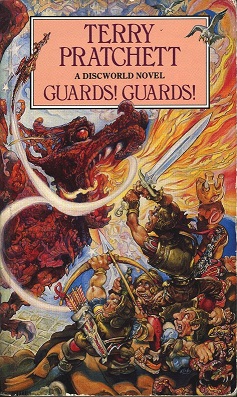
Guards! Guards! — Terry Pratchett

Cover of Guards! Guards!


Guards! Guards!
Terry Pratchett
317 pages
published in 1989

For me Guards! Guards! is the last novel you can describe as an early Discworld novel. From here on all the major subseries have appeared: Rincewind, Death, the Witches and now the Night Watch/Sam Vimes novels. It’s the first novel in which Ankh-Morpork becomes more than generic, somewhat over the top fantasy city, with the first extended cameo for the Patrician and the first insights in how he rules the city. Over time Ankh-Morpork and the Night Watch would come to dominate the Discworld series of course; every novel in the main series since The Fifth Elephant either set in Ankh-Morpolk or featuring the Watch or both, but of course we didn’t know that at the time. Back then it was just Pratchett taking the mickey out of yet another set of fantasy cliches.

In Guards! Guards!‘s case, he did that by importing another set of cliches, that of the hardboiled police procedural. Sam Vimes is a hero straight out of an Ian Rankin novel: the grizzled, older, cynical detective staying in the Night Watch because he has no other place to go. He remained in his post even as the watch has degenerated into a farce and he has become a captain of only three men: Fred Colon, a fat sergeant, Nobby Nobbs, a weassely corporal and a new dwarf recruit called Carrot Ironfoundersson.

Read more…

Books read November

Slim pickings this month and being busy at work didn’t help. Though be honest, I was reading 3-4 books at teh same time so I expect a glut of books finished in early December, but for now I’ve only read four books:

Faust Eric — Terry Pratchett
A somewhat odd Discworld novel, as it was originally published as an illustrated chapbook. Eric tries to summon a demon and gets Rincewind instead. Hilarity ensues.

Imperial Women in Byzantium 1025 – 1204 — Barbara Hill
The Byzantine Empire had a larger than usual share of female rulers, no more so than in the period Barbara Hill discusses, when for various reasons there was more room for strong minded women to influence imperial politics.

A Short Walk in the Hindu Kush — Eric Newby
Newby was working as a tailor in London when a friend asked him to come to Afghanistan to visit the remote north east corner, Nuristan and climb some mountains there. Despite no experience as a mountaineer, how could he refuse?

Iron Kingdom — Christopher Clark
A largely sympathetic account of the history of Prussia, trying to avoid the teleology that dogs a lot of German history, looking forward to the Third Reich.

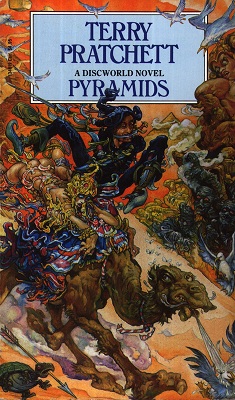
Pyramids — Terry Pratchett

Cover of Pyramids


Pyramids
Terry Pratchett
380 pages
published in 1989

A reader asks:

I’ve uh, never read any Pratchett before and have been wanting to tackle the Discworld novels for sometime but I’ve been intimidated by the reading order issue. It actually doesn’t help matters any that this is one of the most frequently asked questions, it all seems so confusing. Where to begin?

A good question. With a series that has almost forty novels, quite a few spinoff books and theatre, movie and television adaptations, the Discworld can look daunting to get into. Yet it’s not as bad as it looks. There are a couple of natural starting points: The Colour of Magic of course, but that’s not very representative for the rest of the series. A better starting point might be Guards! Guards! as that is the novel in which the whole Sam Vines/Night Watch/Ankh Morpork sub series was set up that has dominated the Discworld ever since. But of course since we’re discussing this question in a review of Pyramids, I’m going to make a case for it as the best starting point for getting into the Discworld.

Read more…