Wyrd Sisters — Terry Pratchett

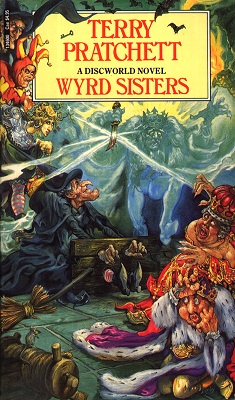
Cover of Wyrd Sisters


Wyrd Sisters
Terry Pratchett
331 pages
published in 1988

The wind howled. Lightning stabbed at the earth erratically, like an inefficient assassin. Thunder rolled back and forth across the dark, rain-lashed hills.

The night was as black as the inside of a cat. It was the kind of night, you could believe, on which gods moved men as though they were pawns on the chessboard of fate. In the middle of this elemental storm a fire gleamed among the dripping furze bushes like the madness in a weasel’s eye. It illuminated three hunched figures. As the cauldron bubbled an eldritch voice shrieked: ‘When shall we three meet again?
There was a pause.
Finally another voice said, in for more ordinary tones: ‘Well, I can do next Tuesday’.

The opening paragraphs of Wyrd Sisters are a good indication of the rest of the book. This is MacBeth: Discworld style and the witches do not intend to stick to the script. That’s because Granny Weatherwax and Nanny Ogg are sensible witches and while the third member of the coven is a bit wet — as in, she actually believes in such things like covens — Magrat Garlick still has a steel core of good Lancrian common sense. They know better than to meddle in affairs (well, mostly) or dance with demons, never mind doing it skyclad. Yet when the king is murdered, his baby heir disappears and the usurper duke turns out not be just a bit evil, but actually uncaring about the land, they’re dragged into meddling against their own will.
Read more…

Books read October

Eleven books read all together this month, largely made possible by rereading some eight Pratchett novels.

Natural History — Justina Robson
Humanity has split itself into a multitude of forms, better to colonise the Solar System with. Then one of the first interstellar human ships finds the remnants of an alien vessel and the secrets of FTL travel and nothing will be the same…

The Hydrogen Sonata — Iain M. Banks
This is the latest Culture novel and somewhat of a disappointment. Good, but not as good as the last one, with a bit of a copout ending.

The Case of the Gilded Fly — Edmund Crispin
The first of Crispin’s Gervase Fen’s mysteries, in which an excentric Oxford don (aren’t they all) solves murders. This one is marred by the lack of sympathy shown to the victim as well ae the mindgames Fen plays with the suspects and readers both.

The Colour of Magic, The Light Fantastic, Equal Rites, Mort, Sourcery, Wyrd Sisters, Pyramids, Guards! Guards! — Terry Pratchett
The first eight Discworld novels, read both because I wanted something comfortable to read as well as because I wanted to re-examine the early Discworld novels. Arguably, it’s in these eight novels that Pratchett matures as a writer and the Discworld is shaped; by the time of Guards! Guards! most of the major subseries have been established.

Sourcery — Terry Pratchett

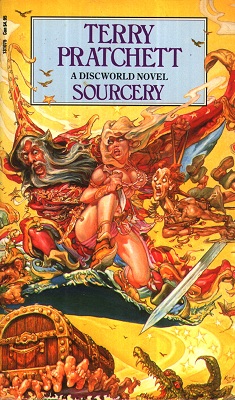
Cover of Sourcery


Sourcery
Terry Pratchett
285 pages
published in 1988

Sourcery is the fifth Discworld novel and the first one after the initial two novels to star Rincewind again. Over time fan opinion has switched to thinking the Rincewind novels are the weakest in the series, but I’ve always liked them myself and I think Sourcery holds up as well as any of the other early novels. It’s the first novel in which there’s a real villain, the first tiem we get to see what makes a real villain in Pratchett’s eyes.

On a surface level there are some similarities to Equal Rites: again there’s a powerful, untrained magic user coming to Ankh Morpork to shake up the Unseen University, but this time he’s not so benign. Coin is not the eight son of an eight son, but the eight son of a wizard. And when a wizard has an eight son, that son doesn’t become a wizard himself, but a sourcerer, a source of magic. The magic he yields is not the tame, nice magic which is the only kind of magic the Discworld has known for ians, but wild magic, the magic from the dawn of times. Not perhaps the kind of magic you’d want a ten year old boy to have, even if his dead father has possessed his wizard staff to give him counsel.

Read more…

Mort — Terry Pratchett

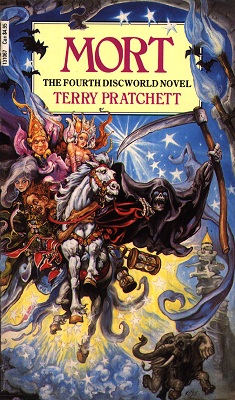
Cover of Mort


Mort
Terry Pratchett
272 pages
published in 1987

If anybody can lay claim to being the first breakout star of the Discworld series, it has to be Death. Started off as a bog standard personification of an abstract concept, managed to work his way up through several cameos in the first three books to this, his first start turn in a novel. Four more would follow, though none in the past decade. He’s not quite his cuddly self here yet, still a bit on the evil side, not as human as in e.g. Hogfather.

Nevertheless Death is being humanised, or why else would he end up looking for an apprentice? Anthropomorphical personages don’t need successors, now do they? Yet still Death ends up on a dusty market square in a small village at the stroke of midnignt taking on a most unlikely apprentice: Mort. Mort is one of those boys who are all knees and legs, who think too much for what they’re doing. An apprentice with Death is literally his last opportunity, but as his father said, there may be opportunities for a good apprentice to eventually take over his master’s business, though Mort is not sure he wants to.

Read more…

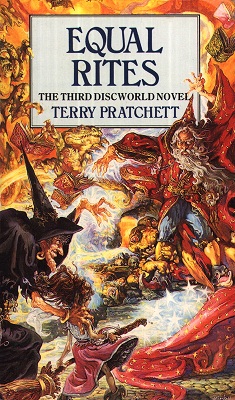
Equal Rites — Terry Pratchett

Cover of Equal Rites


Equal Rites
Terry Pratchett
283 pages
published in 1987

With the third novel in the series, Equal Rites, it became clear that the Discworld was more than just the sum of its characters. Gone were Rincewind, Twoflower and the Luggage, as an entire new setting and cast turned up. This wasn’t something that had been done much — or ever — in fantasy before, not often done after either. It must’ve seemed a bit of a gamble at the time, but this freedom to change protagonists and settings is what made the Discworld series, what has been keeping it from going stale for so long. If you don’t like one particular subseries, there are several others that you can read. Of course it also helps that Pratchett has been such a good writer for so long…

Equal Rites is the first Witches story, though the Granny Weatherwax that shows up here isn’t quite the one we get to know better in the later novels, differing somewhat even from how she’s portrayed in Wyrd Sisters three books onwards. The plot of the story is all about how if you’re a wizard on the verge of dying and looking for an eight son of an eight son to hand your staff over to, it helps to not be too hasty and check that eight son of an eight son isn’t actually a daughter…

Read more…