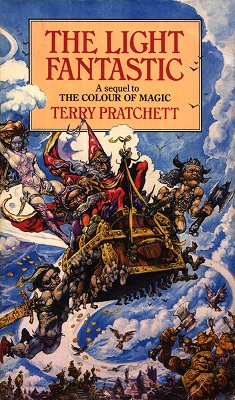
The Light Fantastic — Terry Pratchett

Cover of The Light Fantastic


The Light Fantastic
Terry Pratchett
285 pages
published in 1986

The Light Fantastic is of course the second Discworld novel and a direct sequel to The Colour of Magic starting in media res with Rincewind having fallen off the Disc. To his own amazement he does not actually fall to his death, but is saved by the Great Octavo Spell that had taken up residence in his head. It turns out that this hadn’t actually been an accident all those years ago that had gotten it in his head and all other magic spells afraid to stay near it, but had been in preparation for just this moment. The Discworld is heading towards a huge red star and unless the spell and its seven counterparts are said at exactly the right time, the world will be destroyed…

There’s three years between the publication of The Colour of Magic and The Light Fantastic and it’s noticable in Pratchett’s writing, which has improved a lot between the two novels. It’s also much less parody orientated, but still nowhere near the Discworld we’ve gotten to know and love. We do get a first glimmer of some of the subjects that Pratchett would engage more fully in later novels, including his humanitarianism. For the moment however, the Discworld is still much closer to a standard fantasy world than to what it would later become.
Read more…

The Colour of Magic — Terry Pratchett

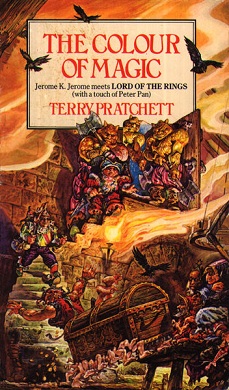
Cover of The Colour of Magic


The Colour of Magic
Terry Pratchett
285 pages
published in 1983

The days are getting shorter, the nights are longer and I got the desire to reread some old favourites. It’s the time of year for comfort reading, as you may notice in my reading patterns from year to year and this time I wanted to lose myself in something actually good, rather than going for something mindless. Which is why I decided to reread the Discworld series from the beginning, though I won’t guarantee I’ll finish the series.

Which brings me to The Colour of Magic, the very first Discworld novel. Over the years it has gotten somewhat of a bad reputation amongst Pratchett fans as not being up to the standards of the series, not being as funny or interesting, not a good place to start the series as a new reader. All of which has a kernel of truth, but at the same time it was the novel that kickstarted the whole series and if it really had no merit, it would’ve been the last book in the series. It is rough and ready, it doesn’t quite fit in with the Discworld as it would evolve over the course of the series, but it still has a certain charm.

Read more…

Books read September

Seven books read this month, three histories and four novels, two fantasy, two science fiction.

Bombers & Mash — Raynes Minns
A social history of the British homefront during World War II as experienced by British women in all walks of life.

the Mad God’s Amulet — Michael Moorcock
The sequel to The Jewel in the Skull, another slab of sword & sorcery.

Bitter Gold Hearts — Glen Cook
The second of Cook’s Garrett, P. I. mix of hardboiled detective and fantasy novels.

Once a Hero & Rules of Engagement — Elizabeth Moon
Two of Moon’s largely enjoyable if lightweight military science fiction novels, somewhat marred by me by Moon’s insistence to use rape as a plot device.

The Kaiser’s Battle — Martin Middlebrook
An exhaustive description of the first day of the last German offensive in World War I, 21 March 1918. What made this book were the numerous eyewitness accounts, both culled from the vast WWI literature already existing and taken from interviews of surviving veterans. Originally published in 1978, this was about the latest that a historian could still do this.

Roger II of Sicily — Hubert Houben
A history of the life and reign of Roger II, the founder of the kingdom of Sicily, translated from the German for the Cambridge Medieval Textbooks series.

The Jewel in the Skull — Michael Moorcock

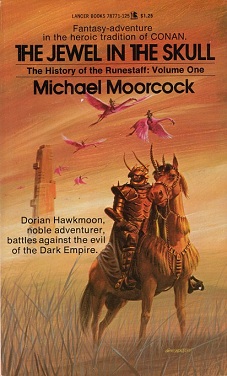
Cover of The Jewel in the Skull


The Jewel in the Skull
Michael Moorcock
175 pages
published in 1967

The Jewel in the Skull is another of Michael Moorcock’s seemingly endless number of fantasy series, the first in the History of the Runestaff quartet. It’s also part of Moorcock’s overarching Eternal Champion mythos, with the hero, Dorian Hawkmoon, being yet another reincarnation of the Eternal Champion. Not that this is important in this book, which can easily be read as a standalone adventure. A such it fair zips along, having been published at the tail end of the era when fantasy and science fiction books were considered long if they managed 150 pages.

It’s also a very blokey book. There are only two female characters of note in it, one of which in the role of the hero’s reward, the other a damsel in distress for the hero to rescue. If you don’t notice or can live with that, the Jewel in the Skull is a clever, fun adventure story. It’s set in a far future Europe, some thousands of years after the Tragic Millennium ended our own civilisation. Much of Europe now is under occupation By Granbretan, a tyrranical empire ruled by an immortal corrupt emperor, a tightly controlled, cruel and strictly hierarchical society. Dorian Hawkmoon, the duke of Köln was the last hero to resist their advance, rising up in rebellion against them, and failed. Now he’s a prisoner in Londra, his fate to serve as entertainment for its rulers…

Read more…

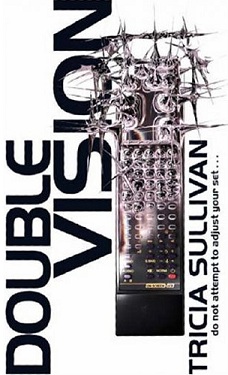
Double Vision — Tricia Sullivan

Cover of Double Vision


Double Vision
Tricia Sullivan
377 pages
published in 2005

Karen “Cookie” Orbach’s life seems fairly mundane when looked at from the ouside: she hasa job with the Foreign Markets Research Division at Dataplex Corp, does karate as a hobby and a weightloss exercise, has no boyfriend or partner but does has a cat, eats too much out of stress and for comfort, reads a lot of science fiction and fantasy. The thing is, Cookie is psychic and while she did offer her services to the police, who believes an overweight Black woman reading too much Anne McCaffrey? Luckily Dataplex did see her potential and engaged her as a Flier, somebody who can see what’s happening in the Grid, an alien world Cookie can see when she watches television, where see can monitor the progress of the military expedition there and work as a reconnaissance flier for Machine Front, which coordinates the offensive.

Cookie’s mundane even boring life stands in shrill contrast to the dangerous glamour of the Grid. Despite being only a passive observer there, it is much more real to her, much more interesting. It matters, while her routine life outside of it doesn’t. It’s a feeling that any science fiction or fantasy fan can recognise, that idea that whatever fantasy world floats your boat is more important than what happens in real life, but for Cookie that fantasy world is real — or is it?

Read more…