Books read Augustus

I thought I had read more books this month, but I come to only seven in total. I blame work as well as my continuing addiction to Football Manager. Hey, Plymouth Argyle won’t win its fit Premiership championship in row on its own, no will it?

Britain’s War Machine — David Edgerton
Exploding the myth that Britain went unprepared into World War II, or couldn’t keep up with the Axis or its larger allies during it.

Double Vision — Tricia Sullivan
An interesting failure this, a mindfuck novel written in 2005 but set in 1984. Cookie Orbach is a psychic, or at least that’s what she believes she is, who watches the Grid, an alien planet she can only observe through watching television. But is it real, or is her talent being exploited for much baser purposes than she imagines?

The Black Opera — Mary Gentle
A freethinking opera writer has to write the best opera he has ever created to save the Kingdom of the Two Sicilies from a miracle.

The Moving Toyshop — Edmund Crispin
Somehow I don’t think this was an entirely serious detective novel. Made me laugh out loud in a couple of places. Watch out for the cameo appearance by a certain Philip Larkin.

From Egypt to Babylon — Paul Collins
A visually orientated history of the Bronze Age in the Middle East and Near Asia. Lots of gorgeous pictures, decent overview of the history there.

The Saxon Shore — Valerie A. Mansfield
Much more limited in scope is this, looking at the reality of what might have been the “Saxon Shore”, mentioned in just one surviving Late Roman document. I’ve been interested in this for a while and found this handbook in a bookstore in Plymouth earlier this year.

The Jewel in the Skull — Michael Moorcock
I’ve had the graphic novel adaptation Jim Cawthorne did in the seventies for ages, but only recently bought the novel. First in years I’ve read a proper Moorcock fantasy novel.
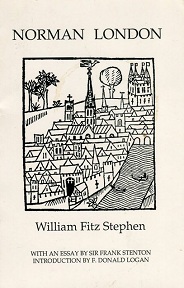
Norman London — William Fitz Stephen

Cover of Norman London


Norman London
William Fitz Stephen
109 pages including index
published in 1990

Now here’s an interesting little booklet. The meat of it consists on a treatise on Norman London, originally written by one William Fitz Stephen for his Life of Thomas Beckett, sometime before 1183. It’s therefore as close an eyewitness account of Norman London as we could ever get. Though interesting, this in itself is not enough to make a book of course. It is therefore partnered by another, more modern essay on the city, written in 1934 by Frank M. Stenton, a renowned historian of Anglo-Saxon England. These two pieces combined from the basis for what’s perhaps the most useful feature of the book, the maps of Norman London at the back of it.

There’s not really much more to say about Norman London. It’s an informative little booklet, but nothing more than that. What’s more, as the Stenton essay is more than seventy years old, it can’t help but be outdated, as new insights, more archaeological research and new theories will have altered our views of the period. I don’t think this would give a good picture of what we thought the Norman city looked like anymore. But this doesn’t make it worthless, if only because it still includes that eyewitness account of London, one of the few if not the only one we have of London at that particular point in time. The Stenton essay on the other hand is more of interest now for its own inherent historical value than for its accuracy.

Read more…

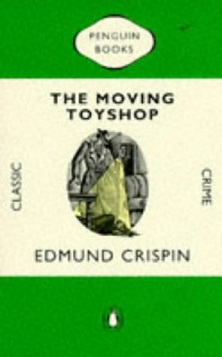
The Moving Toyshop — Edmund Crispin

Cover of The Moving Toyshop


The Moving Toyshop
Edmund Crispin
205 pages
published in 1946

Edmund Crispin, the pseudonym of Robert Bruce Montgomery, who under his own name wrote music scores for amongst others, the Carry On series of movies — something I only learned when I looked him up on Wikipedia just now — was yet another of those cult favourite English detective writer. Sometimes it seems there are hundreds of such writers published from the twenties to the sixties, intermittedly forgotten and rediscovered after their deaths. In Crispin’s case he’s on the upswing, his novels having been reissued in both American and British editions in recent years. This is less of an enterprise than with some detective writers, as he only wrote nine novels and two short story collections.

My copy of The Moving Toyshop isn’t a shiny new reissue though, but a green paperback Sandra bought years ago, when she first had discovered Crispin. She was always much more of a crime reader than I am, always keen to reread old favourites, of which this was one. You can easily tell as there was a cigarette burn (and even some ash still) near the front of the book; this having been one of the books she reread a lot in hospital. I can just picture her sitting in her wheelchair, cup of crappy tea or coffee nearby, out in the hospital garden smoking a fag, reading this book and perhaps dozing off and dropping her ciggie in it….

Read more…

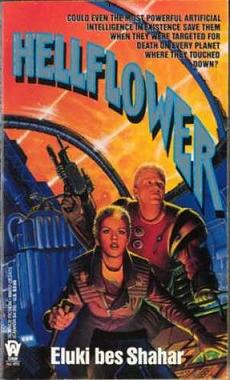
Hellflower — Eluki bes Shahar

Cover of Hellflower


Hellflower
Eluki bes Shahar
252 pages
published in 1991

Eluki bes Shahar is a science fiction and fantasy writer better known as Rosemary Edghill, the form of her name she now prefers. She’s been active since the late eighties, starting her career writing straight romance novels, then moving on to science fiction and fantasy, most recently in collaboration with Mercedes Lackey. I think it’s fair to say she’s only been middling succesfull as a writer, somebody largely forgotten as an science fiction writer. The question is, is she worth rediscovering?

At first glance Hellflower seems to be a bog standard space opera or adventure sf story. Hardbitten female independent trader/starship captain rescues a young nob from a mugging, due to his honour he’s now in her debt, the same honour leads him to be scheduled for execution, she rescues him again, they take off from the planet guns blazing, he turns out to be more than just a young, bored noble and she’s in over her head. What makes Hellflower different from the several dozen other space opera stories with the same plot is the atmosphere of elegiac foredooming it takes place in. This particular caper might have a happy ending after all, but sooner or later the odds will catch up with our protagonist.

Read more…

Books read July

Only six books read this month, mostly science fiction.

Darkland — Liz Williams
First in a duology about a far future female secret agent with psionic powers who gets an assignment to hunt down the lover who abused her years ago. Much better than it sounds.

The Apocalypse Codex — Charlie Stross
The latest in Charlie’s horror/spy thriller series, with the baddie this time being a charismatic tv preacher who is slightly more into that old time religion than is healthy.

Blue Remembered Earth — Alastair Reynolds
Featuring a near future Africa that’s not a dystopian hellhole. When their grandmother, the family matriarch dies, Sunday andd Geoffrey Akinya against their will get involved in a Solar System wide scavenger hunt for her final legacy.

Norman London — William Fitz Stephen
William Fitz Stephen wrote a hagiography of Thomas Beckett and as an introduction to that, gave a portrait of the city of London as it existed in the 11th century. This short pamphlet is build around that text, with introduction, maps and essays giving a context to it.

The British Character — Pont
A humorous collection of cartoons showing the idiosyncrasies of the British.

The Fourth Wall — Walter Jon Williams
Third novel in the Dagmar Shaw series about alternate reality gamers changing the world. Excellent, compelling.