The British Character — Pont

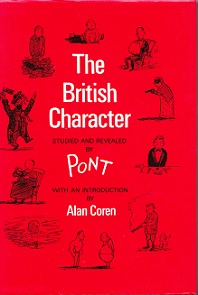
Cover of The British Character


The British Character
Pont
120 pages
published in 1938

It must’ve been a decade ago that Sandra found this book in a secondhand bookstore in Middelburg. She liked the cartoons, but since she had read it by the time I was done browsing, she didn’t think it worth buying. I disagreed and bought it for her as a present. She took it back to Plymouth with her, brought it back over when we started living together and today my eye fell on it when I was looking for something to read from among her books. It reminded me of how she liked several of the cartoons enough to make high quality copies of them, to hang on our walls. She recognised herself in them, some essential quirks of the British character she also possessed. Looking at these cartoons now I can’t help but seen Sandra in them.
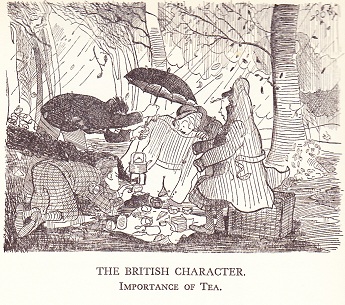
The importance of tea

Pont is a pseudonym for Graham Laidler, a cartoonist who mainly worked for Punch, starting his “British Character” series there in 1936, with this collection first having been published two years later, and multiple times since. He himself had only a short time to enjoy his success, as he died in 1940 at age thirtytwo. He had been ill a long time, his sickness being the reason he turned to cartooning in the first place, rather than the architectorial drawing he had been trained for. Though his cartoons are very much of his time, they do touch on universal aspects of the British character.
Read more…

Barrayar — Lois Mc Master Bujold

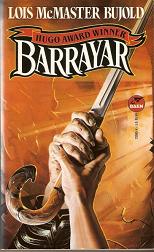
Cover of Barrayar


Barrayar
Lois McMaster Bujold
386 pages
published in 1991

Barrayar was actually the first ever Bujold story I ever read and I hated it. That’s because it was the last part of its serialisation in Analog that I read and I had no idea of what was going. Coming back to it now, after having read all the Miles Vorkosigan books at least once, I enjoyed it much more. Like any prequel Barrayar depends for some of its impact on the reader’s knowledge of the main series. If you don’t know who Miles Vorkosigan is and why he is the incredibly determined little mutant runt that he is when we first met him in the Warrior’s Apprentice, the details of how he got to be that way won’t matter all that much.

Chronologically, Barrayar takes place almost immediately after Shards of Honor and is the second and so far last novel to star Cordelia Vorkosigan/Ransom. Cordelia and Aral are settling in to newly married live on Barrayar, with Cordelia pregnant with Miles. Then the old emperor dies and Aral becomes regent to his young grandson and he and Cordelia are soon plunged into the dangerous, still very medieval politics of the Barrayaran court and nobility. How dangerous Cordelia only realises when they’re the victims of an assasination attempt, with poison gas grenades thrown into their house.

Read more…

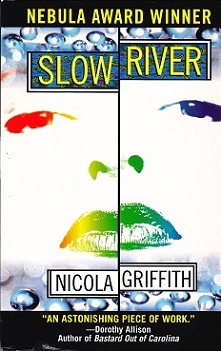
Slow River — Nicola Griffith

Cover of Slow River


Slow River
Nicola Griffith
343 pages
published in 1995

Everybody knows about the Bechdel test now, don’t they? Introduced in Dykes to Watch out For, it’s a test to see if a given story meets a minimum feminist standard: a) does it have at least two women, who b) talk to each other about c) something else than a man? It’s a good way to think differently about the movies you see or the books you read, to see how common it is for a story to have only male characters, or only a token female character, sometimes as prize for the hero. Having a story with only male characters is normal, having one with all or majority female characters is the outlier, can get you shoved into a women only ghetto like romance or feminist literature.

This is true in science fiction as well as mainstream literature, which made reading Nicola Griffith’s Slow River so interesting. It’s her second novel, also the second of her’s I’ve read and like the first, the cast is almost exlusively female. But where that one was set on a planet where men had died off due to some handwaved plague, this one takes place in near-future English city that for once isn’t London. I’m not sure whether Nicola Griffith made this choice of cast deliberately, or it just happened naturally because of the story she wanted to tell, but it works.

Read more..

We Who Are About To… — Joanna Russ

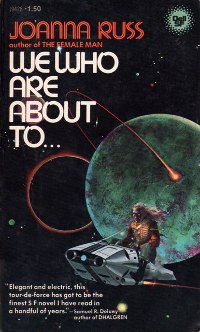
Cover of We Who Are About To...


We Who Are About To…
Joanna Russ
170 pages
published in 1975

We Who Are About To… is arguably Joanna Russ’ most famous and controversial novel after The Female Man. That novel became famous because of its outspoken feminism, still rare in science fiction at the time; if we’re honest, still somewhat rare today. We Who Are About To… comitted a greater sin however, by attacking the optimistic, can do attitude of classic science fiction, the belief that any adversity can be overcome by man’s unique fighting spirit. It’s not just that the protagonist doesn’t win in the end; even Asimov the arch-optimist had written “Founding Father” ten years earlier, a story in which four astronauts fight but fail to terraform a planet before it kills them. No, the real problem is that she rejects the choice out of hand and choses not to fight, not even to try.

That of course went against the grain, with plenty of science fiction fans being outraged about it, if I can believe the contemporary fan publications. But We Who Are About To… is about more than just rejecting science fiction’s traditional morality, it’s also a novel about how die. Slightly over half way through the story the central conflict of whether or not to fight has already been resolved, in favour of not to. The rest of the story is all about how you die. This part of the book has received less attention than the first half.

Read more…

Books read June

Seven books this month, mainly fiction:

Intrusion — Ken MacLeod
What if the power to make the wrong decisions is taken from you, what if you want to make your own decisions without justifying yourself to others, not want to take up the shield of a religion to justify refusing what’s for your own good?

Something Wicked this Way Comes — Ray Bradbury
Sandra gave me this as a present some years ago, because we had been talking about Bradbury for some reason; I read it after his death. A great American fantasy/horror classic, full of his peculiar brand of nostalgia without his sometimes cloying sentimentality

Testament of Youth — Vera Brittain
A book drenched in grief and sorrow from the first page, though still with somewhat of a happy ending. Vera Brittain’s autobiography centers on the Great War and the men she lost through them: her lover, her brother, her friends as well as her struggle to live with these losses. Its matter of factness is what gives it its power.

Tsing-Boum — Nicolas Freeling
The French wife of a Dutch military man is murdered in her flat, shot six times with a machine pistol, as a gangster serial is playing on the tv, drowning the noise. A professional killing, but why this woman?

Cop Killer — Sjowall & Wahloo
Gloomy seventies Scandinavian police procedural, the ur-well of all those Hennings and Bridges and other fashionable Nordic thrillers.

Criminal Conversation — Nicolas Freeling
A highly placed banker accusses an equally highly placed doctor of murder and inspector van der Valk has to play a psychological game to find out the truth.

We Who Are About to… — Joanna Russ
When a starship crashlands on an alien world far from home, all but one woman see it as their duty to restart civilisation there. This is the story of that one woman.