Quoted for Truth: Nicolas Freeling, Criminal Conversation

Nicolas Freeling’s hero, inspector Van der Valk of the Amsterdam recherche, meets up with a woman who might have been blackmailed and gives a short description:

She was a solid, well-constructed woman, not fat at all but all curves, with the very fine-textured, pearly skin that goes so well with dark chestnut hair. Small good teeth, quite rare in Holland, where the women have excellent teeth looking like a well-polished row of marble gravestones.

From 1965, but as Sandra often noticed, Dutch women, especially young Dutch women, do tend to have huge perfect white teeth, though her comparison was more to do with horses than marble gravestones. A very Dutch mouth that.

I love Nicolas Freeling’s mysteries, another writer Sandra turned me on to, as he has a knack for getting Dutch people right: his Holland is one that’s still a ways behind the modern world, though getting there, a Holland gone some time I was born, but one I still recognised if only from period fiction.

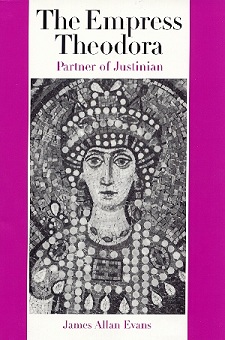
The Empress Theodora — James Allan Evans

Cover of The Empress Theodora


The Empress Theodora
James Allan Evans
146 pages including index
published in 2002

Ken MacLeod once said that “history is the trade secret of science fiction”, but sometimes it’s abused and nowhere more so than in the cribbing from early Byzantine history that has been ongoing ever since Isaac Asimov first put in thinly disguised expys of emperor Justinian and general Belisarius in his Foundationtrilogy. Largely overlooked in these sort of appropriations is the empress Theodora, who as James Allan Evans shows in The Empress Theodora – Partner of Justinian was just as important as her husband in determining the course of the Byzantine empire.

There were quite a few strong woman emperors in Byzantine history, but most of them either ruled through their weak husbands, or as regents ruling in place of their still minor children. Theodora on the other hand ruled together with Justinian, a strong emperor himself. Their rule was a true partnership and it’s this relationship and Theodora’s role in it that Evans wants to examine here. At the same time The Empress Theodora is also a concise biography/history accessible to lay people like me.

Read more.

Intrusion — Ken MacLeod

Cover of Intrusion


Intrusion
Ken MacLeod
387 pages
published in 2012

Over the past five years Ken Macleod has written a series of standalone novels that each in their own way have dealt with the post-9/11, post-War on Iraq 21st century and what it might evolve into. Intrusion is the latest in this series. Where MacLeod had always been a politically minded writer, his last few novels (The Execution Channel, The Night Sessions and The Restoration Game) were all directly rooted in current political realities, especially the socalled War on Terror. Intrusion continues this trend, but this time swapping the War on Terror with the nanny state.

And at first Intrusion feels like a novel from an alternate universe, one in which Labour didn’t lose the elections and had continued on its pre-9/11 social engineering course rather than by distracted by Blair’s foreign crusades. Britain’s nanny state has been turned up to eleven, driven by ubiquitous realtime surveillance and monitoring technology and increasingly finetuned social law. MacLeod has taken everything New Labour and the ConDem coalition have been guilty off in the past decade and a half regarding tackling socalled social problems: increasingly absurd health and safety laws, the liability adverse local bureaucracies, the enthusiasm to seek technofixes for ingrained social problems, the idea that you can force or nudge people into healthier lifestyles through banning or taxing their vices and extrapolated what it would look like a generation or so into the future. It’s a world in which most women wear monitor rings to make sure they’re not pregnant and if they are, are not smoking or drinking or going to places where toxins might be that could harm their unborn child, where ipso facto most women work at home as so many workplaces are not safe for their (potential) offspring due to e.g. trace remnants of cigarette smoke.

Read more…

Books read May

As with last month, I didn’t read much in May, opting for reading two large, difficult(ish) books instead. Other interests also cut down on my reading time, so I’m nowhere near Michel’s output for the month.

The Children Star — Joan Slonczewski
An author I’ve heard a lot of the last year, due to her latest novel, The High Frontier. As James Nicoll has often said, in science fiction biology is the redheaded stepchild that comes to school covered in bruises; Slonczewski is one of the few sf writers who can create believable, workable alien biologies and her skill is on display here.

The End — Ian Kershaw
A history of the German experience in the last year of World War II , which tries to answer not why Germany lost, but why it took so long, until after Hitler’s death, to realise it had lost. Why did it keep fighting on for so long when it was clear in late 1944 that they couldn’t win?

Kamikaze: History’s Greatest Naval Disaster — James Delgado
A pop history look at the two attempted Mongolian invasions of Japan and why they failed. Interesting and I could do with a more indepth history to read about this. Any suggestions?

Divided Allegiance — Elizabeth Moon
The second book in The Deed of Paksenarrion sees Paks dissatisfied with life in the mercenary company she was in in the first book, leave and land herself in a very D&D-like dungeon crawl and hook up with the Fellowship of Gird as a paladin candidate. My copy annoyed me greatly as the cover was completely flaked away before I’d even finished reading it.

The Earth — Richard Fortey
Richard Fortey was Sandra’s favourite science/evolution/geology writer and geology being her favourite science. As far as I know she hadn’t read this particular book, but I bought it in honour of her memory. Fortey explains the geological processes that drive the Earth and the history of how we got to understand, through the process of visiting some of the “holy” places of geology, starting with its birthplace in the Bay of Naples at the Vesuvius.

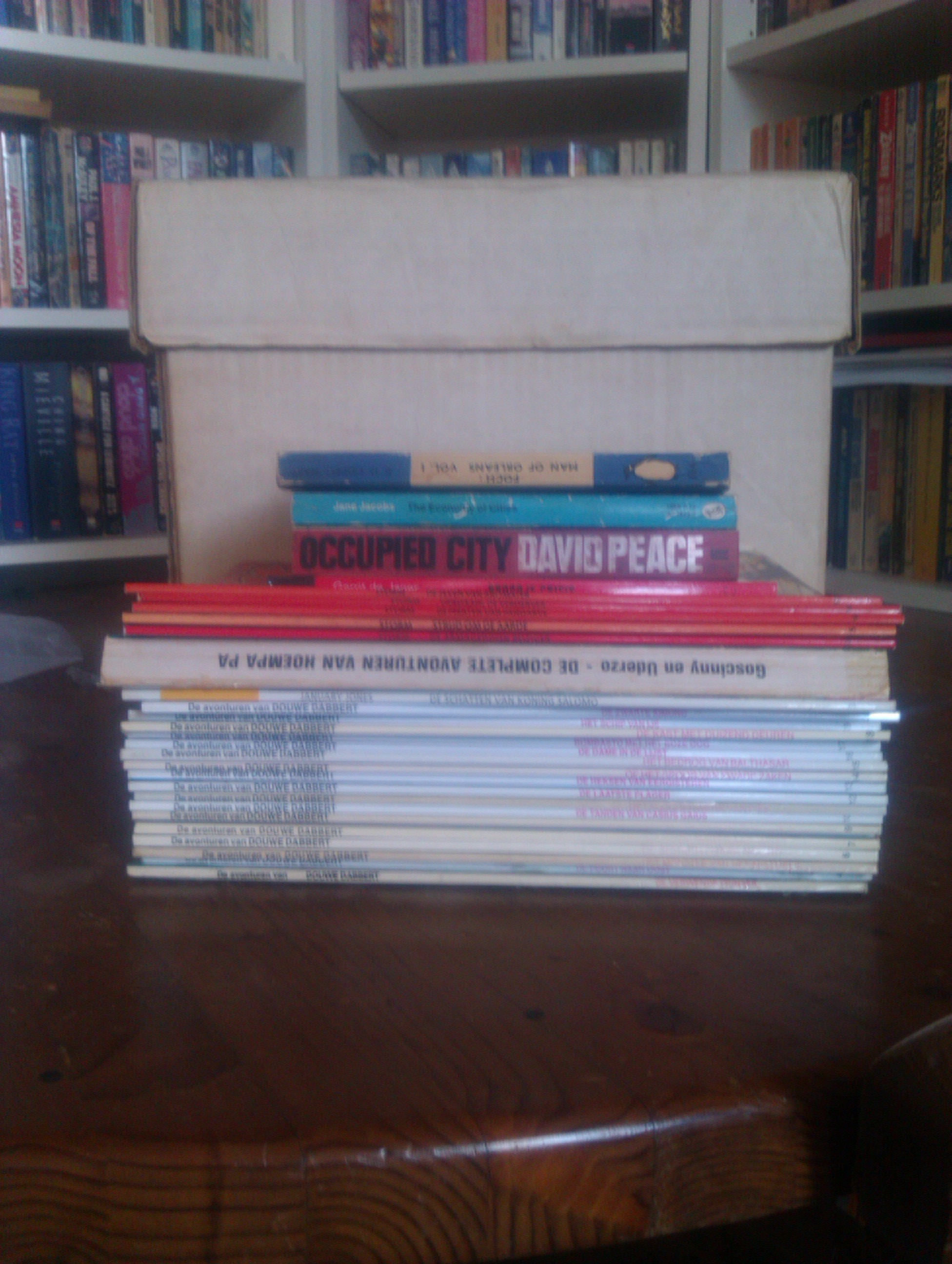
Middelburg loot

Books bought in Middelburg

Going back home to my parents always means an opportunity to look at the secondhand bookstore there (singular, as there can be only one). This weekend was a good one. I found a nice stack of comics, as well as some other neat books.

What I found were fifteen or so Douwe Dabbert strips, an old serio-comic adventure series written by Donald Duck editor Thom Roep and drawn by Piet Wijn, one of the old grand masters of Marten Toonder’s animation and comic studio. These stories were serialised in the Donald Duck weekly magazine, which always included a non-Disney strip like this, aimed at slightly older readers, in its back pages.

On top of those is a January Jones album, barely visible under the big Goscinny/Uderzo Oumpah-pah omnibus. The latter is sort of a prequel strip to Asterix only set amongst “Red Indians” in French North America. January Jones on the other hand is a retro-adventure ligne claire strip that ran in Sjors en Sjimmie in the early nineties, drawn by Eric Heuvel and written by Martin Lodewijk, one of the Netherlands best scenario writers, who also worked on the Don Lawrence Storm series, the last issues I still needed to get I also found this weekend.

Finally, on top of those there’s a Gerrit de Jager cartoon collection of the strips he did for a newspaper about the economic recession and some normal books: Jane Jacobs The Economy of Cities, David Pearce’s Occupied City and Foch: Man of Orleans by B. H. Liddel Hart.

The box behind all this is a short comics box filled with a mere fraction of the collection of floppies I still have stashed at my parents. I spent an hour on Friday digging through my longboxed and taking out some favourite series and sequences, things I knew I wanted to keep. One of these days all of them need to be moved here, or gotten rid off. The dillemma of every aging comics collector: what do I want to keep, what can I live without.