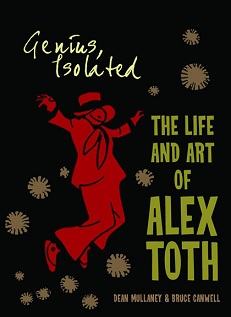
Genius, Isolated — Dean Mullaney & Bruce Canwell

Cover of Genius, Isolated


Genius, Isolated: The Life and Art of Alex Toth
Dean Mullaney & Bruce Canwell
324 pages
published in 2011

If you’re not a hardcore comics nerd you’ve probably never heard of Alex Toth, one of the greatest cartooning geniuses American comics have ever seen. That’s because he never really had a comics series or character that he made his own, but instead had his art scattered over hundreds of seperate assignments for dozens of publishers, often wasted on formulaic, throwaway stories. His true genius lay in his approach to the art form, the way he stripped down cartooning to its essentials, never putting down one more line than was needed. Once you see his artwork you can understand why he’s so revered by his peers, a true “artists’ artist”, but first you needed to find his artwork, which has long been difficult to find other than by hunting through back issue bins.

This has changed in the last decade or so, fortunately, as the American comics field in general has become more aware and interested in its heritage, leading to a flood of high quality reprint projects as well as art books/biographies focusing on individual artists. Toth has had some attention paid to him before, but with Genius, Isolated: The Life and Art of Alex Toth, the first of a trilogy of books devoted to Toth’s life and career there finally is a book that does true justice to Toth’s genius.
Read more…

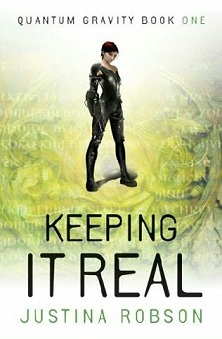
Keeping it Real — Justina Robson

Cover of Keeping it Real


Keeping it Real
Justina Robson
279 pages
published in 2006

Justina Robson is one of those writers I’ve known about for years, but have never read anything by so far. One of the new breed of British science fiction writers who popped up around the turn of the millennium, her first couple of novels found critical acclaim, each being nominated for the Clarke or BSFA Award. Unfortunately popular success seemed to elude her however, until she started the Quantum Gravity series, of which Keeping it Real is the first novel.

It is also the first novel of hers I’ve read. A high concept description of it would be urban fantasy meets cyberpunk, a bit like the old Shadowrun role playing game but much less naff. Personally I’ve always thought cyberpunk was urban fantasy’s science fiction’s mirror counterpart anyway, so the combination seems logical. As Robson explains it in the prologue, an unknown “quantum catastrophe” in the Superconducting Superconductor in Texas in 2015 had torn reality into six realms: Earth, now called Otopia, Zoomenon, the realm of Elementals, Alfheim (elves country), Demonia, home of demons, Faery, home of fairies and finally Thanatopia, supposedly the realm of the dead though no human being has ever visited. The catastrophe was quickly dubbed the “Quantum Bomb” on Otopia, with the big question that keeps human philsophers and scientists awake at night being whether the Bomb really recreated reality or just made it visible to Otopia.

Read more…

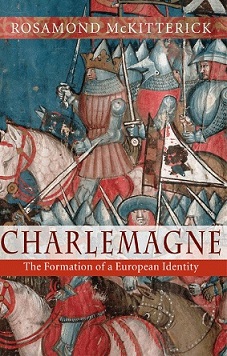
Charlemagne — Rosamond McKitterick

Cover of Charlemagne


Charlemagne: the Formation of a European Identity
Rosamond McKitterick
460 pages including index
published in 2008

I knew Rosamond McKitterick from the volume in the Short Oxford History of Europe series she edited, which is why I picked up Charlemagne: the Formation of a European Identity from the library. Charlemagne himself has only relatively recently picked my interest, mostly through having read Emperor of the West a few years back. Interest in Charlemagne in general has rather picked up in the past decade, as the search for a common pan-European identity has taken on obvious political significance, what with the EU and all.

Which is where this comes in, as Rosamond McKitterick attempts to get back to contemporary sources to re-evaluate Charlemagne and his reign, without the interpretations later historians have given them. Her goal is to in this way provide a new critical understanding of what these sources tell us about the development of the Carolingian empire, its political identity and how these changed during Charlemagne’s reign. It makes Charlemagne a heavily text orientated history, as McKitterick examines the narrative representations of Charlemagne produced during his lifetime and shortly after. To be honest, at times this made it heavy going, especially when I read most of it during the morning and afternoon commute.

Read more…

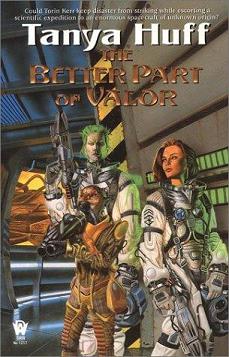
The Better Part of Valor — Tanya Huff

Cover of The Better Part of Valor


The Better Part of Valor
Tanya Huff
411 pages
published in 2002

Once I had finished Valor’s Choice, I knew I was going to have to go back to the bookstore I’d found it in and get the other two Tanya Huff books I’d saw there too. To be honest, I hadn’t even taken me as long as finishing the first two chapters to decide this. I’m always on the lookout for good, intelligent military science fiction and Valor’s Choice was just that, which meant I had to get the sequels too. What I especially liked was the absence of the sort of nasty rightwing politics souring me on so many other mil-sf writers.

The Better Part of Valor starts with staff sergeant Torin Kerr just back from her mission in Valor’s Choice. Having had words with general Morris, who was responsible for said mission, she is immediately sent out on another one by him, without her own platoon even. Whether this is punishment or reward she isn’t sure, but it turns out she will join a new marine platoon put together from scratch to protect a scientific expedition to an “unidentified alien vessel drifting dead in space”. She hopes it will be an uneventful recon mission, but after the last one she was sent on by general Morris, she isn’t hopeful.

Read more…

Books read February

And that’s the second month of 2012 gone, with more books read: seven in total, five science fiction, two history. Need more diversity. I could’ve read more, but got bogged down in one book I didn’t finish, then was ill and disinclined to do anything but look at the telly for a week. I also only managed to review three of them in the month I read them, which isn’t that good either, but it seems I can do only a review a week or so, sometimes two. First world problems?

The End in Africa — Alan Moorehead
The third and final part of Alan Moorehead’s Africa trilogy, reporting on the war in North Africa in 1942-1943.

Seventeenth-century Burma and the Dutch East India Company — Wil O. Dijk
A very interesting, data intense look at an almost forgotten part of Dutch colonial and trading history.

Valor’s Choice — Tanya Huff
The first in a new to me series of military sf books, better than it needed to be.

White Dragon — Anne McCaffrey
The third Dragonriders of Pern novel which I’ve been rediscovering once Anne McCaffrey’s death last year remined me of them. Much better than I remembered.

The People’s Chef — Ruth Brandon
The biography of Victorian chef Alexis Soyer, something Sandra had been wanting me to read last year.

The Better Part of Valor — Tanya Huff
After I’d read the first in the series, I had to read its sequel too.

The Heart of Valor — Tanya Huff
And the third in the series too. All three were eminently readable and fun. What’s more there wasn’t any of the more nasty politics some mil-sf series have at their heart.

Osama — Lavie Tidhar
9/11 meets Life on Mars. A book stuffed with symbolism almost to the point of choking on it, but which just about worked despite or because of it.