This year’s Clarke Award

The Clarke Award (founded by Arthur C. hisself) is given each year to the best science fiction novel first published in the UK the previous year. It’s a juried award, unlike both the Hugo and Nebula, for which any publisher can submit novels it thinks eligible. This year’s submissions longlist has just been made public at Torque Control; so farof the sixty entries, I’ve read exactly one of them, Charlie Stross’ Rule 34. Which I think is also the only sf or fantasy novel published in 2011 that I’ve actually read.

Which won’t stop me from entering Torque Control‘s guess the shortlist game however. Below are the six entries I think will be on it and why:

Embassytown, China Miéville. China is a multiple Clarke Award winner and this novel created quite a lot of buzz early last year, so I think this is a shoe-in.

The Islanders, Christopher Priest. Another easy guess, as Priest has also won the Award previously, while this novel is a return to his old Dream Archipelago series of stories.

Reamde, Neal Stephenson. The Clarke Awards in the past few years have had at least one American nominee in the shortlist and this is the obvious candidate; if we’re unlucky it will be one of the two Connie Willis novels instead.

Osama Lavie Tidhar, which I’m currently reading. This is the one I’m the least sure about, but it seems to have had a fairly large p.r. push (helped by Tidhar making the e-book edition free a while back, which is when I got it), it tackles a big, important theme and it’s somewhat on the literary side of the science fiction genre, which ticks all Clarke boxes for me.

Rule 34, Charles Stross. A good book, an important British sf writer, who has been nominated before.

The Fallen Blade Jon Courtenay Grimwood. He has been shortlisted a few times before, so is a likely candidate for this year as well.

An all male lineup, which would not be my preference so much as me looking at the list of nominees with no other information than what I already knew about the writers and books listed. We’ll see at the end of March how right I was.
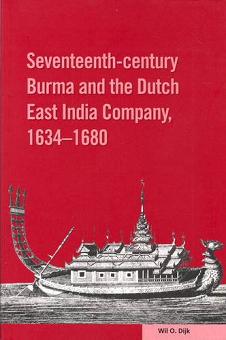
Seventeenth-century Burma and the Dutch East India Company — Wil O. Dijk

Cover of Seventeenth-century Burma and the Dutch East India Company


Seventeenth-century Burma and the Dutch East India Company 1634-1680
Wil O. Dijk
348 pages including index
published in 2006

I got this book out of the library soley on the strength of the author’s own story. Wil O. Dijk was born in Kobe, Japan in 1934, the daughter of a Dutch businessman and a Montenegrin-Burmese (!) mother. As a child she lived in Japan and Burma, with her brother got sent to Singapore when war broke out in 1941, became a prisoner of the Japanese there, like so many other children, while her mother fled to India and her father joined the British 14th army. They all survived war and after being reunited with their parents she and her brother spent some years at boarding school in Holland, before they returned east to Karachi when the Korean War broke out. There she stayed, met her husband, a Dutch foreign service employee, travelled with him from posting to posting all over the world, raising three daughters in the process, then came to stay in Holland permanently in the 1980ties. Wanting to reconnect with her Asian roots, she enrolled as a mature student at Leiden first to study Japanology, then to specialise in Burmese history, the end result of which is this book, written when she was well in her seventies!

Even without the author’s lifestory I would’ve gotten this book though. The focus in Dutch colonial history has understandably always been with Indonesia as well as with the colonies in the Americas, Surinam and the Dutch West Indies, as these were the most enduring, important and longest lived Dutch colonial ventures. With some exceptions (Nieuw Amsterdam obviously, South Africa), the rest of Dutch colonial history is mainly a concern for specialists. Which as Wil O. Dijk makes clear in her introduction, goes double for Dutch involvement with Burma, largely neglected even by specialists, yet no less important and interesting for it.

Read more…

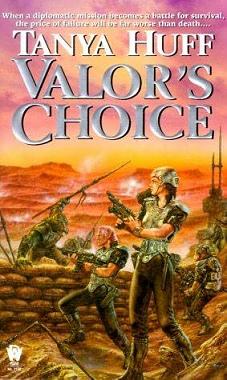
Valor’s Choice — Tanya Huff

Cover of Valor's Choice


Valor’s Choice
Tanya Huff
409 pages
published in 2000

Tanya Huff is one of those science fiction writers I vaguely knew about but never had read anything from, nor to be honest, had heard much about. One of those authors that steadily plods along, has a decent following and career but never quite had a breakthrough novel. I never really had a reason to take a closer look at her work, until I found myself in the English Bookstore last Friday looking for something light to read and Valor’s Choice caught my eye. I’m always on the lookout for good, enjoyable military science fiction and continuously disappointed by what I find on the shelves, when even a cursory glance is enough to show me that yet again my expectations are set too high.

And yet my standards for mil-sf are set so low already; all any story has to be to get me to read it, is to beat the Weber minimum. If the politics are less annoying and rightwing than David Weber‘s, the writing can be just as awkward, as long as there’s something interesting the writer is doing with their story. Literary qualities be damned, just as long as you tell a good story. Tanya Huff, from what I saw in the bookstore seemed capable of delivering at least that much, so I took a gamble on her. You may guess from the fact that I’m reviewing this already that she more than succeeded: I started reading this on the way home from the bookstore and had finished it on Saturday evening.

Read more…

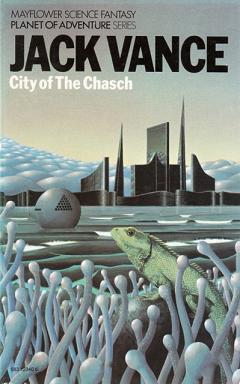
City of the Chasch — Jack Vance

Cover of City of the Chasch


City of the Chasch
Jack Vance
172 pages
published in 1968

When I first started to discover science fiction (longer ago than I care to recall) Jack Vance was one of the more popular writers to be translated into Dutch and the local library therefore had a shitload of his books. I therefore read quite a lot of his work, including the whole Planet of Adventure/Tschai, the Mad Planet (as it was called in Dutch) tetralogy, in one of those big omnibuses Meulenhof specialised in. There’s little I remember off it, to be honest, other than that it was a typical Vancean planetary romance.

Jack Vance is of course the master of this subgenre, effortlessly creating new worlds and societies for his stories, always exotic and strange yet believable and with their own logic. Sometimes the stories he sets in these worlds disappoint, as was the case for me when I reread Big Planet two years ago. For City of the Chasch I had less expectations, just because I remembered less about it, but I was still a bit disappointed with it. Like Big Planet, the worldbuilding here is more sketched in than fleshed out, not as rich and interesting as I had hoped it would be. I had planned to read the next books in the series immediately (I’m still missing the fourth) after I’d finished this one, but now I’ll think I’ll pass.

Read more…

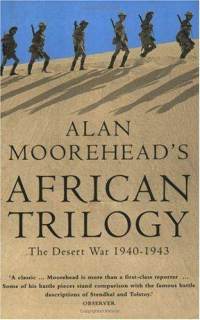
African Trilogy — Alan Moorehead

cover of African Trilogy


Mediterranean Front, A Year of Battle, The End in Africa
Alan Moorehead
642 pages including index
published in 1941, 1943,1943, compilation 1945

If journalism is history as first draft, then these three books, Mediterranean Front, A Year of Battle, The End in Africa; published in one volume as African Trilogy are history as second draft. Written while the Second World War was still ongoing, each of these books tell the story of one year of war in the desert, as seen by one of the preeminent war correspondents of the era. Written largely without the benefit of hindsight, from the notes that Moorehead took at the time, these three books together not only provide an interesting look at an important period in World War II, which England largely had to fight on its own, but also at how people at the time thought about the war, when the outcome was by no means certain yet.

If you’ve heard of Alan Moorehead, it’s probably for his post-war books on the exploration of the Nile, The White Nile (1960) and The Blue Nile (1962). During the Second World War he was a correspondent for the Daily Express, following the war in North Africa, the invasion of Sicily and the war in Italy. As becomes clear from reading these three volumes, Moorehead wasn’t one of those journalists content to stay at headquarters, but went chasing down the front whenever he could. Some of the incidents here certainly read like Boy’s Own Adventures stuff, several times barely escaping running into the enemy at several moments. Moorehead is a born raconteur, aimable, slightly understated, though with some of the attitudes and language use of the time that might seem strange to modern readers.

Read more…