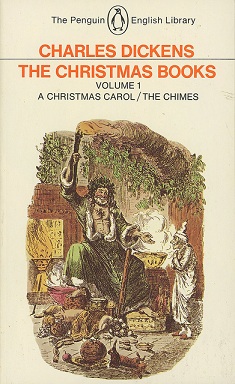
A Christmas Carol — Charles Dickens

Cover of A Christmas Carol


A Christmas Carol
Charles Dickens
100 pages
published in 1843

Sandra always loved Dickens more than any other Victorean novelist and she always tried to convince me to try him but never succeeded. So I thought that it would be nice to try a couple of his novels next year in her honour and to warm up I thought I’d start with A Christmas Carol. It’s short, it’s the season and the story is so familiar to me from various adaptations that I could almost read it on autopilot. I actually read it in its entirety on the train journey to my parents when I was going home for Christmas.

Stories like A Christmas Carol, which are so popular and have been adapted so often that they’ve become part of the background cultural noise, are always interesting to go back to. With some of these stories the original is so different from what you expect that it’s actually a disappointment to read them, as you run into all the awkward bits that had been filed off through various retellings. This wasn’t the case with A Christmas Carol: it’s exactly as you’d expect it to be.
Read more…

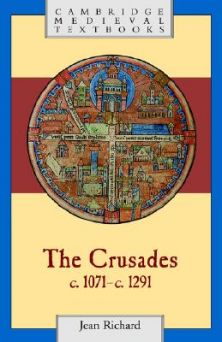
The Crusades c. 1071 – c. 1291 — Jean Richard

The Crusades c. 1071 - c. 1291


The Crusades c. 1071 – c. 1291
Jean Richard
Jean Birrell
516 pages including index
published in 1999

The Crusades are not my favourite subject in Medieval history, as I tend to concentrate my reading on the early Middle Ages, but The Crusades c. 1071 – c. 1291 is part of the Cambridge Medieval Textbooks series which I have good experiences with. The volumes in this series I’ve read so far all have been good introductions to their subjects. Of course, much still depends on the writer and I didn’t know Jean Richard, but he turns out to be a French historian who is well known enough to have an entry on the English language Wikipedia; this book was first published as Histoire des Croisades. The translation is by Jean Birrell and is good enough that you don’t really notice it is a translation.

Because of the American shenanigans in the Middle East in the past decade, the Crusades have been used quite a lot as a metaphor for these adventures, as well as an example for internet jihadists and Keyboard Kommandos both of the War Between Christianity and Islam as an universal war. The crusaders themselves feature as either the heroic defenders of the free west or bloodthirsty invaders of the peaceloving Islamic world. Reading a history like this is the best anecdote to that sort of nonsense. Jean Richard is careful to show that the motivations on both sides were slightly more complex than “Christ v Allah”. Religion obviously played a key role in the Crusades and there were certainly fanatics on both sides, but the realities of the Crusades and life in the Holy Land were more complex than the Crusading myths make out. What Richards contineously emphasises is that the key motivation for the Crusades was not the idea of forcibly converting heathens to Christianity, but rather of safe guarding the Holy land for Christianity, making it safe for pelgrims to visit, keeping the holy places safe for Christian worship.

Read more…

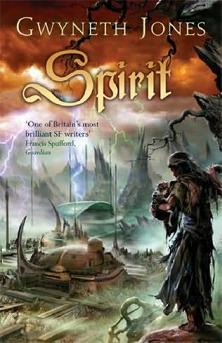
Spirit — Gwyneth Jones

Cover of Spirit


Spirit or The Princess of Bois Dormant
Gwyneth Jones
472 pages
published in 2008

So about halfway through Spirit, or The Princess of Bois Dormant, when the heroine is rotting away in prison on an alien world, forgotten by everybody, it looked like the novel was going to be a science fiction adaption of The Count of Monte Cristo. It wouldn’t have been the first; The Stars My Destination just being the most famous example of such an adaptation. But while the imprisonment of Bibi, Spirit‘s protagonist does consciously echo Dumas’ famous novel, including having an older mentor imprisoned with her who leaves her a fortune, it changes its mind almost instantly and doesn’t become a revenge story after all.

Which is for the best, as Bibi is no Edmond Dantès. Whereas the latter was unknowingly framed for a political crime for those he thought his friends, only discovering the truth years into his imprisonment, Bibi was just collatoral damage, not for the first time either. She had started live as Gwibiwr, the probable daughter of a (Welsh?) chieftan of the White Rock clans who’d long lived in rebellion against the one world government, a rebellion now crushed. Bibi herself is taken into the entourage of Lady Nef and becomes a minor servant, young enough to have lost most of her memories of before. She was therefore a victim of politics long before she was left ot rot in an alien prison for being part of a conspiracy against an emperor who hadn’t yet taken the throne when she had last been on Earth. And unlike Dantès, the people on which she could’ve had her revenge were mostly innocent bystanders as well.

Read more…

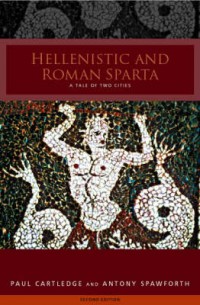
Hellenistic and Roman Sparta — Paul Cartledge & Antony Spawforth

Hellenistic and Roman Sparta


Hellenistic and Roman Sparta
Paul Cartledge & Antony Spawforth
312 pages including index
published in 2002

When most people think of Sparta their first thought will probably be about that godawful movie based on that godawful Frank Miller comic 300: This! IS! Sparta! and all that. For all its faults, it does mirror the common view of Sparta as a warrior state, one of the superpowers of classical Greece, indomitable in its resistance to tyrannical Persia, if not quite a democracy itself. But there is more to Sparta’s history. There’s a tendency in pop history to look only at the classic Sparta, to lose interest once it has been overtaken by Thebe and lost its supremacy, just before the rise of Macedon under Philip and Alexander. What happened to the city once it became just another polis doesn’t interest us all that much, it seems.

We should therefore be grateful for books like this: Hellenistic and Roman Sparta: a Tale of Two Cities which does look at Sparta’s history after its fall from grace, first under Macedon rule, then under Rome. It was originally published in the early nineties, but updated for a second edition in 2002. More of a textbook than a pop history book, but I’ve struggled through much drier texts. At the very least it was an effective treatment of a part of Greek history I’m not that familiar with.

Read more…

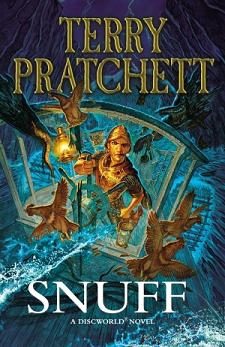
Snuff — Terry Pratchett

Cover of Snuff


Snuff
Terry Pratchett
416 pages
published in 2011

Wouldn’t you know it; you try to start writing a review and suddenly you can’t find the bloody book anywhere. Which is not just annoying because I want to get started but also because I’m now worrying I lost it somewhere. If I have I will have lost a piece of history, it being the last Discworld novel she and I read together before her death, as we did with all the new Discworld novels when we were together; usually she read them first as I could be slightly more patient. We not only were both fans of Pratchett, but we actually met thanks to him, through the dedicated IRC channel at lspace.org which had been set up for the alt.fan.pratchett newsgroup. What’s more, his documentary this year on assisted suicide and the dignity of choosing your own death helped Sandra make up her mind once she was convinced she couldn’t go on anymore.She had thought about it before, but seeing that really firmed up her conviction not to suffer if there was no point to it. Reading Snuff therefore was a bittersweet experience.

Snuff itself is a typical late Pratchett novel, good but not outstanding with few surprises for the longtime fan. Once again, as in Jingo, The Fifth Elephant or Thud to name but three, Samuel Vines is taken out of his element and has to maintain the peace outside of his jurisdiction and once again there are powerful forces who profit from the lack of it he has to conquer. This time Vimes is sent on holiday to his wife, Lady Sybil Ramsbottom’s country estate to play the laird, something he’s not good at nor likes much. Fun is had with city boy Vimes’ discomfort with country ways, again as in previous novels. Finally, there’s yet another fantasy race rescued from its stereotypes: after trolls, dwarfs, golems, zombies and vampires it’s goblins this time.

Read more…