Books read January

That’s the first month of the year done and dusted. Six books read, four history, two science fiction:

The Wages of Destruction — Adam Tooze
Brilliantly written book putting the evolution of nazi politics on war and genocide in the economic context in which they took place. Tooze makes it clear the nazis and Hitler read the economic situation in which Germany found itself in the 1920ties and wanted escape from what they saw as a trap by creating lebensraum for the German people, only to keep finding themselves still trapped with each new solution, ultimately ending in genocide.

Barbarian Migrations and the Roman West 376-568 — Guy Halsall
I saw this in the library and read it largely because Peter Heather had slagged Halsall off in his Empires and Barbarians for wrongthink on the Fall of Rome. Judging by this book the differences between Halsall and Heather are about ten percent real and ninety percent hype. They largely agree on the facts, are fairly close in how to interpret them. Halsall is leaning slightly more towards the idea that it was the internal fights for supremacy in the western empire opened opportunities for the barbarians, rather than the barbarian invasions creating the political unrest as Heather has it.

The Making of Late Antiquity — Peter Brown
Peter Brown is the historian who first made the idea of Late Antiquity fashionable. This is not the book which with he did it, but the closest I could get to it and it’s very strange. No politics, barbarians invasions and Roman collapse here, but a description of the evolution of the “pagan” mindset of yer average Roman during the second century Common Era, into the Christians of the fourth century. Interesting, but not quite for me.

The Goths — Peter Heather
Heather so far is the historian I trust the most on the Late Roman Empire and his speciality is the Goths. Here he tries to write their history, from very meager sources attempting to reconstruct their prehistory up until the time they first enter centre stage in 376 CE, then following them up until the dissolution of the two kingdoms they founded in Italy and Spain, as well as their heritage. Good one volume history, best read in context with e.g. Heather’s other books, or something like the Halsall book above.

The Left Hand of Darkness — Ursula K. LeGuin
Classic science fiction novel and winner of both the Nebula and Hugo Awards, not a feminist novel, but profitable to read it within this context.

Absorption — John Meaney
Part space opera in the tradition of Banks, Baxter, MacLeod, Reynolds et all set in the same universe as Meaney’s earlier novels, part epic fantasy following people at various points in time, from 777 AD until well after the main sequence’s 2603 AD. Not surpringly, part one of a trilogy. Decent book, need to wait for the next volumes to see if it was worth it.
More on The Left Hand of Darkness

I’ve kept thinking about The Left Hand of Darkness since I’ve finished reading it yesterday, especially about the gender aspects. What I didn’t express well enough in my review was how little the idea of a naturally sexless people actually mattered for the story. The core of the story is the relationship between Genly Ai and Estraven and while the latter is supposed to be sexless, it could just as well have been a story about two men bonding together in the face of common danger. As I said yesterday as well, using gendered male pronouns for the Gethenians was a mistake as it reinforces the idea that the characters we meet are all male, if occasionally effeminate. It wouldn’t take that much rewriting to make the gender aspects disappear altogether.

What I kept comparing The Left Hand of Darkness is Nicola Griffith’s Ammonite, which takes place on a planet where through some handwave only female creatures are able to live. Both are at heart planetary romances, stories whose main purpose is to lead the protagonist (usually, as here, an outsider) on an exotic tour of the planet in question, the better to showcase the cultures and landscapes it contains. The planetary romance is a science fiction subgenre of long standing, a logical translation of the exploration or adventure stories set in Darkest Africa and the jungles of South America, only set on Mars or Venus. What Griffith does in Ammonite is telling this very familiar sort of story, but with women in every role you’d normally find male characters and she does so without fuss. Its very matter of factness helps underscore how often the opposite is the case, how many stories there are with only male roles, or with just the occasional token female love interest or professional victim.

Coming back to Darkness, I feel that LeGuin failed where Griffith succeeded. Griffith had women in roles that in formula fiction are automatically filled by male characters and did so matter of factly. LeGuin has supposedly sexless characters doing the same, has the narration (Genly) discuss this sexlessness a lot, but shows characters that still read male, behaving little different from how they would in a standard adventure story. There are no female-presenting characters doing the stuff male characters do normally.

A related problem I have with the gender relations in Darkness, the more I think of it, has to do with the infodumps LeGuin gives about how the whole sexual cycle of the Genthenians works. It’s a common pattern in nature of course, an animal that’s without sex drive for most of the year, only getting in heat at certain times, the twist she added being the idea of being able to “chose” becoming male or female gendered. The problem I had with it was that, despite LeGuin’s comparisons between the unity of the Genthenian gender and the “bisexuality” of the rest of humanity, it was actually still too binairy for me. In kemmer people become either male or female, pairing of with either a female or a male partner, but male-male, or female-female partnerships aren’t mentioned, if I remember correctly: no homosexuality. Kemmer and kemmering are presented as deterministic a process as the rutting rituals of lower animals. Real humans (or even some known animal species) don’t work that way, why would the Gentenians?

I won’t say too much about the idea that rape in such a system is impossible, as LeGuin says somewhere, because that’s so selfevidently silly that it’s not worth going in to.

I do want to say that this criticism does not make The Left Hand of Darkness a bad book, rather than a good novel with flaws. Just the fact that I can engage it on this level is a good thing; too many novels just skid along the surface of your engagement leaving only quickly fading ripples.

The Left Hand of Darkness – Ursula K. LeGuin

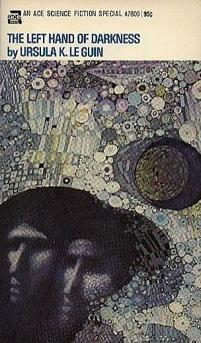
Cover of The Left Hand of Darkness


The Left Hand of Darkness
Ursula K. LeGuin
286 pages
published in 1969

Last year I discovered I read why too few science fiction books written by women and started making up for this lack by (re)reading some favourite writers. With the new year and following the example of several fellow science fiction bloggers, I decided to approach this more systemically, by pledging to read at least one science fiction or fantasy book by a female writer each month. The Left Hand of Darkness is the first and I choose it because it was a well respected classic novel, winner of both the Hugo and Nebula awards, I had never managed finish before, despite having tried three or four times and as important, it was short.

Since The Left Hand of Darkness is such a well known work, over forty years old and discussed and summarised extensively during that time, you can’t help but come to it with certain preconceptions about it. The most important of which you’ll have to let go if you want to get the shape of the true book. This is not a feminist science fiction novel. It’s a novel about gender and gender expectations and the role our assumptions of having two separate sexes each with their own character, strength and weakness play in our societies, but it’s not feminist, unless every book about gender is by definition feminist. What you actually get in this story is a fairly traditional view of gender, as I’ll try to show.

Read more…

Other people’s new year’s resolutions

Like me, another science fiction reader/blogger called Martin (Lewis in his case) found out he read shockingly little science fiction by women and decided to do something about it:

Over Christmas I decided to do something about this: I would read and review one SF novel by a women every month in 2011. I appreciate this sounds pathetically modest but in the context of my current reading I’m afraid it isn’t. There were several SF novels by women already languishing on my shelves, bought but unread and in this state for some time. I rescued these and then topped them up from Amazon. This in itself was an eye-opener; almost all the books I searched for – even those which had only recently been published – were out of print.

He’s not the only one to set himself this challenge: so did Ian Sales:

Torque Control’s Women in SF Week has inspired me to read twelve science fiction novels by women writers during 2011 as my reading challenge. I’ve tentatively identified the dozen novels I’m going to read. I didn’t want to pick only those published since 2001, although many are from the last decade. Nor would I limit myself to books published in the UK. But I did want my list to be comprise only authors I’ve not read before (bar one or two slight cheats).

And, neatly satisfying the law of threes, over at Torque Control, Vector‘s new editor Shana Worthen will be holding a monthly bookgroup reading through the winners of last year’s poll of best sf novels by women published from 2001-2010.

For myself I had already decided last year I needed to read more female science fiction, spending the last months of year reading and rereading some writers I had neglected for too, like Lois McMaster Bujold, C. J. Cherryh and Mary Gentle. But perhaps I should try and set myself the same sort of goal as Ian and Martin as well, even if what I read is so depend on my mood and interests on any given day. So let’s pick a list of twelve books I can and should read this year, either science fiction or fantasy, all written by women:

  • January: The Left Hand of Darkness — Ursula LeGuin (start with a classic, especially when it’s a short one…)
  • February: Bold as Love — Gwyneth Jones
  • March: The Female Man — Joanna Russ
  • April: China Mountain Zhang — Maureen McHugh
  • May: Foreigner — C. J. Cherryh
  • June: The Halfling and Other Stories — Leigh Brackett
  • July: A Point of Honor — Dorothy J. Heydt
  • August: Golden Witchbreed — Mary Gentle
  • September: 10,000 Light Years from Home — James Tiptree, Jr
  • October: Trouble and Her Friends — Melissa Scott
  • November: No Present Like Time — Steph Swainston
  • December: The King’s Peace — Jo Walton

These are on my shelves right now, all save three not read before and selected to have a relatively wide selection of science fiction/fantasy. These (hopefully) won’t be the only female written sf/fantasy books I read this year, but these are the ones I will read.

Amongst Others

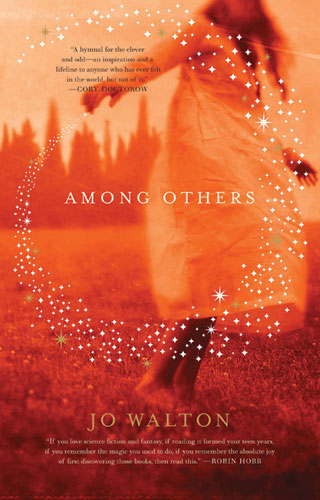
cover of Among Others

When you have Patrick Nielsen Hayden:

I am not Welsh or female, I do not walk with a cane, and I do not have a dead sibling or a parent who wants me dead. I never attended a boarding school, my family is far-flung and American, and I have never (to the best of my knowledge) conversed with fairies. And yet to a startling extent Among Others feels like a book about the experience of being me when I was, like Mori, fifteen. This turns out to be a fairly common reaction to reading Walton’s novel, at least among the kind of people I tend to know. It is quite possibly the best thing I have ever read about the way people of our ilk, when young, use books and reading to—in the words of Robert Charles Wilson—“light the way out of a difficult childhood.”

Locus reviewer Gary K. Wolfe:

I don’t believe I’ve seen, either in fiction or in memoir, as brilliant and tone-perfect an account of what discovering SF and fantasy can mean to its young readers – citing chapter and verse of actual titles – as in Jo Walton’s remarkable and somewhat autobiographical new novel Among Others.

As Cory Doctorow:

This is one of the places where Walton does something that made my head spin. For though Morwenna’s life has much that makes her unhappy, from her family to her pariah status to her gamey leg, these books are not an escape for her. She dives into them, certainly, and goes away from the world, but she find in them a whole cognitive and philosophical toolkit for unpicking the world, making sense of its inexplicable moving parts, from people to institutions. This isn’t escapism, it’s discovery.

Rave about the same book and with largely the same comments, you pay attention. Not that I needed introduction to Jo Walton, having know her as a fellow fan on Usenet since the mid-nineties and as an excellent science fiction and fantasy writer since her first published novel, The King’s Peace, but such high praise from such distinguished reviewers does concentrate the mind. Amongst Others might just be Jo’s breakthrough book, the novel that moves her from a cult author into a proper success, finally. She has been upping the stakes with every new book: from her start with her three book Histoire à clef series fo Arthurian fantasy, to her reworking of Anthony Trollope with dragons in Tooth and Claw, to one of the most chilling alternate histories in the Small Change series. In each case I had expected her to achieve the same sort of success as somebody like Alastair Reynolds had gotten, but for some reason it never quite happened. Even those alternate history novels, which I had thought would’ve been a surefire hit, well, didn’t quite make it:

Well, actually, Half a Crown is arguably an example of the system not working as well as it might. Farthing did okay midlist numbers in hardcover and actually better-than-expected numbers in mass-market paperback. But for reasons best described as “weather” (i.e., nothing whatsoever to do with the book), Ha’penny took a dip in hardcover–fewer library sales, among other things, if I recall correctly–and the mass-market paperback fell off a cliff. This is why Half a Crown hasn’t had a softcover edition yet–since we were clearly doing something wrong, I didn’t want to spray-paint further lousy numbers onto Jo’s track record.

You do wonder why a great writer like Jo hasn’t been able to catch a break yet — insufficient promotion perhaps, though I’m not sure how much that still matters in this interweb age, or perhaps it’s because she switched genres too much, or not writing in the right subgenre, not writing widescreen space opera or, as Patrick says, it’s just the weather? Good writers can and do bubble under, write books that everybody who finds them loves, but which never quite find their audience. Science fiction is littered with examples (William Barton, T. J. Bass to name but two examples from my own shelves); it would be a shame if the same happened to Jo.

Especially since Among Others does sound incredibly interesting, ever since Jo told of how she grew up in a post-industrial landscape on her Livejournal and people started to tell her to turn it into a novel. She has managed to turn her own experiences discovering science fiction and growing up with it in a world where nobody else cared for it into a proper fantasy novel and while with any other writer I would be wary, Jo has been writing about this online for a long time, ever since we both were regulars on rec.arts.sf.written. She still does so at Tor.com, talking about all her favourite books and what they meant to her and why they’re so good and you should read them — she’s probably the one person who has done the most to nudge me towards books I would not have read otherwise, after S.

Which is why I put my order in for the hardcover at the local science fiction bookstore, which had already sold out of the two copies they had apparantly recieved in November. Eight days I got to wait now, oy.