Serious book collecting

What with the v. small apartment we’re living in (2 rooms, 48 square metres in total) and the …slight… increase in book buying I managed last years, the physical limits to book collecting have been on my mind lately. There are only so many Billy bookcases we can fit in our living room and S. has put her foot down on getting them in the bedroom as well. I would love to have my old comic book collection over from my parents, but there just isn’t room. It’s getting so bad that I’m judging new books on format as much as on content: paperbacks are okay, trades are doubtful, hardcovers are right out. And no, a Kindle is not an option. It’s vexing.

And I barely got 200-2500 books or so at home (2020 currently admitted to on Librarything), while the two people in the documentary I watched tonight Boekenjagers (bookhunters) each are responsible for collections in the hundreds of thousands of books, even millions. Charles Blockson is the curator of the Afro-American Collection at Temple University in Philadelphia and had been collecting books on Black history for years before he donated them to the university, hoping to gather together the history of a people who for centuries were not allowed to have one, as he puts it. Aaron Lansky was writing a dissertion on Yiddish literature back in the early eighties and by sheer coincidence got started collecting books in Yiddish, saving them from the garbage dump as those elderly Jews who still read Yiddish were slowly starting to die off and their children, who couldn’t read the language themselves, started to get rid of these books that had meant so much to their parents. That ultimately lead to the National Yiddish Book Center, which at the time of the documentary 13 years ago already had some 17 million books.

Now those are collectors, even if they “cheat” a bit by being professional collectors. Anybody who loves books and loves looking for books and buying books can recognise themselves in these two men. I sure did.

Friday Funnies: Scarlet Traces – The Great Game

World War Mars

The War of the Worlds battlefront moves to Mars….

Since I am reading comics again, I thought why not do something with them, though preferably not something as lunatic as last year’s Fifty Essentials in Fifty Days. Instead, from now on every Friday I’ll attempt to spotlight some deserving, newish comics. Comics such as today’s offering, Ian Edginton and D’Israeli’s Scarlet Traces: the Great Game.

In the same year that H. G. Wells’ War of the Worlds was published, the first unauthorised sequel Garrett P. Serviss’ Edison’s Conquest of Mars appeared, a jingoistic tale of American derring do overcoming the Martian evil, far removed from Wells’ own intentions. Ever since writers have continued to be inspired by it or swiped from it to enlive their own retro-futures, like e.g. Christopher Priest in The Space Machine In comics, apart from the inevitable Classic Illustrated adaptation, there of course also was Marvel’s great over the top reimagination of it in Killraven and which thanks to Don McGregor and P. Craig Russell was much better than it had any right to be. Alan Moore and Kevin O’Neill also used it in League of Extraordinary Gentlemen volume two, with a particular cynical revelation of what really killed the Martians.

Ian Edginton and D’Israeli’ then stand in a long and sometimes proud tradition when in 2003 they created the first Scarlet Traces miniseries, which asked what would’ve happened to a nineteenth century England suddenly in possession of highly advanced Martian technology in the aftermath of the invasion. England in 1898 of course was still convinced of its divine right to rule the world and it’s new technological superiority made this only worse. Martian technology has also unleashed a new industrial revolution, with the south reaping the benefits while the smokestacks of the North and Scotland fell still, replaced by clean, robotic Martian machinery, the workers left on the scraphead surplus to requirements.

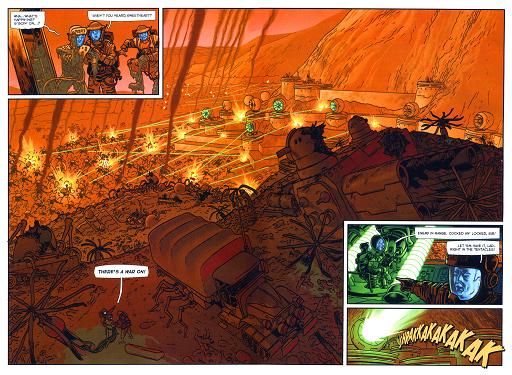
This is the background against which Scarlet Traces: The Great Game is set, jumping ahead to the 1940ties. Martian technology has completely transformed England and the world, leaving London looking as something out of Dan Dare — and D’Israeli’s designs do have something of that fifties English science fiction feel to them, clean and streamlined and bright. England now is not just a world power but has invade Mars and has been waging war for decades, while at home Northern and Scottish terrorists/freedom fighters are the justification for increasingly draconian security measures, overseen by home secretary Mosley, while Scarlet Traces‘ main villain, Davenport Spry is now prime minister.

Enter aristocratic lady photographer Charlotte Hemming, returning to London from an overseas assignment for the Interceptor, one of the few opposition newspapers left in England. When on her way there the BBC building is blown up by a Scottish suicide bomber, she’s on the scene to snap pictures. This lands her and her pulisher, Bernie Goldman, in hot water, hotter still when he gives her her next assignment: to find out what’s really going on on Mars. Bernie is killed by army thugs but Charlotte escapes, rescued by major Robert Autumn, the hero of the previous book. He explains what he had found on his adventures thirty years ago, the great secret behind England’s economic expansion and the mystery of what he and Bernie wanted her to research on Mars. Why is it, that in all these decades of fighting, so few soldiers returned home.

That’s the setup, and the rest of the book has Charlotte travelling to Mars, only to end up in the midst of the heaviest fighting in years, as the Martians attack the main British base at Valles Marineris, a huge city building two and a half thousand miles end to end, build by some unknown race. It’s evident that the military has been hiding the whole truth about the Martians for decades, also that they’re up to something big, a final act of genocide to win the war, but so are the Martians…

Now originally published as a four part miniseries by Dark Horse, this structure is still evident in the story. The first issue has the setup, in the second issue Charlotte gets to know the hidden truths of her world by Robert Autumn and travels to Mars, part three has her arrive and after some confusion starts finding even bigger questions that need answering and in part four all of this has to be tied together and resolved. It doesn’t quite work and feels rushed. Much of the plot is also told through speeches, first Autumn, later the series main villain, another army man, commander James Dravott, as he explains to Charlotte why the war was started and what the stakes are. Some more room for the story to breathe would’ve been nice.

a very fifties looking piece of retrotech here from D'Israeli

But these are quibbles. The main attraction is the world Edginton and D’Israeli have created, which is great. Googling around many reviews call it steampunk, but that’s wrong. This isn’t faux Victorean high tech, this is an alternate nineteenforties and the technology reflects this. As said, the space ships, aereoplanes and equipment could’ve all been designed by Frank Hampton for Dan Dare, sleek, streamlined but round forms as above, yet the various lorries and automobiles we see in the background from the bonnet up look like proper 1940ties British cars, save for the crawler legs instead of wheels. D’Israeli is very good at convincingly portraying this meld of retrofuturism with the almost organic look of the Martian tech incorporated in them.
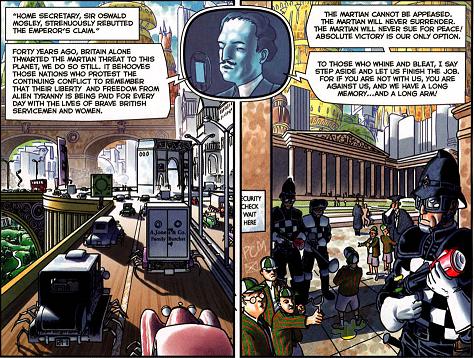
the background of each picture bears examining

D’Israeli is also good at providing unobtrusive but telling background details and cameos, like the lorry with the “A. Jones & Co Family Butcher” logo above, which help shape and make real Charlotte’s world. Everywhere you look there are mundane examples of Martian tech having been incorporated in familiar machines, while the fashions and office furniture is still recognisably forties in look and feel. Once Charlotte gets underway to Mars, military technology dominates, with clanking big WWI style tanks and soldiers in spacesuits that could’ve been worn in the trenches along side the much cleaner looks of the spaceships and the strangeness and grandeur of the Martian ruins. The use of colour is also superb: D’Israeli apparantly did all this directly on the computer, according to the backpages and this must’ve helped the unity of colour and image. It doesn’t feel computerised though. His people are slightly cartoony, with great expressive faces, clean lines and no unnecessary detailing or shading. Somewhat reminded me of Bryan Talbot’s work on One Bad Rat though of course D’Israeli cleary has his own style, but in the way he uses colour and shape to pop out foreground figures from their background.

A satisfying book and the physical presentation of it fitted it perfectly: hardcover bound, slightly bigger than a standard American comic book with nice clean glossy white paper that make the colouring really stand out.
The Wages of Destruction – Adam Tooze

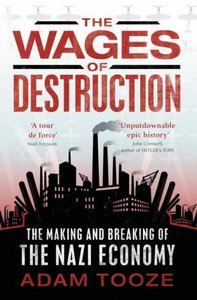
Cover of The Wages of Destruction


The Wages of Destruction
Adam Tooze
800 pages including notes and index
published in 2006

When I read Hitler’s Empire back in August, I had actually wanted to read The Wages of Destruction, due to Alex Harrowell’s review when it came out. I couldn’t find it so Mark Mazower’s book was a more than acceptable substitute. Both books look at the economy of Nazi Germany and the empire it carved out, each in their own way. Whereas Mazower’s point of view is that of a historian turned economist, Tooze approached the subject from the other side: economicst first, historian second. And while Mazower primarily looked at the interaction and tensions between nazi ideology, economci reality and the demands of war, Tooze goes for the more fundamental question of how the fundamental constrains of the German economy influenced nazi decision making, argueing that seemingly irrational decisions made by Hitler and the nazi leadership, not the least the decision to invade Russia, made perfect sense when looking at the economic context.

Which is not to say, nor does Tooze, that Nazi ideology wasn’t not irrational or evil, but that if you take into account their worldview, that in this context their decisions were rational and clearheaded and clearly informed by the economic realities of Germany. To the Nazis, as to most intelligent observers between the wars, it was clear that Germany was doomed to be a second rate power, not big or rich enough to seriously challenge countries like England, with its vast colonial empire, let alone America or the USSR. Under the Weimar Republic, the best it could hope to achieve was to become a middling European power, growing rich on American coat tails. Nazism set out to change this, to conquer a larger living space for the German race by force and through pure willpower and technology transform the German economy into the equal or even the superior of the American. This struggle lies behind all strategic decisions the Nazi leadership made in the runup to the war and during it, each time putting their faith into another great leap forward, each time still finding themselves in the same box, in the end not having been able to overcome these fundamental limitations.

Read more…

2010 in books

When in doubt, steal from the best and Andrew Wheeler’s top 12 favourite books for 2010, one book for each month of the year, seemed like a neat device to copy, so here goes:

January saw me mostly recovering from surgery plus the added bonus of an opportunistic infection, so I read mainly not too challenging books. One book thta did challenge me, was Gwendolyn Leick’s Mesopotamia: the Invention of the City.

February wasn’t much better, with the standout book being Richard Morgan’s first published novel, Altered Carbon.

In March I read both Owen Heatherly’s Militant Modernism and Mark Fisher’s Capitalist Realism, both in their own way attacking the unexamined assumptions at the heart of contemporary society. But it was Fields of Conflict, an anthology of papers on battlefield archaeology that made me think the most.

April: World War Z gave me nightmares, but it was The Night Sessions and The Raw Shark Texts that impressed the most, with the latter recieving a slight nudge.

In May I read a lot of science fiction, including China Miéville’s latest, Kraken, but it was Richard Fortey’s Life, the story of well, life on Earth, that impressed me the most.

June was a slow month again, no doubt because of the Worldcup, but I did read The Reconstruction of Nations by Timothy Snyder, which attempted to show how nationalism and ethnical identity grew in Poland, Belarussia, Lithuania and the Ukraine, countries once united in the early modern state of the Polish–Lithuanian Commonwealth, where ethnicity and nationality was much less important than class.

July was mostly about bubblegum reading, things like three Ian Fleming novels that you can read in a n hour and still have fifteen minutes left to kill. One positive exception was William Hope Hodgson’s Carnacki the Ghost Finder. Back in Edwardian times, mashups between ghost and detective stories were quite popular and Carnacki was one of the better ghost detectives. Not at all scary, but despite their great age still quite enjoyable.

August saw more science fiction and more books on warfare. Mark Mazower’s Hitler’s Empire an indepth look at the economics of Nazi Germany and Europe, was the book of the month. The Battle of Kursk was good too.

In September, it was Hiroshi Sakurazaka’s All You Need Is KILL that made me sit up: a great short, mil-sf novel that was a cross between Groundhog Day and Starship Troopers (the novel, not the movie). Jo Walton’s Ha’Penny and Richard Morgan’s The Steel Remains were excellent too.

Moving on to October, the best book that month was a reread: Lois McMaster Bujold’s Komarr, where it turned out I had missed about eighty percent of the real action in the novel on my first read…

Then came November and I read some twenty books, largely due to a massive reread of all Bujold’s Vorkosigan saga novels. Diplomatic Immunity was a disappointment, Iain M. Banks’ latest Culture novel, Surface Detail was not.

And finally, December, in which N. K. Jeminisin’s first two books in her fantasy trilogy were the best books I read that month. These deserve proper, well thought through reviews, but suffice to say they’re essential reading for everybody interested in fantasy.

Rome’s Gothic Wars – Michael Kulikowski

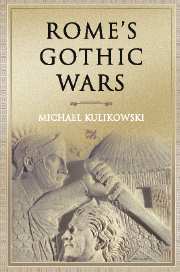
Cover of Rome's Gothic Wars


Rome’s Gothic Wars
Michael Kulikowski
225 pages including notes and index
published in 2007

Rome’s Gothic Wars, written by new to me American historian Michael Kulikowski is meant as an entry level introduction to the Goths and their conflicts with the Roman Empire. As such it’s quite short, with the main text being only 184 pages long. As a history it only deals with the Goths as they first entered Roman consciousness, in the late third century CE, up until the sack of Rome by Alaric and his Goths in 410 CE. Kulikowski does deal with the Gothic “prehistory” in passing, but does not deal at all with their later history and evolution into separate Visogothic and Ostrogothic kingdoms. For Kulikowski, those first two centuries of Roman-Gothic interactions form a neatly completed story, one that turned “Goths” into the Goths.

As Kulikowski argues, wondering where the Goths came from before they are first mentioned in Roman histories is pointless, nor should too much attention be paid to the “deeply misleading” Getica of Jordanes, the sole Roman source for the supposed origins and migration of the Goths, as other modern historians still do, attempting to separate the wheat from the chaff. Instead, Kulikowski believes that the Goths were a product of the Roman Frontier, like the Franks and Alamanni, who appear at the same time. Roman military, economic and cultural interactions with the barbaric tribes along their frontiers created new political entities and the Goths were one of them. The Gothic origins lie in the exact same parts of the Roman frontier zones that they first appear in Roman history, north of the Danube and west of the Black Sea and he’s quite harsh on any modern historian who thinks otherwise.

Read more…