Emperor of the West – Hywel Williams

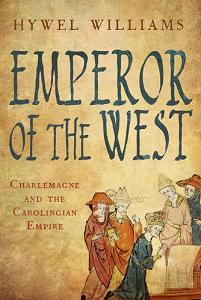
Cover of Emperor of the West


Emperor of the West
Hywel Williams
460 pages including notes and index
published in 2010

Emperor of the West: Charlemagne and the Carolingian Empire is a book I ran across when looking for other books in the Middelburg library, but which turned out to be exactly the book I needed to read after having spent most of December reading Peter Heather’s empires and Barbarians. Heather’s book was a comparative history of the first millennium CE, from the Late Roman Empire through to the Carolingian and Ottonian empires, of which the Carolingian was the first European empire with had its power base in north-west Europe, as opposed to the Mediterranean basin. Heather’s focus was on the interactions of these three empires with the various “barbarian invasions” each had to deal with and how these shaped what would become modern Europe, but what it made me want to read was more about the Carolingians themselves, which is where Emperor of the West came in handy.

Though not quite an introductionary level book — some familiarity with the various characters is expected — Emperor of the West turned out to be a good overview of Carolingian history. Williams’ main focus is on Charlemagne himself, but through him looks at wider Carolingian culture and history. He consistently puts Charlemagne in the context of the Western European recovery from the fall of the Roman Empire in which the awareness of imperial Rome and its history helped shape Charlemagne’s empire, in the same way that the Carolingian conviction that they were uniquely blessed by Christ also did. The Carolingians always looked back to the Roman past and consciously set out to restore it in their own image, but in the process created something new, the first European empire not to depend for its power on the Mediterranean Basin.

Read more…

Books read December

A new year, a new month, a new list of books read last month:

The Hundred Thousand Kingdoms & The Broken Kingdoms — N. K. Jemisin
The first two books in a fantasy trilogy that so far has been excellent.

Glide Path — Arthur C. Clarke
An enginering novel based on Arthur C. Clarke’s experiences in World War II, strongly reminding me both of Clarke’s own enginering science fiction as well as Nevil Shute’s more mainstream novels.

Empires and Barbarians — Peter Heather
Heather continues his examination of the end of the Roman Empire and the rise of its successor states, now widining his focus to take in the Carolingian and Ottonian empires that arose in the second half of the first millennium CE as well. A bit of a slog to get through, but worth it in the end.

Killing for England — Iain McDowall
Described as the new Ian Rankin, McDowall has some of his same strengths, most noticably the same awareness of how much politics is involved in policing. This was a fast paced police procedural that I read in a day, about two Black men turning up drowned in the same small city within months of each other, witht he police struggling to determine whether or not it was coincidence or enemy action…

Emperor of the West — Hywel Williams
Excellent one volume history of Charlemagne and the Carolingian empire.

Rome’s Gothic Wars – – Michael Kulikowski
An introductionary level textbook on the first two centuries of Gothic-Roman clashes, made interesting by Kulikowski’s very certain dismissal of the standard stories of Gothic origins.

Cartomancy — Mary Gentle
Seeing out the year with Mary Gentle’s second short story collection, what could be better?

Books read November

I went on a bit of a sprint this month, reading some twenty books or so in an attempt to up my rate. For the first half of the month I actually managed a book a day, which slowed down a bit later on.

A Civil Campaign — Lois McMaster Bujold
Is this a rom-com or the most hard science fiction story Bujold has ever told? Both. Brilliant, but rereading it you know that dinner scene is coming, making it even more cringeworthy than the first time.

The Babylonians: An Introduction — Gwendolyn Leick
A very short textbook introduction to the Babylonians. Good to get a basic overview, but nothing more.

Empire of Bones — Liz Williams
An Indian outcast rebel queen is the sole contact for a highly advanced but even more stratified alien race.

I Shall Wear Midnight — Terry Pratchett
The last Tiffany Aching novel is not quite as good as the previous ones.

Diplomatic Immunity — Lois McMaster Bujold
Not really a necessary book, to be honest, as everything build up during Komarr and A Civil Campaign is lost for just another fun Miles romp.

Shards of Honor — Lois McMaster Bujold
The first Barrayar novel, introducing Aral Vorkosigan to Cordelia Naismith.

Barrayar — Lois McMaster Bujold
What happens when Cordelia went shopping during the Barrayarian civil war.

Surface Detail — Iain M. Banks
Banks’ latest Culture novel has a very unpleasant, but worryingly plausible scenario at its heart. What if technology progresses so far that it becomes possible to recreate whatever hell your religion has thought up in virtual reality?

The Warrior’s Apprentice — Lois McMaster Bujold
The first novel starring that little hyperactive git, Miles Vorkosigan. Failing his entrance exam for the Barrayarian army, Miles goes on holiday to Beta Colony and as one thing leads to another creates his own mercenary fleet and manages to end not just a foreign war, but also a complot against his own empire.

The Vor Game — Lois McMaster Bujold
Once again Miles has gotten into trouble on Barrayar, hides into his alternate persona of Admiral Naismith and manages to thwart yet another plot against Barrayar.

Brothers in Arms — Lois McMaster Bujold
Kept on Earth thanks to a failure in bureaucracy, Miles meets his clone brother Mark for the first time, as he is the target for another complex plot against the Barrayarian empire.

Borders of Infinity — Lois McMaster Bujold
A collection of three short stories, with some connective tissue.

Ethan of Athos — Lois McMaster Bujold
On Athos there are only men, no women, and when new egg stock needs to be bought for their uterine replicators it’s the somewhat naive Ethan send out to get them, only to run into a galactic complot

The Pocket Essential Philip K. Dick — Andrew M. Butler
A literary cheatsheet for the master of paranoid science fiction — evidence of his arrival amongst the literati.

Mirror Dance — Lois McMaster Bujold
Miles’ brother not his clone Mark returns, tries to borrow the Dendarii for his personal vendetta, fucks up royally and Miles has to save him — and then he’s killed and it’s Mark to the rescue…

Memory — Lois McMaster Bujold
And we’re done with Miles Vorkosigan, ending with the novel in which his entire life and career is destroyed, leaving having to rebuild it from the ground up.

The Quantum Thief — Hannu Rajaniemi
Charlie Stross mentioned this guy to me two years ago as the writer to watch; this is his first novel. It didn’t quite live up to the hype, but if you like cyberpunk space opera in the vein of Stross, Egan or Sterling, Rajaniemi will be right up your street.

The Ruin of the Roman Empire – James J. O’Donnell
An interesting view on the Fall of Rome, blaming not the socalled barbarians, but the emperor who thought to save the empire from them, Justinian I for the collapse of the Western empire.

Pride of Chanur — C. J. Cherryh
The first in one of Cherryh’s more lighthearted series still has her trademark method of putting her characters under enormous stress, as the crew of the Pride of Chanur has to deal with the strange hairless alien that has turned up on their ship.

Chanur’s Venture — C. J. Cherryh
The first sequel to Pride of Chanur.
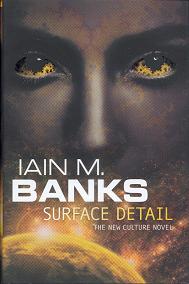
Surface Detail – Iain M. Banks

Cover of Surface Detail


Surface Detail
Iain M. Banks
627 pages
published in 2010

The problem with any new Culture novel is that they’ll never be as good as the original three — Consider Phlebas, The Player of Games and Use of Weapons. Back in the late eighties when these books were first published there was literally nothing like them; now we know what the Culture is like, what to expect from Banks and there are whole generations of sf writers who have been influenced by him writing similar sort of novels. Yet everytime I still hope that the next Culture novel is as good as the first three, which is unfair — even if it is, it won’t have the same impact.

But Surface Detail comes close. From his first published book, The Wasp Factory, Banks has had a reputation for writing well crafted but often repulsive scenes of violence and torture and here he surpasses himself. Because in Surface Detail he gives us a horrifying but all too plausible idea: what if you could use virtual realities to create the hells your religion says sinners should be cast down into? What if civilisations routinely went through a stage in their development when their technology was good enough to create simulations of hell, but their morality still primitive enough to actually want to subject people to them? One of the first scenes in the book shows what that would look like from the inside and it’s not for the squeemish; it actually gave me some bad moments reading it just before I went to bed. No cuddly fantasy hell this; imagine whole creative output of an entire species devoted to making up ever more cruel tortures, without end.

Read more…

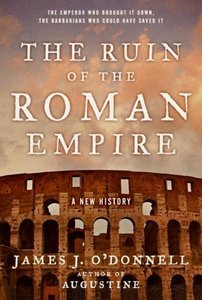
The Ruin of the Roman Empire – James J. O’Donnell

Cover of The Ruin of the Roman Empire


The Ruin of the Roman Empire
James J. O’Donnell
436 pages including index and notes
published in 2008

A few years ago I became interested in Roman history, especially with the later Roman Empire, what historians now call Late Antiquity, the period during which Rome supposedly fell. Supposedly fell, as the simple history we’ve been taught in school of barbarian invasions from the fringes of the Empire finally overrunning its heartlands, looting Rome and deposing the last true Roman Emperor in 476 CE, is of course wrong. That story is an invention, largely created by, as James J. O’Donnell put it, “a short, fat man”, Edward Gibbon, in his famous Decline and Fall of the Roman Empire, which codified this standard history of the fall of the Roman Empire. It was challenged in the early seventies, most famously by Peter Brown’s The World of Late Antiquity, as new research and new generations of historians started to question this old story. They found a Roman Empire and world that was severely challenged in the fifth century CE, but much more continuity between the old classical world and the new dark ages than there had been room for in the standard model.

Fast forward a few decades and the revisionists themselves are being corrected by later generations of scholars, e.g. in the books of Peter Heather and Bryan Ward-Perkins I’ve reviewed before. James O’Donnell’s entry on the subject, The Ruin of the Roman Empire is the most idiosyncratic so far I’ve read, aptly summed up by its subtitle: “The emperor who brought it down. The Barbarians who could’ve saved it.” The emperor is Justinian I, who wanted to make the empire whole again, the barbarians the supposed invaders who had taken over its western provinces. O’Donnell argues that if Justinian I had not tried to reconquer Italy and North Africa, but had concentrated his energies on his Eastern provinces and the border with Persia, something like the Roman Empire could’ve survived for longer than it did, if not an united Roman Empire. The fall of Rome in 476 CE was not the end of the Roman Empire.

Now read on.